
The Macro Story: A K-Shaped Credit Cycle Takes Hold
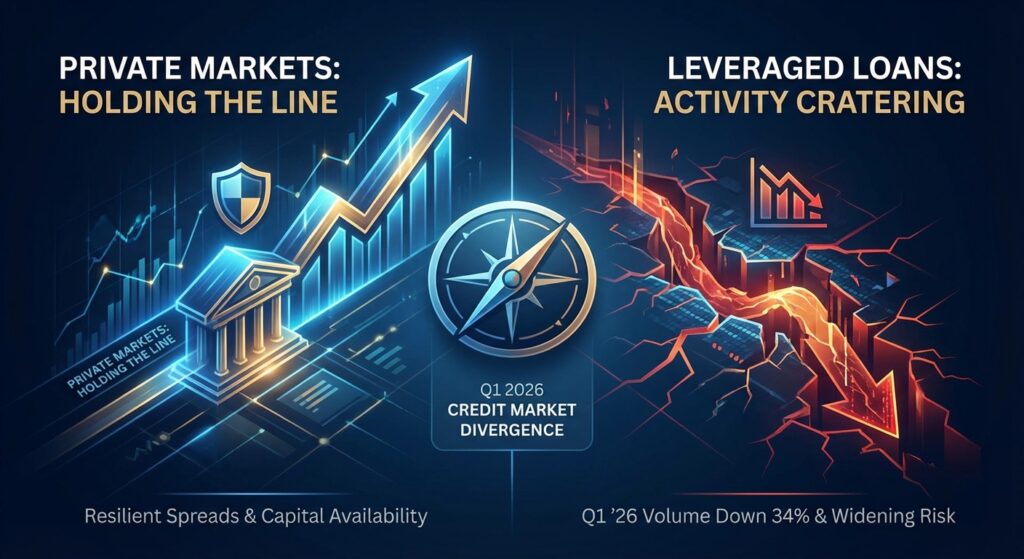
The first quarter of 2026 has delivered an unambiguous verdict on the state of credit markets: bifurcation is no longer a theoretical risk; it is the operating reality. A confluence of geopolitical instability, an oil-driven inflation resurgence, and the Federal Reserve’s forced pause on its rate-cutting cycle has produced the most uneven lending environment since the 2020 pandemic shock. According to data reported by FinancialContent / MarketMinute, US leveraged loan primary issuance collapsed to $235 billion in Q1 2026, down 34% from $355 billion in Q1 2025, marking the slowest quarterly start since the pandemic. Refinancings fell 42% and repricings declined 39% as risk-off sentiment froze opportunistic activity.
The macro catalyst was swift: Brent crude surging above $120 per barrel in February triggered what analysts are calling the “March Oil Shock,” reigniting inflation fears and forcing the Fed to shelve further rate reductions. This halted a repricing and refinancing wave that had defined 2025’s credit market narrative. As McDermott Will & Schulte’s Q1 2026 Credit Conditions report noted, heading into the year median Fed policymakers projected only one additional 25 basis point cut in 2026, with unemployment expected to stabilize near 4.5% and inflation remaining well above the 2% target at approximately 2.6%. For credit markets, the message is clear: the era of monetary tailwinds providing a floor for marginal credits is over.
Quantitative Snapshot: Spreads, Leverage, and the Public-Private Divide
| Metric | Current Value (Q1 2026) | Prior Period | Source |
|---|---|---|---|
| US Leveraged Loan Issuance (Q1) | $235B | $355B (Q1 2025, −34%) | FinancialContent |
| Private Credit Unitranche Spread (Upper MM) | SOFR + ~450 bps | SOFR + 475 bps (Q3 2025, tightened ~25 bps) | McDermott / Mondaq |
| BSL Single-B New Issue Spread | SOFR + ~319 bps (late-2025 low) | Widening in Q1 2026 for lower-rated credits | McDermott / Mondaq |
| High-Yield Spread (B-rated Credits) | +3.17% (March 2026) | +2.65% (Q4 2025, +52 bps widening) | FinancialContent |
| Loan Distress Ratio (trading below 80¢) | 7.23% (March 2026) | Highest level in 3 years | FinancialContent |
| Private Credit Non-Accrual Rate (Upper MM) | ~0.9% (Q3 2025 median) | Below 20-year historical avg. of ~1% annual loss rate | Heron Finance / Cliffwater |
| Average Private Credit LTV | ~40% | Stable; ~90% of assets are first-lien | Heron Finance / Cliffwater |
Critically, the gap between BSL and private credit pricing, historically more than 100 basis points in BSL’s favor at the margin, is now functioning as a credit-quality screen rather than a pure cost-of-capital arbitrage. Elite borrowers access the BSL market at SOFR + 319; everyone else negotiates privately at SOFR + 450 or higher, frequently with tighter covenants and OIDs compressing toward 98.75–99.25, per Valuation Research Corporation’s Q4 2025 update.
Sector-Specific Lender Appetite: Who Is Getting Capital and Who Is Not
The K-shape is most visible at the sector level. Technology (specifically legacy software and SaaS) has undergone the sharpest reassessment. What FinancialContent terms the “SaaSPocalypse” reflects a structural reassessment: as agentic AI tools commoditize software workflows, high-leverage valuations tied to recurring SaaS seat counts are being questioned by lenders. Credit spreads for software companies have widened materially even for names with investment-grade adjacency, and private credit lenders are demanding more conservative leverage covenants and lower entry multiples for software-heavy deal structures.
Conversely, hard-asset sectors (energy infrastructure, data centers, and healthcare) are experiencing robust capital availability. Oracle’s $38 billion AI-infrastructure debt package and a $20 billion buyout financing for Electronic Arts (led by Silver Lake) demonstrated that cash-flow-positive businesses with tangible asset backing can still price efficiently even in a constrained market, per FinancialContent. Healthcare and financial services were identified as standout M&A sectors by McDermott Will & Schulte, with lender appetite remaining strong for credits with durable cash flow profiles insulated from tariff pass-through risk.
Media and broadcasting represent the clearest distress pocket. Cumulus Media’s second Chapter 11 filing in eight years, to restructure $592 million in debt, and New Fortress Energy’s Restructuring Support Agreement underscore that tariff-exposed, capital-intensive businesses with deteriorating coverage ratios are facing an effectively closed primary market. The structural underwriting shift is notable: per VRC, the upper end of middle-market spread bands is now explicitly reserved for cyclical, storied, or tariff-exposed credits, and even those may struggle to clear the market at any price.
Implications for Institutional Investors and Operators
For Borrowers: The window for opportunistic refinancing has closed for all but the strongest credits. Companies with debt walls approaching in late 2026 or 2027 must act immediately: either via asset dispositions, covenant amendments, or private credit rescue financing at rates that could reach double digits. Operators should stress-test their fixed charge coverage ratios against a higher-for-longer rate scenario; with the Fed on pause and oil-driven inflation persistent, floating-rate debt service burdens will not ease materially in the near term.
For Private Credit Investors: The quality dispersion across private credit managers is widening. Heron Finance’s Q1 2026 Benchmark Report, drawing on 71 funds with over $1 trillion in aggregate AUM, shows that while median non-accruals remain below long-term historical averages at 0.9%, the percentage of loans performing below manager expectations has risen, and that underperformance is concentrated in a subset of funds. Manager selection has never been more consequential. The report also confirms that average LTVs remain conservative at approximately 40%, with ~90% of assets in first-lien positions, providing structural protection that public high-yield does not replicate.
For Lenders: Redemption pressure is a live risk. Blackstone’s BCRED faced $3.7 billion in redemption requests in Q1, nearly 8% of NAV, requiring the firm to deploy $400 million of its own capital to honor requests beyond the standard 5% quarterly gate, per FinancialContent. This liquidity-structure mismatch (monthly or quarterly liquidity windows backed by illiquid bilateral loans) is now under active regulatory and investor scrutiny, as highlighted by PIMCO’s April 2026 Credit Market Lens. BDC dividend sustainability is also under pressure: FS KKR Capital Corp’s reduction of its quarterly dividend from $0.64 to $0.48 may foreshadow sector-wide income compression.
Forward Outlook: Selectivity Is the New Strategy
The 90/10 rule now governs credit market access: approximately 90% of the market (investment-grade and upper-tier leveraged credits) remains functional, while the bottom 10% faces an existential liquidity crunch. VRC’s outlook anticipates that elevated purchase multiples and tight spreads will persist for high-quality assets, but cycle- and tariff-exposed credits will face structurally higher risk premiums until deal volume accelerates or reference rates decline meaningfully, neither of which appears imminent.
Distressed debt specialists and structured credit funds are best positioned to capitalize on the dislocation in the lower arm of the K. For the mainstream private credit market, the priority should be portfolio triage: identifying credits with deteriorating interest coverage, upcoming maturities, and tariff exposure before they tip into non-accrual status. Macro stability (particularly a sustained decline in energy prices and a resumption of Fed easing) remains the prerequisite for a broad market recovery. Until that condition is met, capital will continue to flow toward structural certainty, and the K-shaped bifurcation will deepen.
Key Market Insights
- Volume collapse is a quality signal: The 34% drop in Q1 2026 leveraged loan issuance is not purely macro-driven; it reflects a market repricing the risk of marginal credits previously supported by loose underwriting and cheap rates.
- Private credit spread compression has stalled: Unitranche pricing near SOFR + 450 has held largely flat versus late 2025, as lender competition for high-quality deal flow is offset by macro uncertainty. Lower-quality credits are facing materially wider ask spreads and tighter structural terms.
- Coverage ratios are the new gating metric: With floating-rate debt service elevated and the Fed on pause, lenders are focusing intensely on fixed charge coverage ratios and interest coverage sustainability, not just leverage multiples, as primary underwriting screens.
- Sector rotation is structural, not cyclical: The move away from software/SaaS toward energy infrastructure, data centers, and healthcare reflects a durable reassessment of cash flow quality and AI-driven business model disruption, not a temporary risk-off rotation.
- Liquidity mismatch is the systemic risk to watch: Redemption pressure on semi-liquid private credit vehicles (BDCs, interval funds) and the potential for forced asset sales represent the clearest systemic risk channel if macro conditions deteriorate further in H2 2026.


