
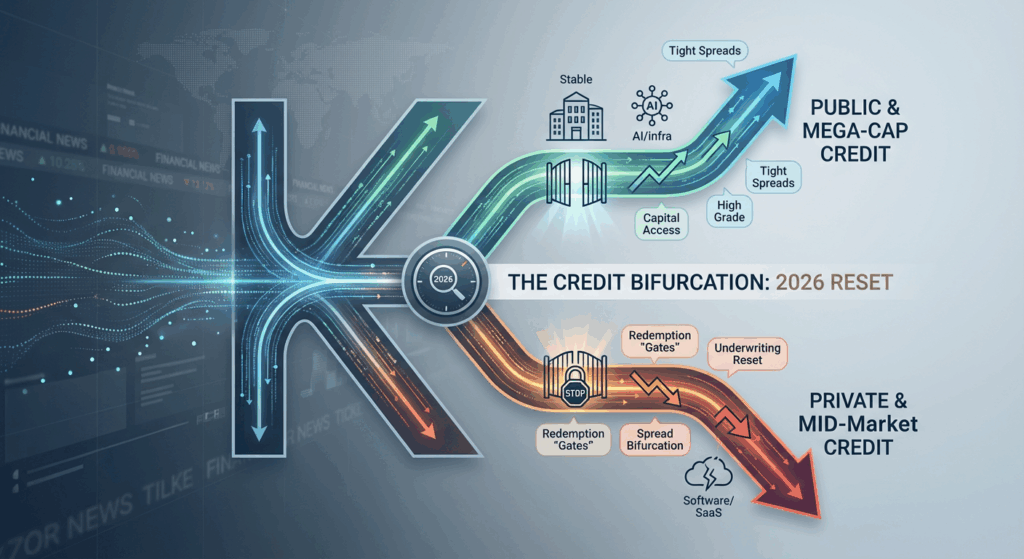
The Macro Signal: One Market, Two Realities
The defining story of April 2026 is not a credit crisis; it is a credit bifurcation. Public bond markets are registering near-historic spread compression, with high yield at 285 basis points (the 5th historical percentile) and investment grade at 80 basis points (the 6th percentile), according to finexus.net. Meanwhile, private credit, the $2+ trillion asset class that displaced bank lending across the middle market, is absorbing its first meaningful redemption stress test, a surge in fund-level gates, and a 34% year-over-year collapse in leveraged loan primary issuance, per investor.wedbush.com.
For institutional investors and operators, this divergence is not an abstraction. It is reshaping which borrowers can access capital, at what cost, under what covenants, and with what leverage: all of which feed directly into the financial KPIs lenders are scrutinizing most closely right now: debt-to-equity ratios, fixed charge coverage ratios (FCCR), and interest coverage across floating-rate capital structures.
Quantitative Market Snapshot
| Metric | Current (Apr 2026) | Prior Period | Source |
|---|---|---|---|
| High Yield Bond Spread | 285 bps (5th percentile) | 328 bps (Apr 2, 2026); 322 bps (Mar 19, 2026) | finexus.net |
| Investment Grade Spread | 80 bps (6th percentile) | 92 bps one month prior | finexus.net |
| Leveraged Loan Primary Issuance (Q1 2026) | ~$241B (total incl. repricings) | ~$355B in Q1 2025 (–32% to –34% YoY) | sikich.com / investor.wedbush.com |
| Private Credit Loan Spreads (Mid-Market, Q1 2026) | ~+100 bps wider vs. Jan 2026 | Tightest conditions seen in January 2026 | sikich.com |
| U.S. Private Credit Default Rate | 9.2% (2025, record high) | 8.1% in 2024 | atlaspeakresearch.com |
| Software Sector Average Leverage (Private Credit) | 7.4x EBITDA | vs. 5.9x for broader loan pool | atlaspeakresearch.com |
| Private Credit Capital Deployed (30 days to Apr 21) | $254B across 114 transactions | Mega-deals ($10B+) = $94B of total | inforcapital.com |
Data as of April 23, 2026. Sources linked per metric above.
Sector Analysis: Where Lender Appetite Is Concentrating, and Retreating
🟢 Active Lender Appetite
AI Infrastructure & Hard Assets: The standout credit story of early 2026 is the financing of AI data center buildouts. Pimco’s $14 billion debt financing for Oracle’s Michigan data center is emblematic of where private credit’s largest guns are pointing, per inforcapital.com. Hard-asset collateral, contracted cash flows, and visible demand underpinning these structures make them highly lender-friendly. FCCR and debt-service coverage benchmarks are more predictable in infrastructure-style credits, reducing covenant stress even at elevated leverage.
Healthcare (Select Subsectors): High-quality, cash-flow-positive healthcare businesses, highlighted by Hologic’s successful $7.25B loan pricing amid broader market malaise, continue to attract institutional lending, per investor.wedbush.com. However, lenders are increasingly wary of companies with complex pharmaceutical supply chains given ongoing tariff uncertainty.
Mega-Cap / Investment-Grade Corporates: In public markets, the tightening of BB spreads to 173 bps (down 29 bps in one month) reflects aggressive institutional demand for upper-tier credits, per finexus.net. The concentration of M&A loan volume, with more than 40% coming from just five mega-transactions in Q1, reinforces this flight to scale and quality, per sikich.com.
🔴 Tightening Lender Appetite
Software / SaaS (Middle Market): Software now constitutes roughly 16% of the U.S. loan market (~$235B) and approximately 20% of private credit portfolios, and it has become the sector’s most acute pressure point, per atlaspeakresearch.com. With average leverage at 7.4x EBITDA (versus 5.9x across the broader pool), revenue growth decelerating from 18% to 10% year-over-year, and software equities down ~22% since January, loan-to-enterprise-value ratios on sponsor-backed software credits have risen materially. Lenders are demanding tighter covenants, lower leverage multiples, and wider spreads on new originations. The era of covenant-lite, 8x+ software deals is effectively closed for now.
Lower-Rated / Sub-$30M EBITDA Borrowers: The smallest middle-market borrowers are absorbing the sharpest credit tightening. Default rates for companies with less than $30 million in EBITDA have moved into double digits, per FSOC data cited by atlaspeakresearch.com. Refinancing progress for sub-BB-rated credits slowed meaningfully in Q1, and maturity pressure is becoming increasingly concentrated among weaker borrowers with no clear relief path, per sikich.com.
Media & Broadcasting: Cumulus Media’s second Chapter 11 filing in eight years, restructuring $592 million in debt, serves as a benchmark event for the sector, signaling that traditional media continues to face existential liquidity barriers, per investor.wedbush.com.
Implications for Institutional Investors and Operators
For Borrowers and Operators
The most immediate operational implication is the recalibration of underwriting KPI thresholds. Lenders are tightening minimum FCCR requirements and compressing acceptable debt-to-equity ratios, particularly for floating-rate borrowers. With the Federal Reserve’s rate-cutting cycle effectively paused (a consequence of the February-March oil shock driving Brent above $120 per barrel and reigniting inflation) most private credit borrowers remain in floating-rate structures with minimal hedges, per atlaspeakresearch.com. Operators approaching 2026-2027 debt walls need to act now: asset sales, covenant amendments, or rescue financing at double-digit all-in yields are the realistic options available for weaker credits.
For healthy borrowers, the current environment still offers access to capital, but concentration and quality determine execution. New-money issuance of approximately $70 billion in Q1 remained only modestly below prior-year levels, confirming that deal-driven financing remains viable for the right profiles, per sikich.com.
For Institutional Investors and Lenders
The private credit retail-channel experiment is facing its first genuine stress test. Gates triggered at BlackRock’s HLEND (9.3% of NAV in redemption requests), Blackstone’s BCRED (7.9%, requiring $400M in sponsor capital), and Cliffwater’s Corporate Lending Fund (~14% requests, capped at 7%) are not isolated events; they are a structural signal that semi-liquid perpetual BDC vehicles face a fundamental liquidity mismatch when investor sentiment shifts, per atlaspeakresearch.com. Institutional allocators should scrutinize fund-level liquidity sleeve sizes, PIK income ratios (which have risen significantly since 2019 and can obscure credit deterioration), and manager-level mark-to-model assumptions against the public BDC market’s signal, listed BDCs were trading at approximately 78 cents on the dollar of reported NAV as of mid-March 2026.
At the same time, mega-fund closes (Blackstone, Ares, and Adams Street each raising $7.5–$10B in recent weeks) confirm that institutional conviction in direct lending as a core asset class remains intact, per inforcapital.com. The opportunity set is concentrating in scale, quality, and hard-asset-backed credits.
Forward View: The Next 90–180 Days
The forward trajectory for credit markets is one of sustained selectivity rather than systemic breakdown. Historical parallels from finexus.net show that when high yield spreads have been within 10% of current levels, the median 3-month forward spread change is just +1 basis point, suggesting consolidation at current levels rather than aggressive further tightening. The S&P 500 has been positive 85% of the time in equivalent historical periods, providing a constructive equity backdrop that supports corporate balance sheets.
However, the divergence between the top and bottom tiers of the credit market is likely to widen before it narrows. Mega-fund deployment at scale, combined with the dislocation in the software and lower-middle-market segments, creates a specific opportunity for distressed and opportunistic credit specialists. The 90/10 rule (where 90% of the market remains stable and 10% faces acute liquidity stress) defines the environment. Capital flowing into the $254B in recent private credit deployment is betting that this selective bifurcation persists long enough to lock in today’s spreads before a rate-cutting cycle eventually compresses them, per inforcapital.com.
For operators and lenders alike, the watchword for the balance of 2026 is precision: sector selection, FCCR discipline, and liquidity-structure integrity will separate the resilient from the restructured.
📌 Key Market Insights
- Public spreads are at historic lows, private credit stress is rising: High yield at 285 bps (5th percentile) and IG at 80 bps (6th percentile) mask a private credit market where default rates hit a record 9.2% in 2025 and redemption gates are being triggered across major BDC platforms.
- The software sector is the single largest structural risk in private credit: At 7.4x average EBITDA leverage, ~20% portfolio concentration across major lenders, and equity values down ~22% since January, software underwriting assumptions are being reset, expect meaningfully lower leverage multiples and tighter covenants on new originations.
- Mega-fund consolidation is accelerating: $254B deployed in 30 days, led by Blackstone, Ares, and Adams Street, confirms that institutional capital is concentrating with scale managers capable of funding $10B+ transactions, crowding out smaller platforms and widening the access gap for mid-market borrowers.
- Floating-rate exposure without hedges is the most immediate FCCR risk: With the Fed’s cutting cycle paused and base rates still elevated, borrowers with minimal interest-rate hedges face persistent pressure on fixed charge coverage, operators with approaching maturities should model FCCR stress scenarios at current rates through at least mid-2027.
- Retail-channel liquidity structures in private credit require immediate scrutiny: Semi-liquid perpetual BDC vehicles trading at ~78 cents on the dollar of reported NAV, combined with PIK income ratios elevated since 2019, suggest that reported yields and NAVs may be overstating true credit quality for a meaningful subset of the market.


