
The Pitch Meeting They Never Took
Ken Hoppe had built exactly the kind of company venture capitalists dream about: a profitable SaaS business inside the Salesforce ecosystem, serving billion-dollar enterprises, with six full-time employees and $1.7 million in annual recurring revenue. The term sheets would have come. Ken just never went looking for them.
“It’s my own money and my co-founder’s money,” he explained, describing his decision to raise $400,000 in revenue financing from Founderpath instead of opening his cap table to outside investors. “Founderpath helped us keep control of the company while still getting the capital we needed to grow.”
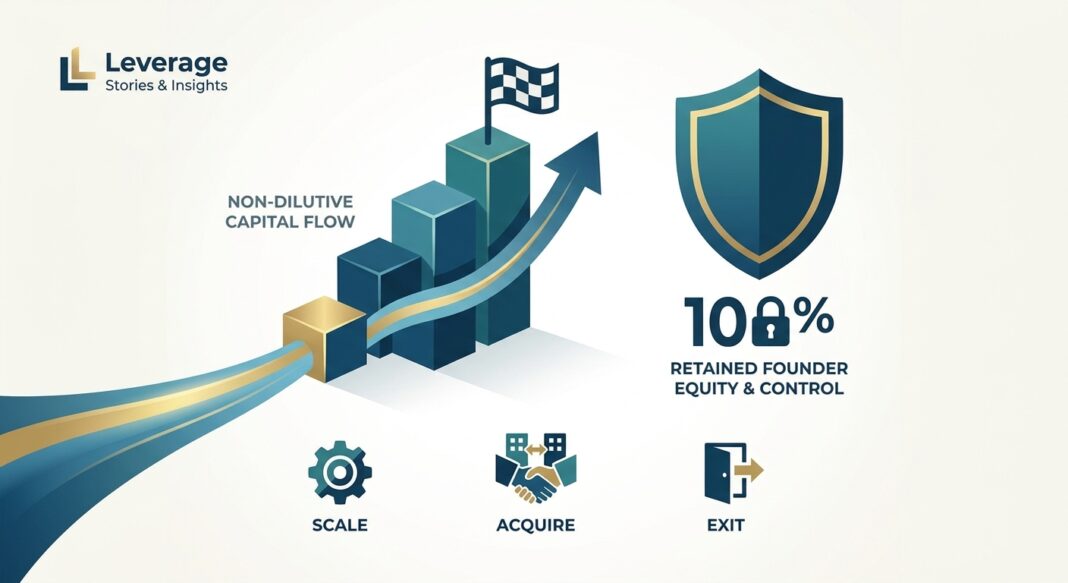
The capital funded Modigi’s first sales hire and customer success manager. Repayment was pegged to revenue inflows, carrying an effective discount rate of 8–12% over a 12-month payback window: no board seats, no warrants, no equity dilution. The result: 100% founder ownership preserved, a 2x gain in pipeline efficiency, and a trajectory targeting $3–4 million in EBITDA within two years of the raise.
Modigi’s story is not an outlier. It is the opening chapter of a much larger shift in how ambitious, capital-efficient founders are choosing to grow.
The Decision That Defines Everything
Every founder reaches the same inflection point. The business is working. Revenue is growing. But scaling the team, entering new markets, or funding an acquisition requires more capital than the business currently generates. At that moment, the capital structure decision is not a financial abstraction; it is a question about who owns the future of the company.
The venture capital path is well-understood: trade equity and governance rights for growth capital and a network, then race toward a liquidation event on the investor’s timeline. What is less frequently discussed (and far less frequently taught) is the alternative: using debt, revenue share, or venture credit facilities to fund precisely the same milestones while the founder’s ownership percentage stays exactly where it was on day one.
Jonathan Benjamin, CEO of UnityLab (formerly Unity Laundry Systems), faced this exact choice three separate times as he grew his commercial appliance platform from $700,000 in revenue to a global operation spanning the U.S., China, and Europe. Each time, he chose revenue-based financing from Sage Growth Capital over equity. “We always knew that delaying traditional equity raises would benefit our founding team, since early-stage VC funding could prove both expensive and detrimental to the business,” Benjamin explained.
The numbers bear that out. When UnityLab needed $750,000 to close the acquisition of Hoffman New Yorker (a well-established industrial brand with 24 employees and a global customer base) Sage provided it on a revenue-share basis. That preserved cap table cleanliness allowed Benjamin to raise a $6.6 million Series A at a significantly higher valuation just months later, after he had already demonstrated post-acquisition integration results. The sequence mattered enormously: prove the thesis with non-dilutive capital, then raise equity from a position of strength.
What Actually Happened: Three Outcomes Worth Studying
1. The SaaS Founder Who Kept 100%
Modigi’s Ken Hoppe deployed $400,000 in revenue financing to hire sales and customer success staff without surrendering equity. The outcome: $1.7M ARR with a lean six-person team, zero marketing spend driving a 2x pipeline improvement, and a runway to $3–4M EBITDA. The counterfactual (a seed round at, say, a $6M valuation) would have cost the founding team roughly 15–20% dilution for the same capital. At the projected exit valuation, that dilution differential alone represents millions of dollars in founder wealth destroyed before the company ever reached scale. Source: founderpath.com.
2. The Acquisition Ladder
UnityLab’s 10x growth over four years was financed through three sequential rounds of revenue-based capital from Sage, each structured to fund a specific milestone before a subsequent equity or debt round was raised. The $150,000 first tranche funded two new product SKUs. The $750,000 second tranche funded the Hoffman acquisition. A third facility in 2024 funded international expansion into China and Italy, a global supply chain overhaul that cut gross margin costs by 40%, and platform infrastructure for future M&A. The company grew from 47 customers to over 25,000 worldwide, without founder dilution at any of these critical inflection points. Source: sagegrowthcapital.com.
3. The Venture Debt Exit Play
Father-and-son founders Greg and Timothy Holifield took a different but equally instructive path with SafePointe, their AI-based weapons detection company. Facing heavy accounts receivable lines and the capital cost of hardware embedded in their SaaS licensing model, the Holifields secured a $1 million non-dilutive debt facility from TIMIA Capital in September 2022. Within 12 months, SafePointe had tripled its monthly recurring revenue and was acquired by SoundThinking (Nasdaq: SSTI), a leading public safety technology firm. The equity investors who co-invested at the same time made 10x on their money in nine months. TIMIA’s debt cost a fraction of that, which is precisely the point. “When there are no warrants associated with debt, it is truly fantastic money, and much cheaper than equity. I love this class of debt,” Greg said post-exit. It was the Holifields’ fourth successful exit, all built on the same philosophy.
The Lessons: A Framework for the Capital-Efficiency Era
Taken together, these stories reveal a coherent set of principles that any founder, operator, or family business owner should internalize before accepting a term sheet or signing a line of credit.
Non-dilutive capital is not a consolation prize. It is a strategic tool that, when deployed correctly, produces better founder outcomes than equity at early and growth stages. The cost of revenue financing, typically an 8–15% effective rate over 12–18 months, is almost always lower than the implied cost of equity dilution compounded over a multi-year hold period.
Sequencing matters more than the individual instrument. UnityLab’s Benjamin demonstrated that the real leverage is in ordering your capital raises: use non-dilutive financing to prove a thesis, then raise equity at the valuation that thesis supports. This is not just about saving dilution today; it is about maximizing the valuation at which dilution eventually occurs.
Debt and equity are not mutually exclusive. SafePointe ran both simultaneously, using venture debt to fund working capital while equity investors took the equity risk. Each instrument was priced appropriately for its risk profile. The founders understood the difference and structured accordingly.
Venture capital carries hidden costs that founders rarely model. As Myagi co-founder Simon Turner, who used a $2.5M TIMIA facility to grow ARR from $2.4M to $4.4M before a successful exit to Rallyware, observed: “One thing venture capital doesn’t take into account is that many businesses have a natural cadence at which they grow. For many companies, growing too fast can be detrimental to the business.” The VC clock, not the market clock, often drives that pressure. Source: timiacapital.com.
Cash conversion cycle optimization is its own form of leverage. Taste Salud, a bootstrapped CPG brand that sold through $40 million in revenue over 24 months without raising outside equity, used working capital management and GreenSpark’s cashflow orchestration platform to compress its cash conversion cycle from +36 days to -42 days. That 78-day swing in cash velocity is, in effect, a free line of credit, capital created not by raising money, but by managing it with precision.
Key Insights
- Revenue-based financing typically costs 8–15% in effective terms: structurally cheaper than early-stage equity dilution compounded over a five-to-seven year venture hold period, especially when the exit multiple on that equity is high.
- Sequencing non-dilutive capital before equity rounds allows founders to prove thesis milestones first, then raise equity at the valuation those milestones command, as UnityLab demonstrated with its Hoffman acquisition bridge into a $6.6M Series A.
- Venture debt and equity are complementary, not competing instruments. SafePointe ran both in parallel: debt financed working capital and hardware costs, equity took long-term upside, each priced appropriately for its risk.
- VC timelines impose artificial growth pressure that can force founders to outgrow their market’s natural cadence, as Myagi’s Simon Turner experienced firsthand, a risk that non-dilutive financing structurally eliminates.
- Working capital management is its own form of leverage. Optimizing cash conversion cycles and AP timing, as Taste Salud’s 78-day improvement demonstrates, can generate capital equivalent to a debt facility without adding a single dollar of liability to the balance sheet.


