
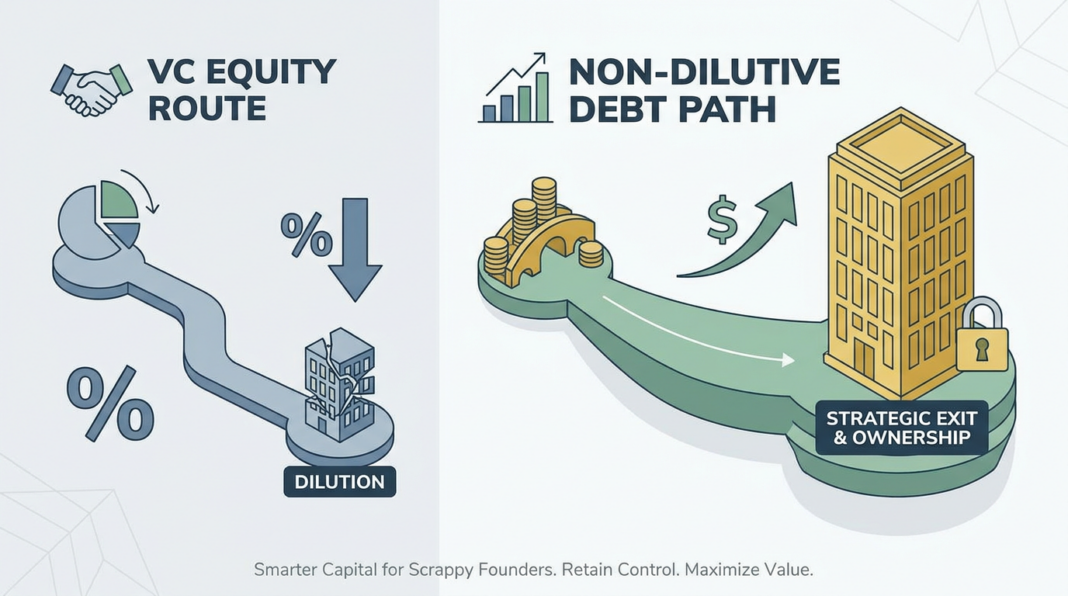
The Story: A Founder Who Refused to Hand Over the Keys
In early 2021, Simon Turner had a decision to make. Myagi, the retail sales enablement platform he co-founded in Melbourne, had just survived the pandemic, and, improbably, thrived. Demand for digital retail solutions had surged, and Myagi was posting its best six-month growth streak ever. The instinct for most founders in that position is to sprint toward a Series A. Turner took a different turn.
He called TIMIA Capital.
Rather than dilute his equity at what he believed was an artificially compressed early-stage valuation, Turner secured a $2.5 million non-dilutive debt facility from TIMIA, structured around Myagi’s recurring revenue. No equity surrendered. No board seat conceded. No VC timeline imposed.
Two years later, Myagi was acquired by Rallyware, a performance enablement platform serving large sales forces. Turner walked away with a materially larger share of that outcome than he would have if he’d taken a traditional equity round in 2021. As he reflected afterward: “Debt is a powerful tool for capital-efficient businesses when used under the right circumstances.”
Turner’s story is not unique. Across the SaaS and technology landscape, a growing cohort of founders is discovering that the reflexive reach for venture capital can be the most expensive decision they ever make, and that structured, non-dilutive debt, used strategically, is one of the most powerful levers available to operators who want to retain what they build.
The Decision: What Were the Real Options?
For most early- and growth-stage founders, the capital menu looks deceptively simple: raise equity from VCs or angels, or bootstrap until you run out of runway. But a third path has matured significantly over the past decade: revenue-based financing, venture debt, and private credit instruments that provide growth capital without permanent equity dilution.
Turner’s choice crystallized the trade-off. A venture round in early 2021 would have required surrendering a meaningful ownership stake at a valuation that, in hindsight, dramatically underpriced Myagi’s trajectory. Instead, TIMIA’s facility was priced as debt, structured around Myagi’s recurring revenue, with repayment tied to cash flows rather than a forced exit timeline. Myagi used the capital to build out its sales and customer success functions and to enhance its referral-based growth model.
The outcome? Myagi’s ARR climbed from $2.4 million to $4.4 million over the life of the TIMIA facility, a near-doubling of recurring revenue that strengthened the company’s market position and made it a far more attractive acquisition target. When Rallyware came knocking in 2023, Turner negotiated from a position of strength, not desperation, according to timiacapital.com.
Compare that to the equity path. Had Turner raised a $2.5 million Series A at, say, a $10 million post-money valuation, he would have surrendered 25% of the company, permanently. And that’s before accounting for the compounding dilution of subsequent rounds, liquidation preferences, and the VC mandate to swing for a billion-dollar outcome rather than optimize for a clean, value-creating acquisition.
The Outcome: Three Founders, One Consistent Pattern
Myagi is not a one-off. The same pattern plays out across the case studies now emerging from non-dilutive capital providers.
SafePointe: Tripling MRR Before an Acquisition
Father-son founders Greg and Timothy Holifield built SafePointe, an AI-based weapons detection company in Florida, on bootstrap capital before engaging TIMIA for a $1 million debt facility in September 2022. SafePointe was a hardware-enabled SaaS business, meaning its customer acquisition costs were front-loaded in expensive hardware deployments, creating a working capital gap that equity investors often misunderstand.
TIMIA’s facility, disbursed in three tranches as contract milestones were hit, allowed the Holifields to fund new customer hardware deployments without ceding ownership. The result: SafePointe tripled its monthly recurring revenue in under twelve months. In 2023, it was acquired by SoundThinking (Nasdaq: SSTI), a leading public safety technology firm, according to timiacapital.com.
Greg Holifield’s assessment of the cost comparison was blunt: “They think the interest rate is too high, but when there are no warrants associated with debt, it is truly fantastic money, and much cheaper than equity.” He noted that equity investors who participated alongside TIMIA made 10x on their capital in nine months. TIMIA’s debt cost a fraction of that on an effective basis.
Modigi: Six Employees, $1.7M ARR, Zero Dilution
Ken Hoppe, CEO of Modigi, ran an even leaner operation, a six-person SaaS company embedded in the Salesforce ecosystem, serving enterprise clients. When Modigi needed to hire its first salesperson and customer success manager, Hoppe faced the classic founder dilemma: slow down and self-fund, or raise equity and share the upside.
He chose a third option: $400,000 in revenue-based financing from Founderpath, secured against Modigi’s MRR contracts, with no personal guarantees and no equity transferred. The facility funded his key hires, and Modigi scaled to $1.7 million in ARR profitably, with Hoppe and his co-founders retaining 100% of the company, according to founderpath.com. Modigi is now targeting $3–4 million in EBITDA within 24 months.
UnityLab: 10x Growth Without Surrendering the Cap Table
Jonathan Benjamin’s UnityLab (formerly Unity Laundry Systems) offers perhaps the most sophisticated illustration of how non-dilutive capital can be sequenced across a company’s full growth lifecycle. Beginning with a $150,000 revenue-based investment from Sage Growth Capital in 2020 when the company had fewer than 50 customers, UnityLab used successive tranches of non-dilutive financing to fund product expansion, acquire Hoffman New Yorker, expand into China and Italy, and reduce gross margin costs by 40%.
By preserving equity through each of these stages, Benjamin entered his Series A, a $6.6 million round in Q3 2022: from a position of demonstrated value creation and a clean cap table, commanding a materially better valuation than would have been possible if early-stage equity had been used to fund the same milestones, according to sagegrowthcapital.com. Revenue-based financing served not as a substitute for equity but as a strategic bridge that made each equity event more favorable.
The Lessons: A Framework for Operators Facing the Same Decision
The through-line across Myagi, SafePointe, Modigi, and UnityLab is not that equity is always wrong. It’s that equity used reflexively (before the business has demonstrated predictable cash flows and before the founder has exhausted non-dilutive options) is almost always more expensive than it appears at the term sheet stage.
The following framework helps operators think through this decision clearly:
1. Price Equity at Its True Cost
Equity is permanent. A 20% stake surrendered at a $5 million valuation is not a $1 million transaction, it’s a claim on every dollar of future enterprise value you create, including the value generated by the very capital you just raised. Revenue-based financing and venture debt, by contrast, have a defined cost that expires when repaid. The Holifields captured this precisely: equity investors made 10x in nine months while debt cost a fraction of that.
2. Match Capital Type to Capital Need
Not all capital needs are created equal. Hiring a salesperson, funding a hardware deployment, or bridging an accounts receivable gap are working capital needs, not permanent equity events. Non-dilutive instruments are often structurally better suited to these use cases than equity, which is designed for permanent, high-risk investments in company-building.
3. Use Debt to Improve the Equity Event
Benjamin’s UnityLab playbook is instructive: use non-dilutive capital to hit the milestones that improve your equity valuation, then raise equity. This sequencing compresses the equity you surrender and maximizes the value of each ownership percentage point retained.
4. Know the VC Incentive Structure
Venture capital funds are optimized for power-law returns, a small number of massive outcomes that justify the losses across the rest of the portfolio. As Turner observed, this creates pressure to “grow at all costs,” which may not align with a business that has a natural, profitable growth cadence. Debt providers, by contrast, are aligned with cash flow durability, an incentive structure that often fits capital-efficient businesses better.
Key Insights
- Equity is perpetually expensive. Every point surrendered early compounds against every dollar of future value created. Non-dilutive debt has a defined cost ceiling, equity does not.
- Revenue-based financing is now a mature asset class. Providers like TIMIA Capital, Founderpath, Sage Growth Capital, and others have built scalable underwriting infrastructure around recurring revenue metrics, making access faster and more predictable than ever for SaaS and subscription-driven businesses.
- Debt can fund an exit-ready company more efficiently than equity. SafePointe tripled MRR and sold to a Nasdaq-listed acquirer within 12 months of taking a $1 million debt facility, a timeline and outcome that equity-backed companies rarely achieve with comparable capital deployment.
- The best founders use debt to improve their equity rounds, not avoid them. UnityLab’s ability to raise a $6.6 million Series A at a favorable valuation was a direct consequence of the proof points funded by non-dilutive capital. Debt and equity are not mutually exclusive; they are sequenceable tools.
- VC pressure and founder optionality are structurally misaligned. Venture funds need exits within defined fund lifespans. Founders building durable, cash-flowing businesses often do not, and choosing debt preserves the strategic flexibility to exit on their terms, not their investors’.


