
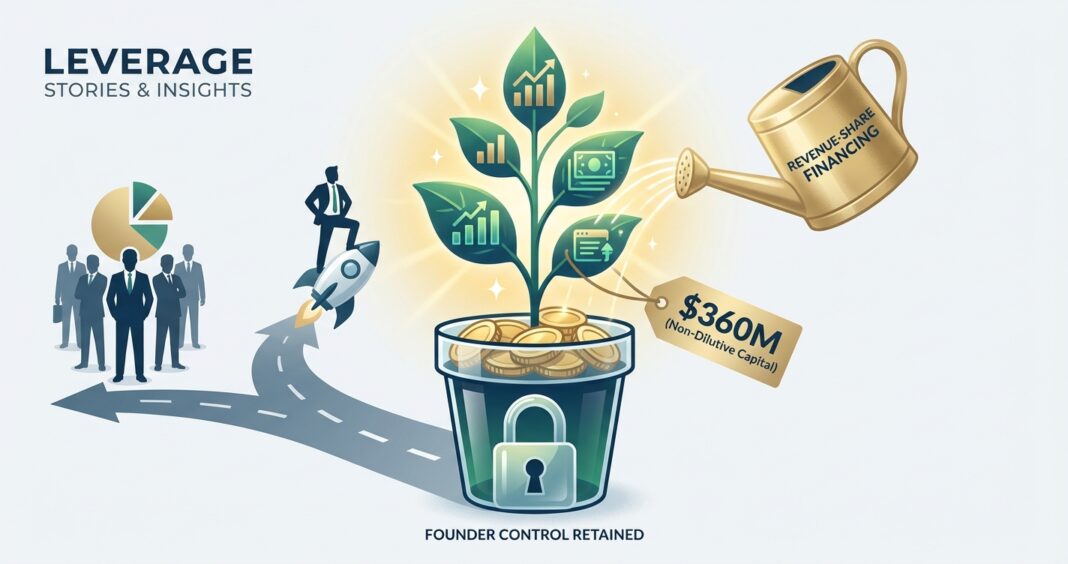
The Story: A Founder Who Kept Saying No to Venture Capital
For more than a decade, Jack Jia built Musely (a direct-to-consumer telemedicine platform specialising in compounded treatments for skin, hair, and menopause care) without touching a single dollar of outside equity. Founded in 2014 and pivoting to prescription skincare in 2019, the company had reached cash flow positive and was growing revenue at roughly 50% year-over-year, serving over 1.2 million patients. VCs came knocking regularly. Jia consistently turned them away.
Then, in 2025, General Catalyst’s Customer Value Fund (CVF) reached out: not to buy equity, not to offer a traditional loan, but to propose something structurally different: a revenue-share financing arrangement. For the first time, Jia listened. By May 2026, Musely had secured over $360 million in non-dilutive capital, the largest financing of its kind the company had ever undertaken, and not a single share had changed hands.
“When I mathematically modeled it, I found this absolutely compelling,” Jia told TechCrunch. It was a statement that quietly captured a broader shift in how the most capital-efficient founders are thinking about growth.
The Decision: Revenue-Share vs. Equity Round
The capital need was real. Musely’s unit economics were strong, but at DTC scale, customer acquisition costs become a relentless burden. As Jia explained it: “When you become a billion-dollar revenue company, you need another billion in order to grow to the next billion.” Marketing spend at that scale demands a war chest, but funding it with equity would mean permanently surrendering a portion of the business Jia had spent over a decade building without outside dilution.
The options on the table were:
- Traditional VC equity round: Available, but permanently dilutive and accompanied by board seats, governance conditions, and misaligned exit timelines.
- Bank debt: Interest-bearing, covenant-heavy, and often structurally incompatible with growth-stage DTC businesses.
- CVF’s revenue-share structure: Musely receives capital upfront; repayment is structured as a fixed, capped percentage of the revenue generated through the deployment of those funds: no equity, no interest in the traditional sense, no board control surrendered.
Jia chose the third path. The CVF model (which counts Grammarly, Lemonade, and Ro among its portfolio) is specifically designed for businesses with predictable, recurring revenue streams, where the risk of repayment is tied to the revenue performance the capital is intended to drive. For a company growing at 50% annually with a proven customer base, the structure was a natural fit.
The Outcome: Scale Without Sacrifice
The $360 million will be deployed across sales, marketing, and customer acquisition, the highest-leverage uses of capital for a DTC business at Musely’s stage. Critically, the outcome comparison tells the real story.
Had Jia accepted a conventional VC round of comparable size (say, at a $1.5 billion post-money valuation) he and existing stakeholders would have surrendered roughly 24% of the business. At a future exit valuation of $3 billion, that dilution would represent approximately $720 million in value transferred from founders to investors. Instead, Musely’s repayment obligation is capped and tied to the revenue the capital generates, structurally aligning the cost of capital with the actual performance of the investment.
Musely is not alone. Across the market, founders with strong fundamentals are making the same calculation:
- Inkle, a financial operations platform for VC-backed startups, used non-dilutive financing from Efficient Capital Labs to avoid two equity rounds entirely, retaining approximately 90% founding team equity and full board control while expanding to serve 500+ companies globally, as detailed in ECL’s published case study.
- Hello Klean, a London-based subscription e-commerce brand, replaced short-term debt with a £1.5 million long-term credit line from re:cap: extending payback terms to up to 60 months to match their actual customer lifetime value, enabling confident hiring and international expansion into the Middle East and EU without any equity dilution, according to re:cap’s case study. “Taking on debt is like a health seal,” founder Omer Ozener told re:cap. “You’re healthy by default if you’re able to add this to your capital structure.”
- UnityLab (formerly Unity Laundry Systems) used revenue-based financing from Sage Growth Capital at multiple critical junctures, including a $750K tranche to close an acquisition of industrial business Hoffman, avoiding equity dilution long enough to complete the deal, prove the thesis, and then raise a $6.6 million Series A at a favorable valuation, according to Sage Growth Capital. The company grew more than 10x in four years.
The Lessons: A Framework for Non-Dilutive Capital Decisions
The Musely story, read alongside Inkle, Hello Klean, and UnityLab, reveals a consistent set of principles about when non-dilutive debt structures outperform equity, and when they don’t.
When Revenue-Share and Non-Dilutive Structures Win
- Predictable, recurring revenue is the prerequisite. Every one of these deals was underwritten on revenue visibility: MRR, subscription cohorts, or DTC retention curves. Without that visibility, lenders cannot price the risk and founders cannot model the repayment. Cash flow positive or near-positive businesses are the natural fit.
- The cost of dilution compounds over time. Founders dramatically underestimate the long-term cost of equity given away early. A 20% dilution at Series A, followed by another 15% at Series B, doesn’t just reduce ownership; it resets the incentive structure, introduces board dynamics, and shortens time horizons. Non-dilutive capital sidesteps every one of these friction points.
- Structure must match use of funds. Hello Klean’s breakthrough insight was that short-term debt (6-12 months) was structurally incompatible with a six-month customer payback period. The capital structure and the business model’s cash flow cycle must rhyme. Mismatched tenor creates existential pressure even when the underlying business is healthy.
- Non-dilutive capital can be a bridge to a better equity round. UnityLab’s playbook (use revenue financing to de-risk an acquisition, prove the thesis, then raise equity at a higher valuation) is replicable. The sequence matters enormously. Founders who raise equity before proving key assumptions give away the most value at the worst time.
- The VC model is not neutral. VCs are structurally incentivised toward large exits on compressed timelines. For founders building durable, cash-generative businesses, the Musely profile, this incentive is actively misaligned. Revenue-share and credit structures impose no exit pressure, no governance friction, and no timeline misalignment.
When It Doesn’t Work
Non-dilutive structures are not universally superior. Pre-revenue companies, businesses with negative unit economics, and ventures requiring network-effect capital at scale may still need equity. The framework is straightforward: if the business cannot reliably service repayment from operations, debt of any structure becomes existential risk rather than leverage.
Key Insights
- Non-dilutive capital has reached institutional scale. Musely’s $360M deal signals that revenue-share and alternative credit structures are no longer niche instruments; they are mainstream options for capital-efficient, high-growth businesses.
- The true cost of equity is invisible until exit. Founders who model dilution at the point of exit, not at the point of raise, make materially different capital decisions.
- Debt tenor must match business model cash flow cycles. Mismatched repayment schedules turn healthy businesses fragile; aligned structures unlock confident investment in growth.
- Non-dilutive capital and equity are not mutually exclusive. The smartest founders use non-dilutive financing to delay equity until valuations and leverage are maximised, as UnityLab demonstrated with its Series A timing.
- Control is a compounding asset. Every board seat surrendered and every governance right conceded limits future strategic optionality. Founders who preserve control early retain the ability to choose their outcome, not have it chosen for them.


