
The Story: A 60-Year-Old Brand, a $234M Debt Anchor, and an Undervalued Crown Jewel
By the start of 2026, Lands’ End (NASDAQ: LE) found itself in a familiar bind for mature consumer brands: a loyal customer base, a recognisable name worth far more than the stock price implied, and a balance sheet weighed down by a $234 million term loan that was quietly strangling strategic optionality. The Dodgeville, Wisconsin-based digital retailer (known for its solution-based apparel, outerwear, uniforms, and swimwear) had spent years building a licensing business on the side, quietly monetising the Lands’ End name across categories from travel accessories to intimate apparel. But the real value sitting on the books was the brand’s intellectual property itself: trademarks, licensing agreements, and decades of earned consumer trust, carried on the balance sheet at $257 million.
The core operating business was generating revenue north of $1.3 billion annually, but growth was elusive. Fiscal 2025 net revenue fell 2% year-over-year to $1.34 billion, and the term loan’s interest burden was eating into any capital flexibility the company might otherwise deploy toward innovation, share buybacks, or strategic investment. Conventional wisdom in this situation usually points to one of two roads: raise dilutive equity to shore up the balance sheet, or sell the company outright to a strategic or private equity buyer. Lands’ End chose neither. Instead, it found the value hiding inside its own name.
The Decision: Sell the IP You Already Own, and License It Back
On January 26, 2026, Lands’ End announced a joint venture with WHP Global, a New York-based brand management firm whose portfolio: spanning Toys ‘R’ Us, Express, Bonobos, Vera Wang, Rag & Bone, and others, collectively generates over $8 billion in global retail sales. The structure was elegant in its simplicity and powerful in its mechanics:
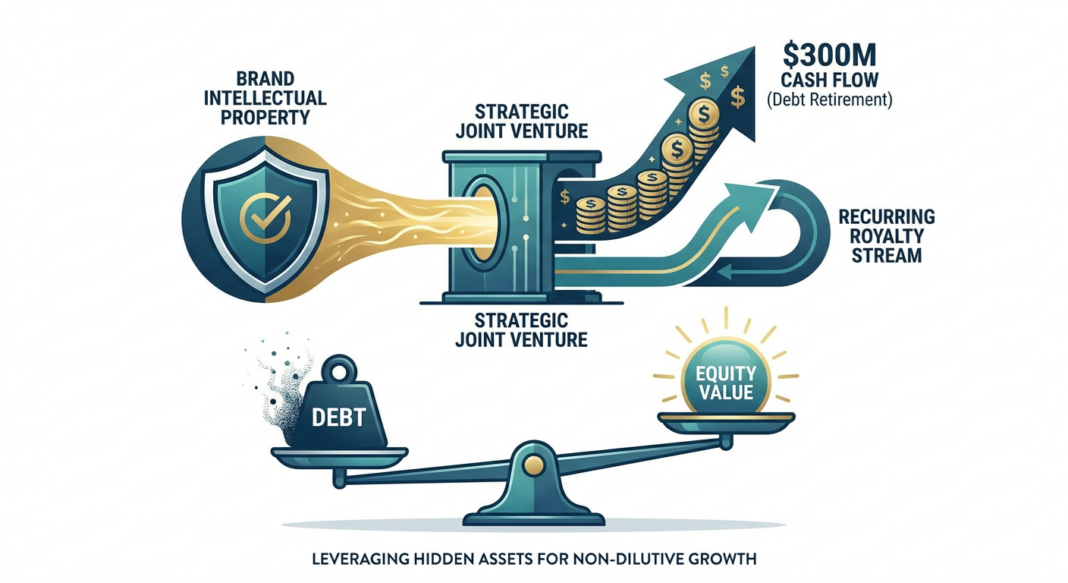
- Lands’ End contributed all brand intellectual property and existing licensing agreements to a newly formed JV entity (LE Topco, LLC).
- WHP Global paid $300 million in cash for a 50% controlling stake in the JV, valuing the IP vehicle at an implied $748.6 million.
- Lands’ End then licensed its own brand back from the JV under a long-term exclusive agreement, committing to $50 million in guaranteed minimum annual royalties starting in year one.
- Excess cash above the JV’s operating reserve threshold flows back to both partners on a quarterly basis, proportional to their 50/50 ownership split.
The critical structural insight: no new equity was issued to existing shareholders’ dilution. No VC. No secondary. No convertible note overhang. The $300 million materialised from the company’s own balance sheet, specifically, from an asset that accounting convention had always undervalued relative to what a strategic operator would actually pay for it. Lands’ End also retained full operational control of its direct-to-consumer and B2B businesses, ensuring zero disruption to customers, channel partners, or employees. Simultaneously, WHP Global launched a $100 million tender offer for Lands’ End shares at $45 per share, acquiring approximately 7% of the company, an alignment of incentives that made WHP a shareholder in the very business it was now helping to grow.
The Outcome: Zero Debt, $491M Gain, and a New Earnings Engine
The transaction closed on April 1, 2026. The numbers tell a striking story about the power of non-dilutive IP monetisation done correctly:
- Term loan eliminated entirely: Lands’ End used the majority of the $300M proceeds to fully repay its $234 million term loan, leaving the company with no long-term debt outstanding as of Q1 2026.
- Accounting gain of $491.6 million: The transaction generated a recorded gain of $491.6 million, the difference between the $300M cash received and the book value of the IP contributed, implying the market had been sleeping on hundreds of millions of embedded brand value for years.
- Q1 2026 reported net income: $330.7 million (diluted EPS of $10.56), almost entirely driven by the JV gain.
- New recurring royalty stream: The JV now delivers a high-margin royalty income stream that supplements core operating cash flows, structurally improving the quality of earnings going forward.
- $100 million share repurchase program authorised by the Board in April 2026, a capital return action that would have been unthinkable under the prior debt-laden capital structure.
Compare this to the dilutive equity alternative. Had Lands’ End raised $300 million via a secondary offering (at, say, $15–20 per share (where the stock was trading before the deal announcement)) it would have issued roughly 15–20 million new shares, permanently diluting every existing shareholder’s stake by 30–40%. Instead, CEO Andrew McLean described the JV as “a genuine inflection point” creating multiple parallel pathways to shareholder value: organic business growth, JV profit-share distributions, the buyback programme, and a potential future exchange of the JV stake for equity in WHP Global itself at the same valuation multiple applied in any WHP monetisation event.
There is a nuance worth noting honestly: core Q1 2026 revenue fell 8.5% to $238.9 million and Adjusted EBITDA remained negative at -$6.2 million, reflecting operational disruptions and tariff pressures. The underlying business still has work to do. But the capital structure transformation, from debt-burdened to debt-free with a recurring royalty annuity, has materially widened the runway for that operational work to happen.
The Lessons: A Framework for Non-Dilutive IP Capital
The Lands’ End / WHP Global transaction is not a one-off. WHP used a structurally similar model when it partnered with Express in 2024. In December 2024, Vera Wang sold her brand’s IP to WHP Global, continuing as Founder and Chief Creative Officer while becoming a WHP shareholder, monetising three decades of brand equity without losing her creative seat. This is a playbook, and it is spreading.
Here is the framework for operators and boards considering a similar move:
1. Map Your Hidden Asset Layer
Most established businesses carry intellectual property (trademarks, proprietary processes, brand names, customer relationships) at book value that dramatically understates what a strategic acquirer or JV partner would pay. The gap between book IP value and market IP value is where non-dilutive capital lives. Lands’ End carried its IP at $257 million; the market valued it at $748.6 million. That $491.6 million gap was shareholder value hiding in plain sight.
2. Structure for Retained Operational Control
The single most important structural element in the Lands’ End deal was the licence-back arrangement. By licensing its own brand from the JV under a long-term exclusive agreement, Lands’ End preserved every customer-facing decision: product, channel, pricing, brand voice. WHP controls the JV board but does not run the retailer. Operational continuity was non-negotiable, and the deal was structured to guarantee it.
3. Build in the Upside Optionality
In the event of a qualifying WHP Global monetisation (such as a public listing or majority sale) Lands’ End may exchange its JV stake for equity in WHP Global at the same valuation multiple. This is a masterclass in capital structure design: take the liquidity now, eliminate the debt, but preserve a right to participate in future upside on terms you could not have negotiated as a minority equity investor in year one. The upside optionality is free, because it was engineered into the deal structure at inception.
4. Use Proceeds to Retire the Drag, Not Fund the Hype
The $300 million did not go into a marketing blitz or a speculative acquisition. The overwhelming majority went to retiring the $234 million term loan, the single biggest structural impediment to management’s flexibility. CFO Bernie McCracken noted that the full term loan repayment “significantly strengthened our balance sheet and reduced our interest burden,” providing enhanced flexibility for capital allocation. Capital discipline is not a slogan; it is the decision to use non-dilutive proceeds to remove constraints, not to add complexity.
5. Know When This Works, and When It Does Not
IP monetisation via JV or sale-leaseback structures works best when: (a) the brand or IP has demonstrable third-party licensing value beyond the operator’s own use; (b) the company has a sustainable core business that can absorb a royalty obligation without existential risk; and (c) the debt being retired creates more value than the royalty cost it replaces. It does not work for early-stage companies with no IP track record, or for operators whose core economics cannot support a guaranteed minimum royalty payment through a downturn. The Lands’ End model requires a brand with real, proven licensing demand, not a promise of one.
Key Insights
- IP is a balance sheet asset that most operators systematically underprice. The gap between accounting book value and market value is where non-dilutive capital is manufactured, Lands’ End found nearly $500 million in that gap.
- The licence-back structure is the key to retained control. Monetising the IP while licensing it back preserves 100% of operational authority. You sell the asset; you keep the business.
- Debt elimination compounds forward. Retiring $234M in term debt does not just save interest expense; it restores optionality, enables buybacks, and resets the strategic conversation with every future counterparty.
- Upside optionality can be negotiated into the deal at inception. The right to exchange JV equity for WHP Global equity at a monetisation event is a call option on the platform operator’s future, embedded into the structure at no additional dilutive cost.
- WHP Global’s repeat playbook confirms the model is scalable. From Express to Vera Wang to Lands’ End to Marc Jacobs, the IP monetisation joint venture is becoming a recognised, repeatable capital structure for established consumer brands, a signal that the market has validated non-dilutive IP capital as a category, not a one-time curiosity.


