
The Story: A Founder Who Refused to Sell Cheap
In 2012, Julian Hearn started filling nutritionally complete meal pouches out of a warehouse in Aylesbury, England. The pitch was blunt: stop wasting time on food. Huel, a portmanteau of Human Fuel, was not a lifestyle brand. It was a utility product with a bold promise and a lean cost structure. Hearn had no institutional backers, no celebrity co-founder, and no Series A war chest. What he had was a functioning business.
He bootstrapped Huel to £18 million in annual revenue before he ever picked up the phone to talk to a VC. That decision, which many advisors at the time would have called reckless, turned out to be the single most valuable capital move he ever made. Because when Hearn finally did raise institutional money, he did it from a position of strength, not desperation. He chose when to raise, how much to raise, and at what valuation. Dilution became something he managed rather than something that happened to him.
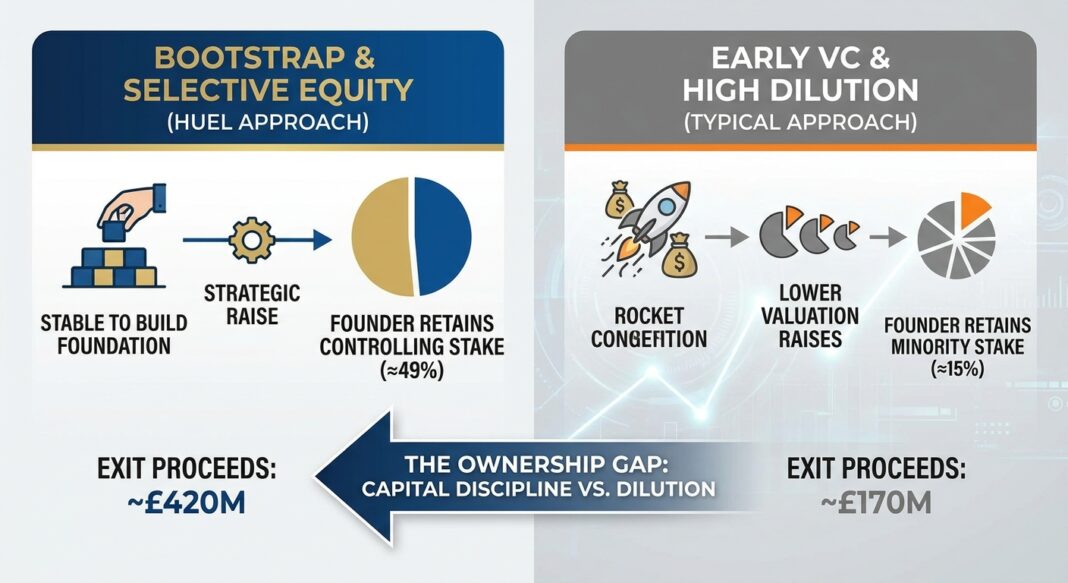
When Danone acquired Huel in 2026 for €1 billion, Julian Hearn personally received approximately £420 million in exit proceeds. He still owned 49.3% of the company after raising $184 million across three funding rounds. Most founders who raise comparable capital end up owning 15–25% at exit, according to cap table analysis from creatorsblueprint.co. Hearn kept more than double the typical founder stake. The difference was not luck. It was a capital philosophy.
The Decision: Raise at Inflection Points, Not Out of Necessity
Most consumer founders raise equity early, often too early, because they need cash to build product, pay salaries, and buy their first round of inventory. The trade-off is straightforward and brutal: give up 20–30% at a seed round, another 20–25% at Series A, and so on, until the founder is a minority stakeholder in their own company before the business hits its stride.
Hearn rejected this model. By building Huel to profitability and meaningful scale before engaging institutional investors, he fundamentally shifted the negotiating dynamic. Investors were no longer the ones with leverage; he was. When he did raise, he raised minimally and at valuations that reflected a proven, cash-generating business rather than a speculative bet. The result was a cap table that remained founder-controlled through the growth phase and all the way to exit.
The broader lesson here is not anti-equity, Hearn did raise equity capital, three times. The lesson is about sequencing and necessity. Equity raised to survive destroys ownership. Equity raised to accelerate what’s already working is a different instrument entirely. When you have revenue, margins, and a working model, you hold the cards. The venture industry is built on scarcity of capital; founders who manufacture their own scarcity, by not needing a check urgently, get dramatically better terms.
Danone’s willingness to pay 17–20x EBITDA, a premium multiple for a brand whose revenue growth had slowed to 17%, was a direct consequence of Huel’s unit economics: improving gross margins through vertical integration, a strong contribution margin, and an omnichannel distribution profile that made the brand acquisition-ready rather than just growth-stage. The business was built to be valuable, not just fundable.
The Outcome: What 49% vs. 20% Actually Means in Pounds
The arithmetic of ownership is unforgiving. At a €1 billion exit, approximately £850 million, the difference between owning 49% and owning 20% is the difference between £416 million and £170 million. That’s a £246 million gap, generated entirely by capital discipline rather than any incremental improvement in the business itself.
To frame it differently: Hearn’s decision to bootstrap to £18M before raising (and then raise minimally) was worth more to him personally than many entire venture-backed company exits generate for their founders. The investors who backed Huel across its three rounds also did well; the math of a premium EBITDA multiple is generous to patient equity holders at every cap table position. But the founder’s outcome was categorically different because he started from a position of ownership strength that most VC-backed founders surrender in their first 18 months.
The broader market is beginning to validate this approach beyond consumer brands. General Catalyst’s Customer Value Fund recently deployed $360 million to Musely, a profitable DTC healthcare company, through a revenue-share structure explicitly designed to avoid equity dilution. Musely’s CEO Jack Jia, who had not raised equity since 2014, told TechCrunch he consistently declined traditional VC because he didn’t want to reduce his ownership. He mathematically modeled the CVF’s revenue-share terms and found them, in his words, “absolutely compelling,” per lazytechtalk.com. Non-dilutive capital is no longer a niche workaround; it is becoming a mainstream alternative for founders who have earned the right to be selective.
Even at the infrastructure level, the same philosophy is reshaping how the largest technology companies access capital. Apollo and Blackstone’s $35 billion structured financing for Anthropic (structured as off-balance-sheet, asset-backed debt tied to TPU leases rather than equity) allowed Anthropic to fund massive compute expansion without diluting shareholders, as reported by based.info. The cost of that institutional credit? Approximately 5.75% on A2 notes, compared to the 20%+ implied return that venture equity investors typically demand. The gap between debt cost and equity cost is the return that founders give up every time they issue shares unnecessarily.
The Lessons: A Framework for Founders Facing the Same Choice
Huel’s story is not a template: Hearn benefited from a category with naturally strong margins, a product that could be built lean, and a consumer willingness to subscribe that created predictable cash flows. Not every founder can bootstrap to eight figures. But the principles of his capital strategy apply far more broadly:
- Delay equity as long as the business allows. Every month of bootstrap before Series A is ownership preserved. The compounding effect on cap table math is enormous.
- Raise at business inflection points, not at arbitrary calendar milestones. Investors pay for proof, not potential. Revenue and margin proof dramatically increases valuation and reduces the dilution per dollar raised.
- Know the cost of every dollar of capital. Equity is not free; it carries the highest implied cost of any financing instrument. Model the long-term ownership impact of every raise before signing a term sheet.
- Explore non-dilutive structures before defaulting to equity. Revenue-based financing, direct lending, project finance, and structured credit are increasingly available to businesses with proven cash flows, and each preserves ownership that equity extinguishes permanently.
- Build the business to be acquired on your terms, not investors’ timelines. Hearn’s ability to command a 17–20x EBITDA multiple came from margin quality and omnichannel distribution, not from a hot market or a competitive auction driven by VC pressure to exit on a fund cycle.
The current capital markets are, for the first time in a generation, offering founders and operators genuinely competitive alternatives to venture equity. Private credit outstanding to technology and growth companies reached $200 billion as of June 2026, per based.info. Structured project finance is now financing construction-stage data centers at investment-grade terms that were historically unavailable pre-revenue, as Hut 8 demonstrated by closing $4.25 billion in non-recourse, non-dilutive senior secured notes for its Beacon Point data center, a structure that preserves parent-level balance sheet strength and protects shareholder equity entirely, according to gurufocus.com.
Julian Hearn’s £420 million outcome was not a lucky accident. It was the arithmetic conclusion of a decade of disciplined capital decisions. The founders who study that discipline (and apply it to their own capital stack) are the ones who will look back on their exit and recognize that the most valuable thing they built was not the product. It was the cap table.
Key Insights
- 🏦 Bootstrapping to revenue is the highest-leverage capital move a founder can make: Hearn’s decision to reach £18M before raising Series A preserved enough ownership to make him a centimillionaire at a €1B exit, outperforming comparably funded founders by £246M+.
- 📊 The cost of equity is the most expensive line item founders rarely model: At 20%+ implied venture returns versus 5.75% institutional debt rates, every unnecessary equity round is a permanent, compounding transfer of value from founder to investor.
- 🔄 Non-dilutive capital is now a mainstream institutional product, not a niche workaround: From General Catalyst’s revenue-share CVF to Apollo and Blackstone’s off-balance-sheet AI infrastructure financing, founders with proven cash flows have genuine alternatives to equity dilution.
- 💡 Premium exit multiples reward unit economics, not growth rate alone: Danone paid 17–20x EBITDA for Huel despite slowing top-line growth because margin quality and omnichannel distribution made the acquisition defensible. Profitability preserves both ownership and exit optionality.
- 🏗️ The same equity-preservation logic is scaling from DTC to infrastructure: Hut 8’s $4.25B non-recourse, non-dilutive project finance for a construction-stage data center proves that disciplined capital structure is not a founder-only strategy; it is an institutional imperative at every asset class level.


