
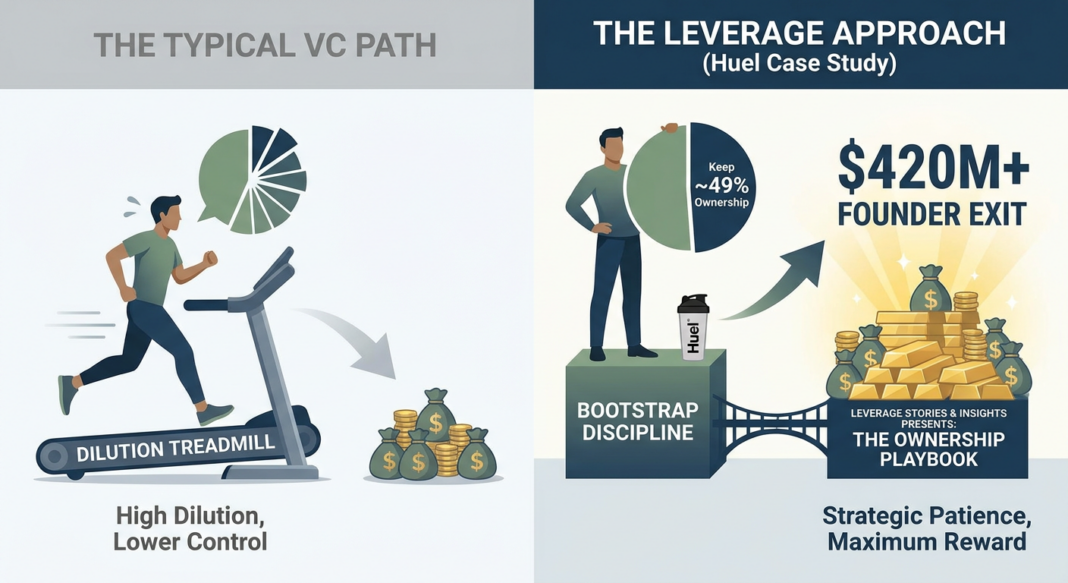
The Story: From Digging Holes to £420 Million, Without Giving the Company Away
Julian Hearn left school at sixteen. He worked retail. He spent two years digging holes in roads. By the time he founded Huel, the complete nutrition brand that would eventually sell to Danone for €1 billion, he had no venture capital contacts, no Silicon Valley network, and no interest in the standard VC dilution treadmill.
What he had was patience, unit economics discipline, and an instinct that would prove far more valuable than a warm intro to a Sand Hill Road partner: he understood that raising money too early, at too low a valuation, from investors with misaligned incentives, is not a fundraising win. It is a slow-motion transfer of wealth from founder to fund.
So he waited. He bootstrapped Huel from zero to £18 million in revenue before raising a single pound of outside capital. When he finally did raise, a Series A at a valuation of roughly £100 million, he was negotiating from a position of strength, not desperation. He raised only what the business needed, at each stage, and no more. By the time Danone wrote the cheque in 2026, Julian Hearn still owned 49.3% of the company he had built. His personal proceeds: approximately £420 million, according to analysis of Companies House filings and deal waterfall disclosures covered by creatorsblueprint.co.
For context: most DTC founders who raise $184 million across three rounds arrive at exit owning somewhere between 15% and 25% of their company. Hearn owned nearly half of his.
The Decision: What the Dilution Treadmill Actually Costs
The canonical VC playbook works like this: raise a seed at a low valuation, a Series A that dilutes you 20–25%, a Series B that dilutes you again, a Series C, and so on, with every round resetting the clock on investor return expectations and shrinking the founder’s eventual take-home. By the time a $184 million raise is complete under standard VC terms, a founder who started at 80% ownership can easily find themselves below 20%. A €1 billion exit nets them €180 million, not €490 million.
Julian Hearn ran a different calculation. By bootstrapping to £18 million in revenue first, he arrived at his Series A with genuine leverage. His valuation, roughly five to six times revenue, reflected a real, scaling business, not a pitch deck. The dilution from that first institutional round was proportionally smaller because the denominator (the company’s value) was already large. Each subsequent round followed the same logic: raise at an inflection point, when metrics justify a premium valuation, and raise only what is operationally necessary. Do not raise because the market is hot or because a term sheet feels validating.
This is not just founder mythology. It is a capital structure decision with a calculable outcome. Across $184 million raised, Hearn still held 49.3% at exit, a retention rate that the analysis in creatorsblueprint.co attributes directly to the sequencing and sizing discipline of each raise, not luck.
The broader market is now validating this thinking at scale. As humcapital.com reports, late-stage venture debt deals hit a decade high in Q1 2026, with the average deal climbing to $68.2 million, a signal that sophisticated operators across every size cohort are actively choosing non-dilutive paths over reflexive equity issuance. SpaceX’s debt load grew from $14 billion to $23 billion in a single year. OpenAI took on $4 billion in debt alongside its equity rounds. These are not distressed companies. They are companies that understand the true cost of equity.
The Outcome: What the Numbers Actually Say
The Danone acquisition valued Huel at €1 billion, a premium multiple of 17 to 20 times EBITDA, according to deal coverage. That premium was not paid for revenue growth alone (Huel’s top-line growth had actually decelerated to 17% by exit). It was paid for margin quality, operating durability, and a business model that had been deliberately built rather than venture-scaled. Gross margins had expanded from approximately 55% in 2022 to 59% by 2024, driven by a vertical integration strategy that included proprietary manufacturing capacity. Contribution margins improved by 800 basis points over the same period.
Now consider the counterfactual. A DTC founder who raised the same $184 million under standard VC terms (seed, Series A, B, and C with typical dilution at each stage) would likely have arrived at the same €1 billion exit owning 20% or less. At 20% ownership, personal proceeds are approximately £200 million. The delta between Julian Hearn’s outcome and the median VC-diluted founder outcome, on an identical exit valuation, is roughly £220 million. That is the computable cost of reflexive equity issuance.
The non-dilutive parallel is playing out elsewhere in the market right now. Telemedicine company Musely recently secured more than $360 million in non-dilutive capital from General Catalyst’s Customer Value Fund, structured around measurable customer lifetime value rather than equity ownership, allowing the company to scale customer acquisition aggressively without surrendering board seats or cap table percentage, as reported by startupfortune.com. The mechanics differ from Huel’s path, but the underlying logic is identical: if the business has predictable, durable economics, there is capital available that does not require you to hand over ownership.
The Lessons: A Framework for Founders Facing the Same Decision
The Huel story is not an argument against raising equity. It is an argument for raising equity intentionally: at the right stage, in the right amount, from partners whose incentives align with the business being built, not the fund return being manufactured. Here is the framework that emerges from Hearn’s approach and the broader market data:
1. Bootstrap to the First Genuine Inflection Point
The longer a founder can scale on internally generated revenue before engaging outside capital, the higher the entry valuation on their first raise, and the less dilution they absorb per dollar raised. This is not a luxury reserved for capital-light businesses. Huel sold physical product. The discipline is available to any operator willing to prioritise unit economics over growth rate optics early in the company’s life.
2. Match Capital Type to Capital Use
Not every dollar of growth spend requires equity. As humcapital.com frames it: inventory is an asset-based lending use case. Predictable recurring revenue is a cash flow facility use case. Customer acquisition with measurable cohort economics is a revenue-linked financing use case, exactly the structure Musely deployed at $360 million scale. The mistake most founders make is defaulting to equity for every capital need because it is the only structure they have been taught to pursue. Matching capital type to capital use is what separates sophisticated operators from serial diluters.
3. Raise at Inflection Points, Not at Market Peaks
Each of Huel’s raises followed demonstrable business milestones, not fundraising calendar logic. This means the valuation at each round reflected genuine operational progress, compressing dilution and improving negotiating leverage. The inverse (raising because the market is receptive or because a fund is actively deploying) is how founders end up with terms that look like wins in a press release and losses on a cap table.
4. Vertical Integration Compounds Valuation
Danone paid a premium multiple not because Huel was the fastest-growing DTC brand in its category, but because Huel had built structural margin advantages that were difficult to replicate. The manufacturing capabilities Hearn built internally converted contract costs into owned infrastructure and gross margin. The strategic acquirer valued the moat, not the growth rate. For founders thinking about exit valuation, margin quality and operational defensibility often matter more than top-line velocity, particularly in a market where growth-at-any-cost narratives are met with scepticism from strategic buyers and public markets alike.
5. Explore Non-Dilutive Options Before You Need Them
The companies getting the best debt and structured credit terms in 2026 are the ones that built lender relationships before they were under runway pressure. As humcapital.com notes, the private credit market is at historically peak deployment capacity, hundreds of billions in dry powder are actively competing for quality deals at every revenue tier from $5 million to $500 million. Founders who map their non-dilutive options early are negotiating from strength. Those who discover them under duress are not.
Key Insights
- Bootstrap valuation creates raise leverage: Julian Hearn’s decision to reach £18M in revenue before raising meant his first institutional round valued a real business, compressing dilution on every subsequent raise and preserving 49% ownership at a €1B exit.
- The dilution delta is calculable and enormous: On an identical €1B exit, the difference between Hearn’s 49% ownership and a median VC-diluted founder’s 20% ownership is approximately £220M in personal proceeds, the measurable cost of reflexive equity issuance.
- Non-dilutive capital is scaling fast and becoming mainstream: Venture debt hit a decade high in Q1 2026 with average deal sizes reaching $68.2M; Musely raised $360M non-dilutively against customer lifetime value, signalling that structured credit is now a first-order option for growth-stage companies.
- Margin quality commands premium multiples at exit: Danone paid 17–20x EBITDA for Huel despite decelerating revenue growth, because vertical integration and expanding contribution margins told a more compelling story than top-line velocity alone.
- Capital strategy is company strategy: The founders who compound the most value are those who treat every capital decision as an operating decision: asking not just “can we raise this?” but “what is the cheapest, most aligned form of capital for this specific use, at this specific stage?”


