
The Story: A Kitchen Table, a Powder, and a Different Kind of Leverage
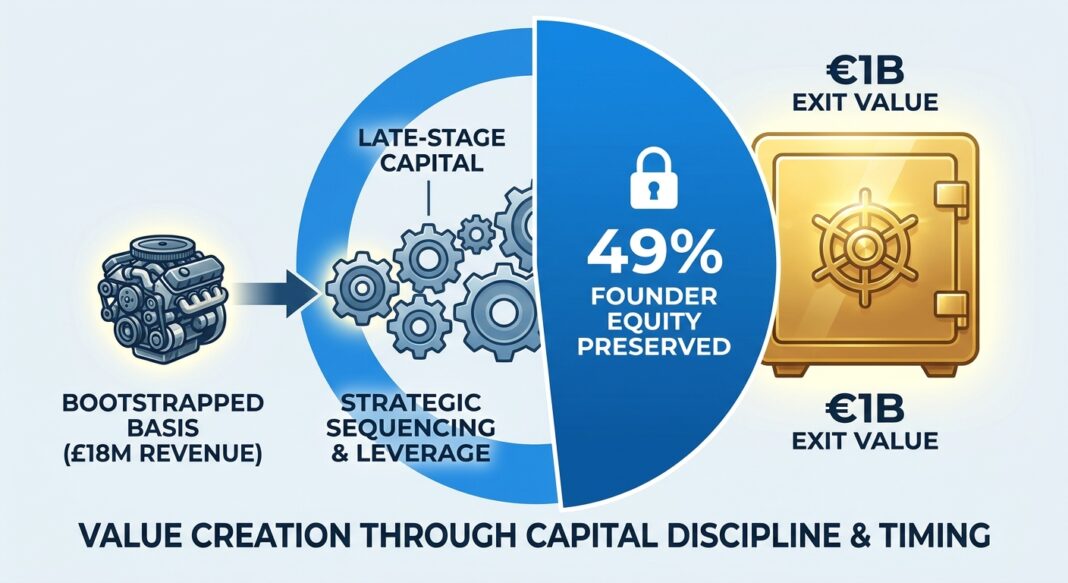
In 2026, Danone paid €1 billion for Huel, a UK-based complete nutrition brand that began life mixing powdered food in a Northamptonshire kitchen. When the proceeds were distributed, founder Julian Hearn walked away with £420 million personally. That represented 49.3% of the exit, an almost unthinkable ownership stake for a founder who had raised $184 million across three institutional funding rounds.
For context: most DTC founders who raise a comparable amount across seed, Series A, Series B, and growth rounds end up owning somewhere between 15% and 25% at exit. Hearn owned nearly half. The difference wasn’t luck, a better product, or a friendlier investor. It was sequencing, and a disciplined understanding of what leverage actually means before you ever walk into a term sheet negotiation.
Hearn bootstrapped Huel to £18 million in annual revenue before approaching institutional capital. He built on low startup costs: contract manufacturing, performance marketing, and a DTC model that generated positive unit economics from the very first subscription bag shipped. He reinvested profits. He didn’t take an outsized salary. And when VCs finally came to the table, they weren’t funding a hypothesis. They were buying into a proven machine. That distinction changed everything.
The Decision: What Happens When You Raise From Strength, Not Desperation
Most founders raise capital the moment they need it, which is also the moment they have the least negotiating power. They show up to Series A with £2 million in revenue, a deck full of projections, and a burning rate that gives them six months of runway. Investors know this. The terms reflect it.
Hearn inverted the sequence. By waiting until £18 million in revenue, he negotiated from a position of demonstrated performance rather than projected potential. His Series A was reportedly priced at a valuation of approximately £100 million: roughly 5–6x trailing revenue. A founder raising Series A with zero revenue on the same amount of capital might be valued at £8–10 million. The math is stark:
- Zero-revenue Series A (£26M on £10M pre): ~72% dilution
- Huel’s Series A (£26M on £100M pre): ~20% dilution
That single decision, to delay institutional capital until the business could speak for itself, compressed dilution across every subsequent round. Hearn raised what he needed, not what the market was willing to offer. He structured rounds that preserved his controlling stake through each dilution event, even as he brought in institutional partners including Piper Serica and others who backed subsequent growth phases. According to public analysis of Companies House filings and cap table waterfall modeling, Hearn’s ownership held at 49.3% at the point of Danone’s acquisition, a figure that has been widely reported and analyzed in the context of the deal, as covered by creatorsblueprint.co and bondtv.vaultai.ca.
The lesson embedded in this decision isn’t ideological. Hearn didn’t avoid venture capital; he used it. The lesson is about when you use it and how much you take. Capital raised late and selectively is structurally different from capital raised early and gratefully. One is a tool. The other is a dependency.
The Outcome: What 49% of €1B Actually Means, and What It Cost to Get There
Danone’s acquisition of Huel wasn’t just notable for its headline figure. It was notable for its multiple. Public reporting indicates Danone paid approximately 17–20× EBITDA for Huel despite the brand’s revenue growth having moderated to approximately 17% in the period preceding the deal: a level that, for most mature DTC businesses, would compress exit multiples significantly.
The premium Danone paid is directly attributable to what Hearn built during the bootstrapping years: unit economics that most VC-backed DTC brands never achieve because they spend their way to scale before proving their model works at the individual customer level. Huel’s customer acquisition cost, repeat purchase behaviour, and gross margin profile were built under capital constraints that forced efficiency, and that efficiency showed up in the EBITDA quality Danone was willing to pay for.
The counterfactual is equally instructive. Had Hearn raised Series A at zero revenue, as most founders do, his ownership at exit would likely have fallen to the 15–25% range typical of DTC founders who raise comparable amounts. On a €1B exit, that difference in ownership translates to a personal outcome of £150–250M versus £420M. The delta (somewhere between £170M and £270M) is the compounded cost of early dilution. It doesn’t appear on any term sheet. It is the invisible tax that most founders never calculate because they’re too focused on the round in front of them to model the exit behind it.
Hearn’s institutional investors also generated strong returns, as noted by bondtv.vaultai.ca, underscoring that founder equity preservation and investor returns are not mutually exclusive outcomes when the underlying business has been built with capital discipline.
The Lessons: A Framework for Founders Facing the Same Crossroads
Huel’s outcome is not replicable in every industry. A biotech founder cannot bootstrap to £18M revenue before raising institutional capital. A semiconductor startup cannot self-fund a fab. But for a meaningful category of founders (those in DTC, services, SaaS, and professional markets) the sequencing strategy Hearn used is available and consistently underutilised. The pattern extends beyond traditional equity. As inthemoneyhq.com has documented, capital structure itself is increasingly a competitive advantage: how you finance the business is as important as what the business does.
The framework that emerges from Hearn’s story has four operating principles:
- Bootstrap until the business can speak in numbers, not projections. The longer you wait, the higher your pre-money valuation and the lower your dilution per dollar raised. Every month of profitable operation before a raise is a negotiating asset.
- Raise what you need, not what you can get. VC incentives favour large rounds because larger deployments generate larger absolute returns at the same percentage carry. Founders should model what capital is actually required to reach the next value inflection, then raise that amount and no more.
- Preserve control as a strategic asset. Governance rights, board composition, and ownership percentage are not abstract concepts; they determine who decides whether to sell, when to sell, and at what price. Hearn retained control through each round, which meant the €1B decision was his to make.
- Model the exit before you model the round. The question is not what percentage you’re giving up today. The question is what that percentage is worth at exit. Run the waterfall backwards from a realistic exit scenario before signing any term sheet.
For founders considering non-dilutive alternatives, the landscape has continued to expand. General Catalyst’s Customer Value Fund recently deployed $360 million into Musely through a revenue-share structure that avoids equity dilution entirely, a model that Musely’s co-founder and CEO Jack Jia described to TechCrunch as one he “mathematically modeled” and found “absolutely compelling” after consistently turning down traditional VCs who would have reduced his ownership, as reported by lazytechtalk.com. Leveraged dividend recapitalisations, unitranche credit facilities, and revenue-based financing instruments are all tools that allow profitable founders to extract liquidity or fund growth without surrendering the equity that compounds in their favour every year they continue to operate, as illustrated in the bondtv.vaultai.ca leveraged recap case study.
Hearn’s story is not a case study in avoiding venture capital. It is a case study in controlling the terms of your relationship with capital. The distinction matters, and the difference, as his £420 million personal outcome demonstrates, is not marginal.
Key Insights
- Timing is the most undervalued variable in dilution math. Raising Series A at £18M revenue instead of £0 reduced Hearn’s dilution from ~72% to ~20% on the same capital amount, a difference that compounded through every subsequent round.
- The invisible tax of early dilution doesn’t appear on a term sheet. On Huel’s €1B exit, raising early at conventional terms would have cost Hearn an estimated £170M–£270M in personal proceeds, a number almost no founder calculates before signing.
- Capital discipline during bootstrapping builds the unit economics that command premium exit multiples. Danone paid 17–20× EBITDA, a premium directly attributable to the operational efficiency Huel was forced to build without VC subsidy.
- Founder returns and investor returns are not zero-sum. Hearn’s institutional backers generated strong returns alongside his £420M personal exit, demonstrating that equity preservation for founders does not require poor outcomes for the capital that supported them.
- Non-dilutive and selective-dilution tools are expanding. From revenue-share agreements (General Catalyst’s CVF) to leveraged dividend recaps via private credit, profitable founders now have more instruments than ever to access liquidity or fund growth without the compounding cost of early-stage equity dilution.


