
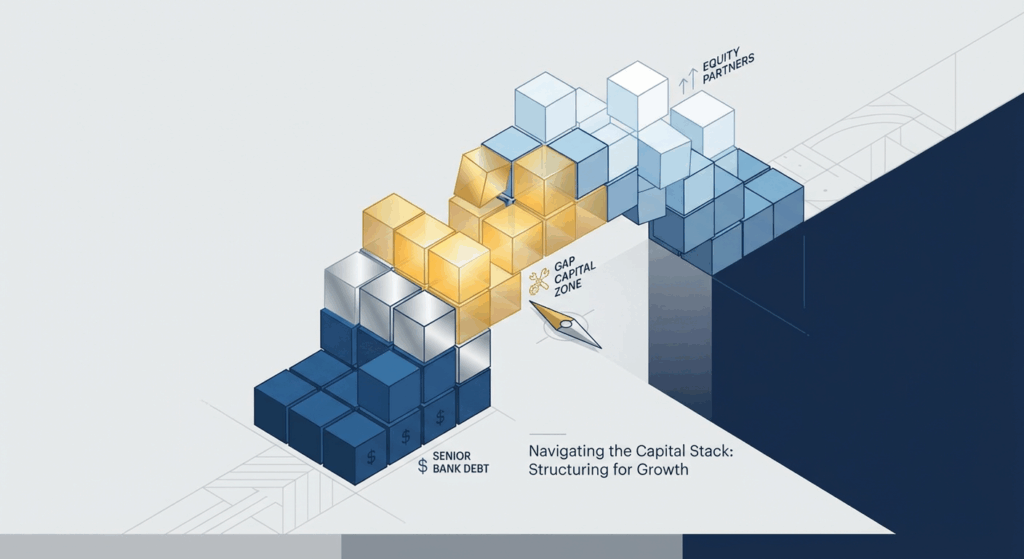
The Growth-Stage Financing Gap: Where Most Capital Strategies Break Down
A business generating $8M in EBITDA with a proven product, a growing customer base, and a pipeline of acquisition targets should not struggle to find capital. And yet this is precisely the stage where capital strategies most commonly stall. Senior lenders (banks, primarily) will advance against historical cash flow, typically to 3.0x–4.0x EBITDA on a secured basis. Equity sponsors want a controlling position or a valuation that dilutes founders materially. The space between those two options is the gap capital zone: the layer of the stack that requires the most structural sophistication and the clearest use-of-proceeds narrative.
Navigating that zone is not about finding the cheapest dollar. It is about finding the right dollar for the specific business need, and understanding what each layer of the capital stack actually costs, demands, and constrains.
Stage-by-Stage Capital Logic: Matching Funding to the Business
Before mapping specific instruments, operators must anchor their capital strategy to the stage of the business and the explicit use of proceeds. These are not interchangeable decisions.
- Seed and early stage: Capital is funding experimentation. Risk is highest, collateral is minimal, and the only appropriate instruments are equity-like: SAFEs, convertible notes, and priced preferred equity from angels or institutional pre-seed funds. As wearepresta.com notes, at pre-seed stage, investors are betting on founders and thesis, not on cash flows, because there are none yet.
- Growth stage ($2M–$15M ARR or EBITDA): The inflection point. Recurring revenue is provable, unit economics are demonstrable, and the use of proceeds shifts from exploration to scaling. This is where the capital stack genuinely opens up, and where sequencing decisions become high-stakes.
- Mature / cash-flow positive: Senior secured bank debt becomes available and is the lowest-cost option. The capital question shifts to leverage optimization, covenant headroom, and whether a recap or acquisition facility is needed alongside the operating revolver.
- Succession and transition: Capital structure must accommodate ownership change: whether management buyout, sponsor recapitalization, or a partial liquidity event. Mezzanine, preferred equity, and seller notes all have defined roles here.
The Cost of Capital Spectrum: From Banks to Equity
Every layer of the capital stack carries a price, and that price is not only expressed in interest rate or return expectation. It includes control provisions, covenant constraints, dilution, and optionality forfeited. Understanding the full spectrum is the foundation of any deal structure decision.
| Layer | Typical Cost (All-In) | Key Constraint | Best For |
|---|---|---|---|
| Senior Bank / ABL | 7%–10% (floating) | Maintenance covenants, collateral coverage | Working capital, capex, predictable cash flows |
| Unitranche / Direct Lending | 10%–13% (fixed or floating) | Higher leverage limits, single lender concentration | Acquisitions, sponsor-backed buyouts, speed of execution |
| Mezzanine / Sub Debt | 13%–18% (cash + PIK) | Equity kicker / warrant coverage, subordination | Bridging valuation gaps, funding acquisitions without full equity dilution |
| Preferred Equity | 15%–22% (cumulative dividend or accrual) | Liquidation preference, participation rights | Growth capital where debt serviceability is uncertain |
| Common / Venture Equity | 25%+ IRR expectation | Control, board seats, exit timeline | Early risk capital, transformational growth, pre-revenue stages |
As lendity.com observes, many founders continue reaching for equity capital long after their business has achieved the revenue predictability that would support cheaper debt instruments, forfeiting ownership at exactly the moment when it is most valuable.
Structuring Gap Capital: The Access vs. Cost Trade-Off
Gap capital (the tranche that sits between what a senior lender will advance and what an equity investor would cost) is typically structured as one of three instruments, depending on the specific use of proceeds:
1. Unitranche Facility
A single blended-rate facility that combines senior and subordinated economics into one instrument and one lender relationship. For a $50M acquisition by a $100M enterprise value software business, a unitranche at 11.5%–12.5% all-in eliminates inter-creditor complexity and accelerates execution. The trade-off: the blended rate is higher than pure senior debt, and the covenant package, while typically incurrence-based rather than maintenance-tested, still carries meaningful restrictions on additional indebtedness, distributions, and disposals.
2. Mezzanine with PIK Toggle
Where cash interest serviceability is a constraint, common in acquisition financing where the acquired asset’s EBITDA must cover the debt service, a PIK toggle allows the borrower to elect to accrue interest rather than pay it in cash during the integration period. Lenders will typically require warrant coverage of 2%–5% of fully diluted equity as an equity kicker alongside the PIK feature, reflecting the additional risk of non-cash interest accrual.
3. Preferred Equity
Where leverage capacity is fully utilized but the business needs growth capital, preferred equity sits above common equity in the liquidation waterfall but below all debt. It carries a cumulative preferred return, often 12%–16%, and may include participation rights or a conversion feature. Critically, preferred equity does not require cash debt service, making it appropriate where near-term free cash flow is being reinvested in growth rather than returned to capital providers.
As alvren.com frames it, intelligent capital stack sequencing means taking cheaper, lighter instruments first and reserving more restrictive or dilutive capital for later, using each raise as runway to proof, not as a standalone funding event.
The Gap Capital Playbook: Four Steps from Quantification to Close
Step 1: Quantify the Gap Precisely
Define the total funding need with specificity: what is the acquisition price, integration cost, or growth investment? What does senior debt provide at the maximum leverage the business can support? The arithmetic difference, net of any equity contribution, is the gap. Lenders and mezzanine providers will immediately test whether the borrower has done this math rigorously. Vague funding needs produce vague (or no) term sheets.
Step 2: Build the Diligence Package Around Use of Proceeds
Gap capital providers are underwriting purpose, not just creditworthiness. The information memorandum must answer: Where is the money going? What does the business look like post-deployment? What is the path to repayment or refinancing? Key materials include a trailing 24-month EBITDA bridge, a pro forma leverage and coverage model, and a clear account of how the investment generates the return that services the capital. As alvren.com notes, clean cap table documentation, revenue recognition memos, and a covenant headroom analysis are minimum requirements for any credible process.
Step 3: Run a Parallel Process Across the Stack
Do not approach gap capital providers sequentially. Run a simultaneous process across unitranche funds, mezzanine providers, and preferred equity investors, then use competing term sheets to establish market terms. The leverage from a competing offer is real; without it, the borrower is negotiating blind. Target a minimum of three to five credible counterparties across instrument types.
Step 4: Negotiate Structure Before Pricing
The most consequential deal points in gap capital are not the interest rate or preferred return; they are the structural terms: covenant definition, equity kicker size, PIK toggle triggers, prepayment penalties, and change-of-control provisions. Experienced borrowers negotiate structural flexibility first, then allow pricing to reflect the agreed structure. Accepting a tight covenant package in exchange for a 50-basis-point pricing reduction is typically a poor trade; covenant breaches create leverage events regardless of the nominal rate.
Key Takeaways
- Stage and use of proceeds determine instrument type. Gap capital is not a single product; it is a zone of the stack defined by the specific funding purpose and the business’s capacity to service different risk profiles.
- The cost of capital is multi-dimensional. Interest rate and preferred return are only two dimensions; covenants, control, dilution, and optionality forfeited are equally material to the total cost.
- Unitranche is a speed and simplicity trade-off. It eliminates inter-creditor complexity at the price of a blended rate above pure senior debt, best suited to acquisitions where execution speed is a competitive requirement.
- PIK and equity kickers are linked variables. When a borrower accepts PIK interest to preserve near-term cash flow, the lender will price the deferred risk through warrant coverage or an equity participation; this is structural logic, not negotiating aggression.
- Run a parallel process and negotiate structure before price. Competing term sheets establish market terms; structural flexibility (particularly on covenants and prepayment) compounds in value over the life of the facility in ways that a basis point on the coupon never will.


