
The Corridor Nobody Draws on the Whiteboard
A founder reaches $3M in annual recurring revenue. The bank will extend a revolving credit facility against receivables, maybe $500K if the covenant package is clean. A Series A venture fund wants to see $8–10M ARR before writing a check. A private equity sponsor wants EBITDA margins that don’t yet exist. And the company needs $4M right now to hire a sales team, fund inventory, and close an adjacent tuck-in acquisition.
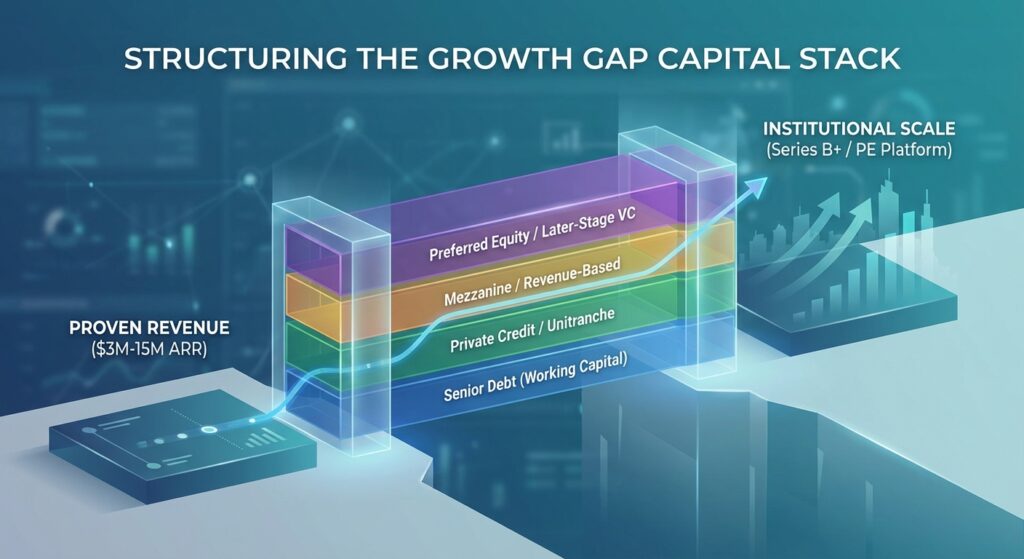
This is the gap, and it is the most structurally consequential moment in a company’s financing life. Founders who navigate it well preserve equity, retain governance, and compress their cost of capital over time. Those who reach for the nearest capital without mapping the full stack first routinely give away 25–30% of enterprise value to solve a problem that a well-structured credit facility could have solved for 12–15% all-in yield.
This article maps the capital stack for growth-stage businesses, links each layer to its proper use-of-proceeds, and walks through a tactical playbook for quantifying the gap, preparing the process, and negotiating the structure.
Stage Context: Why the Growth Corridor Is Structurally Distinct
Capital strategy should always begin with stage clarity. As frameworks from capitalxo.com and swingbridgellc.com illustrate, the capital stack is ordered by seniority, and seniority determines both cost and control. Senior lenders carry the lowest risk and therefore offer the cheapest capital. Equity investors, sitting at the bottom of the priority waterfall, absorb the most risk and demand the highest return.
The growth stage (roughly $2–15M in revenue, positive gross margins, and early but not yet institutional-grade unit economics) sits between two clean financing worlds. It has too much operating history to justify purely speculative seed equity, but too little cash flow predictability to satisfy conventional senior lenders. That structural ambiguity is why growth-stage capital often comes with hybrid features: interest plus equity participation, cash pay plus PIK toggle, or revenue-correlated repayment schedules.
Understanding this context is the prerequisite to building any term sheet.
Mapping the Cost of Capital Spectrum to Use-of-Proceeds
Not all capital needs are equal, and the use-of-proceeds should drive the instrument selection before any lender conversation begins. Here is how the spectrum maps at the growth stage:
1. Senior Bank Debt: Working Capital & Asset Coverage
Cost range: Prime + 1–3%, or SOFR + 150–300bps
Best for: Revolving working capital, accounts receivable lines, equipment financing
Structural constraint: Requires hard collateral or strong covenant visibility. Maintenance covenants (leverage, coverage ratios tested quarterly) are standard. Incurrence-based packages are rare at this tier.
If the use-of-proceeds is purely working capital (bridging receivables, funding seasonal inventory) a senior bank revolver is almost always the right first call. It is the cheapest capital available. The discipline of maintaining bank covenants also forces financial hygiene that improves the company’s readiness for the next layer.
2. Private Credit / Unitranche: Acquisition Finance & Growth Investment
Cost range: SOFR + 500–700bps (all-in 10–13% as of Q1 2026)
Best for: Tuck-in acquisitions, platform growth investment, sponsor-backed recapitalizations
Structural features: Single-lender unitranche collapses the traditional senior/mezz split into one instrument. This simplifies the intercreditor arrangement and accelerates execution. Covenant packages at this tier tend toward incurrence-based tests rather than quarterly maintenance triggers, giving borrowers more operating flexibility.
As the capital stack framework at capitalxo.com notes, mezzanine and subordinated debt layers exist precisely because some businesses need more capital than senior lenders will provide against existing collateral, but don’t yet warrant full equity dilution.
3. Mezzanine / Subordinated Debt: Recapitalization & Transition Finance
Cost range: 13–18% blended (cash pay + PIK + equity kicker)
Best for: Owner liquidity events, management buyouts, bridge-to-exit capital
Structural features: PIK (payment-in-kind) toggle allows interest to accrue to principal during a cash-preservation window. Equity kickers, typically warrants covering 2–5% of fully diluted equity, compensate the lender for subordinated risk. These features make mezzanine capital flexible but expensive; it should only be drawn when the return on invested capital clearly exceeds the blended cost.
4. Revenue-Based Finance & Growth Loans: SaaS & Recurring Revenue Models
Cost range: Effective 15–25% annualized
Best for: Hiring sales and marketing, funding customer acquisition ahead of contracted revenue
Structural features: Repayment is tied to a percentage of monthly revenue rather than a fixed schedule. As documented at angelinvestorsnetwork.com, these instruments carry no equity dilution and no board governance changes, a meaningful preservation of founder control during the critical pre-institutional phase.
5. Preferred Equity: Strategic Inflection Points
Cost range: 20–30%+ IRR expected by investors
Best for: Transformational growth rounds where the capital need exceeds what any debt instrument can responsibly cover
Structural constraint: As lendity.com illustrates, a founder who raises $5M at a $15M pre-money valuation surrenders 25% of the company, potentially $12.5M+ in exit proceeds at a $50M outcome. Preferred equity is not wrong; it is simply the most expensive capital on the stack and should only be deployed when the strategic return justifies the dilution.
The Gap Capital Playbook: Four Steps
Step 1: Quantify the Gap with Precision
Before approaching any capital provider, build a 24-month cash flow model that isolates three figures: (a) the minimum liquidity floor required to maintain operations, (b) the capital required to fund the specific growth initiative, and (c) the maximum debt service the business can support at current and projected EBITDA. The difference between (b) and what existing senior capacity can provide is the structural gap. This number, rigorously documented, is the foundation of every term sheet conversation that follows.
Step 2: Prepare the Materials Package
Growth-stage capital processes require a tighter materials package than most founders expect. Lenders and structured equity investors at this tier want: three years of historical financials (audited if possible), a 13-week cash flow model, a detailed use-of-proceeds schedule, a customer cohort analysis showing retention and expansion revenue, and a management presentation that maps capital deployment to specific revenue outcomes. The cleaner the materials, the more competitive tension you can create in the process.
Step 3: Run a Parallel Process Across Tiers
Do not approach capital providers sequentially. Run a parallel outreach to senior lenders, private credit funds, and structured equity investors simultaneously. This creates pricing tension and gives you real-time market intelligence on which tier is actually accessible for your credit profile. The goal is not just to secure capital; it is to understand where the market prices your risk so you can optimize the structure.
Step 4: Negotiate the Structure, Not Just the Rate
Rate is only one dimension of a term sheet. The variables that matter more over the life of a deal are covenant package design (maintenance vs. incurrence), call protection periods, PIK optionality, equity kicker sizing, and prepayment flexibility. At the growth stage, incurrence-based covenants are worth paying a modest rate premium for; they allow the business to invest, pivot, and grow without triggering technical defaults. Equity kickers should always be negotiated as warrants (with a fixed strike price) rather than equity grants, preserving the founder’s ability to buy back participation if performance accelerates.
Key Takeaways
- Use-of-proceeds drives instrument selection. Working capital belongs in a senior revolver. Acquisition finance belongs in unitranche or private credit. Transition and recap capital belongs in mezzanine. Matching the instrument to the purpose is the first discipline of capital stack architecture.
- The growth corridor demands hybrid thinking. Between bank debt and institutional equity lies a rich set of instruments (unitranche, mezzanine, revenue-based finance, preferred equity) each with distinct cost, control, and flexibility trade-offs that must be evaluated as a system, not in isolation.
- Equity is the most expensive capital on the stack. At a $50M exit, 25% equity dilution costs $12.5M. A well-structured growth credit facility at 14% all-in for three years costs a fraction of that. Founders who treat equity as the default growth instrument systematically underprice their own capital.
- Covenant design is a negotiation priority, not an afterthought. Incurrence-based packages preserve operational flexibility and are worth a modest rate premium at the growth stage. Maintenance covenants can become operational constraints during the exact inflection points when flexibility matters most.
- Parallel process execution is non-negotiable. A sequential capital raise produces the terms one provider is willing to offer. A parallel process produces competitive pricing, structural optionality, and a clear picture of where the market actually prices your credit, which is the only basis for a genuinely informed decision.


