
The Growth-Stage Capital Problem Nobody Talks About Cleanly
A company generating $4M in annual recurring revenue has cleared the hardest hurdle in business: product-market fit. Unit economics work. Churn is manageable. The pipeline is real. What comes next (scaling the sales team, opening a second geography, funding a tuck-in acquisition) requires capital. But the amount required ($2M to $8M, typically) sits in an uncomfortable dead zone.
It is too large and too operationally complex for a clean bank revolving credit facility, which requires collateral, profitability, and a borrowing base the company may not yet support. It is too small (and too near-term in its return horizon) for institutional venture capital, which is optimizing for a unicorn outcome, not a $40M exit in four years. And raising a full Series A for $3M of working capital needs signals to institutional investors that the company lacks conviction about its own trajectory.
This is the gap. And the capital stack exists precisely to fill it, if you know how to read it.
Mapping Use-of-Proceeds to the Capital Stack
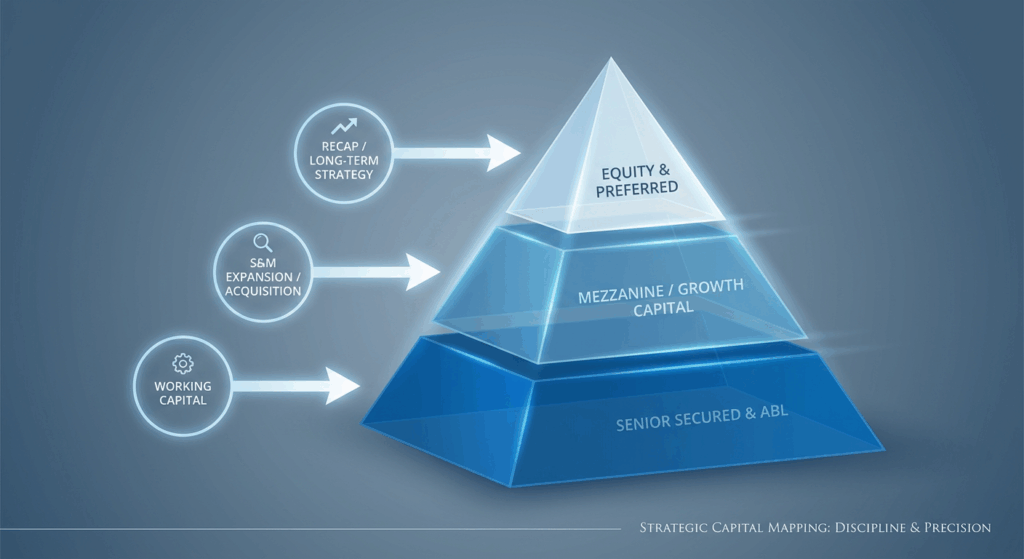
The first discipline of gap capital is precision in use-of-proceeds. The instrument you choose should be determined by what the money does, not by what is easiest to raise. The capital stack, as described by corporatefinanceinstitute.com, is a hierarchy of financing sources structured by repayment priority and risk-return profile. At its simplest, it runs from senior secured debt (lowest cost, highest collateral requirement) through subordinated or mezzanine debt (moderate cost, hybrid features) to preferred and common equity (highest cost in dilution terms, no repayment obligation).
Use-of-proceeds maps onto that stack as follows:
- Working capital and receivables financing → Senior revolving credit, asset-based lending (ABL). Collateral-backed, self-liquidating, lowest cost.
- Sales team expansion, marketing spend, and go-to-market investment → Revenue-based financing or growth loans. Non-dilutive, repayment tied to revenue performance, 30–90 day approval cycles, as highlighted by angelinvestorsnetwork.com.
- Tuck-in acquisitions or platform build-outs → Unitranche or senior stretch facilities, potentially with a mezzanine tranche for the purchase price gap.
- Recapitalizations, founder liquidity, or equity buyouts → Preferred equity, structured subordinated debt with PIK optionality, or a combination.
- Bridge to a defined liquidity event → Convertible notes or venture debt with warrant coverage.
Conflating these purposes is where deals go wrong. Financing a recurring sales headcount build-up with a term loan that requires quarterly principal amortization creates a cash flow cliff. Financing a one-time acquisition with equity at a depressed valuation permanently impairs founder economics. Matching the instrument to the purpose is not a stylistic preference; it is a structural discipline.
The Cost of Capital Spectrum: Access vs. Price Trade-Offs
Every layer of the stack has a cost, but that cost is not always expressed in interest rate terms. As noted by lendity.com, early equity at a $5M valuation is not cheap money; it is the most expensive money on a per-dollar-of-exit-value basis, even when it carries no coupon. The cost spectrum should be understood across four dimensions:
- Cash cost: The all-in interest rate or yield, including fees, OID (original issue discount), and any PIK (payment-in-kind) component that accretes to principal.
- Dilution cost: Equity given up through warrants, equity kickers, or direct share issuance. Venture debt instruments, for example, typically carry warrant coverage of 5–20% of the facility amount, exercisable at a strike price reflecting the most recent valuation round.
- Control cost: Board seats, information rights, protective provisions, and consent rights that constrain operational decision-making.
- Covenant cost: Maintenance covenants (tested quarterly, regardless of events) impose an ongoing operational constraint. Incurrence covenants only trigger on specific actions, a materially more flexible structure that borrowers should seek whenever leverage permits.
A senior bank facility at SOFR + 250bps with a tight maintenance covenant on fixed charge coverage may carry a lower cash cost than a unitranche at SOFR + 600bps, but the operational constraint embedded in the covenant package may cost far more in strategic optionality over a 36-month hold period.
The Gap Capital Playbook: Quantify, Prepare, Process, Negotiate
Step 1: Quantify the Gap with Precision
Begin with a 24-month integrated cash flow model. Identify the month in which existing liquidity is insufficient to fund the stated growth plan; that deficit, stress-tested at 80% of projected revenue, is your gap. Size the capital need to fund through to a defined milestone (next financing, profitability, or exit), not to the nearest round number. Oversizing creates leverage pressure; undersizing creates a re-financing risk within the same capital structure.
Step 2: Prepare the Financing Package
Lenders and structured capital providers across the growth stage are evaluating the same core variables: revenue quality (ARR vs. non-recurring), gross margin profile, customer concentration, net revenue retention, and the plausibility of the growth plan. Prepare a three-statement financial model, a customer cohort analysis, and a clear use-of-proceeds schedule that ties the capital ask to specific, time-bound milestones. The wearepresta.com framework notes that the 2026 capital environment has shifted decisively toward unit economics and sustainable scalability, any financing package that cannot demonstrate both will face structural pricing penalty.
Step 3: Run a Parallel Process
Do not sequence the process linearly. Approach senior bank lenders, private credit / direct lending funds, revenue-based finance providers, and mezzanine or structured equity providers simultaneously. The goal is not necessarily to close with the cheapest provider; it is to generate a credible competitive dynamic that forces each party to sharpen terms. A term sheet from a direct lender is leverage in a conversation with a bank. A bank’s conditional interest is leverage with a mezzanine fund that wants to price at a significant premium.
Step 4: Negotiate the Structure, Not Just the Rate
The most consequential negotiation points at the growth stage are rarely the headline coupon. They are:
- Covenant type and headroom: Push for incurrence-only covenant packages wherever possible. Where maintenance covenants are unavoidable, negotiate 20–30% headroom above the base case and a clear cure mechanism.
- PIK optionality: For mezzanine tranches, PIK toggle provisions allow the borrower to elect to accrue interest rather than pay cash during high-growth periods, preserving liquidity when it matters most.
- Prepayment flexibility: Call protection schedules (non-call 1, then declining premium) are standard in private credit. Push for soft call structures and make-whole provisions that step down quickly; this preserves the ability to refinance if the business performs ahead of plan.
- Warrant coverage and exercise price: In venture debt or mezzanine instruments with equity participation, negotiate the coverage percentage down (target below 10% of facility amount) and lock the exercise price at the most recent equity round, not at a discount to it.
- Information and reporting cadence: Monthly management accounts are often requested, negotiate this to quarterly compliance certificates with monthly flash reporting, reducing the administrative burden without sacrificing transparency.
Key Takeaways
- Use-of-proceeds determines the instrument. Working capital, growth spend, acquisitions, and recaps each sit at a different layer of the capital stack, map them precisely before approaching any capital provider.
- Cost of capital is multidimensional. Cash coupon, dilution, control provisions, and covenant constraints are all forms of cost. Optimize across all four dimensions, not just the headline rate.
- The growth-stage gap is real and structurally defined. It exists between the ceiling of bank credit and the floor of institutional equity, and private credit, revenue-based finance, and mezzanine instruments exist specifically to fill it.
- Parallel process creates structural leverage. Running bank, private credit, and structured equity conversations simultaneously is not aggressive; it is the standard of a well-run financing process and the primary driver of better terms.
- Negotiate the covenant package as hard as the coupon. Incurrence covenants, PIK optionality, and prepayment flexibility determine how much strategic freedom you retain inside the capital structure, and that freedom compounds over the life of the facility.


