
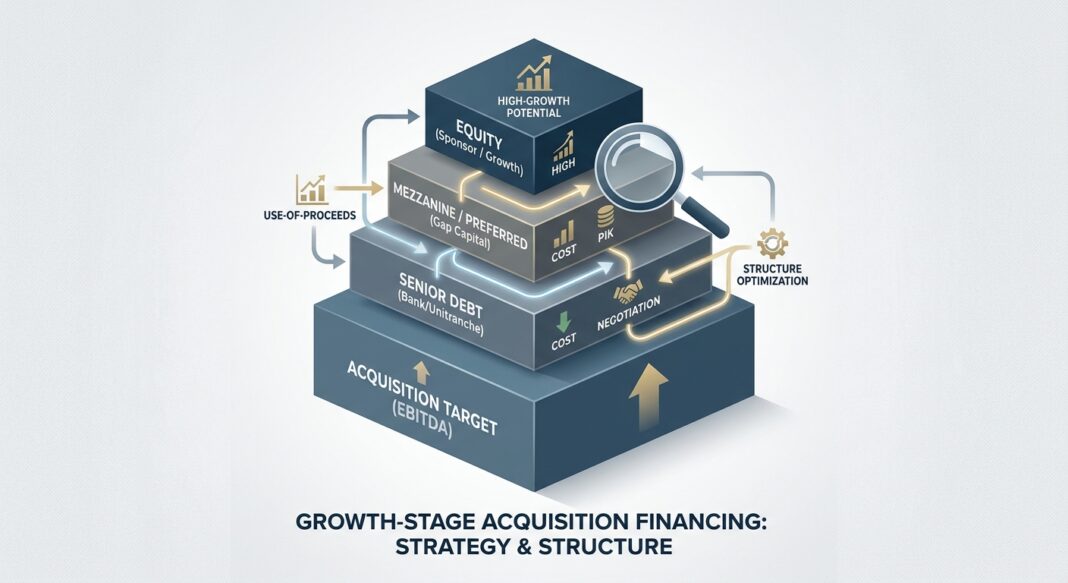
The Capital Challenge: Funding an Acquisition at the Growth Stage
You are running a profitable lower-middle-market business. EBITDA is $8–$12 million. You have identified an acquisition target that would add $5–$7 million in EBITDA, expand your geographic footprint, and meaningfully accelerate an exit timeline. The deal is priced at $50–$60 million enterprise value. Your senior bank has pre-approved $20–$25 million, roughly 3x leverage on the combined entity. The equity you are willing to contribute closes to $20 million. That leaves a gap of $10–$15 million sitting between committed senior debt and available equity.
This is the classic growth-stage acquisition gap: the point at which the capital stack must be deliberately designed, not inherited. The funding choice made here (unitranche, senior-plus-mezzanine, or a hybrid) will determine your all-in cost of capital, your operating flexibility for the next five to seven years, and the percentage of exit proceeds that flow back to equity. Getting this wrong is expensive. Getting it right is a practitioner skill.
This article maps the full cost-of-capital spectrum available to a growth-stage operator pursuing acquisition financing in 2026, walks through the component mechanics of each structural option, and delivers a tactical playbook for quantifying the gap, preparing materials, running the process, and negotiating the final structure.
Mapping the Cost of Capital: From Banks to Equity
Before selecting a structure, operators must understand where each capital source sits on the risk-return spectrum and what that implies for cost and access. The hierarchy is not simply about price; it is about which provider can underwrite your specific risk profile and use-of-proceeds.
- Commercial Banks (Senior Secured): The cheapest capital available. Commercial banks offer the cheapest capital at SOFR plus 275 to 425 basis points but impose the tightest leverage constraints and covenants. For acquisition financing, banks are typically limited to 3–4x leverage on a combined entity and require hard asset coverage or strong deposit relationships. Speed is slower and documentation more rigid. The bank is the foundation of the stack, not the full solution.
- Private Credit / Unitranche (Direct Lending): Private credit has grown into a $1.6 trillion industry and is on pace to surpass $2.5 trillion by 2028. Direct lenders compress senior and subordinated debt into a single instrument. Current spreads in the middle market run approximately SOFR plus 475 to 550 basis points for deals in the $40M–$100M EBITDA range, according to Lincoln International’s Q1 2026 private market data. Unitranche facilities can reach 4–5x leverage in a single facility, filling the gap the bank leaves behind.
- Mezzanine / Subordinated Debt: Subordinated capital that sits below senior debt and above equity in the waterfall. A typical 2026 mezzanine debt financing rate for a healthy $5M to $15M EBITDA lower-middle-market company runs 11% to 14% cash coupon plus 1% to 4% PIK, with warrant coverage of roughly 1% to 5% of fully diluted equity. Mezz fills the gap between what a senior bank will extend and what the sponsor will contribute as equity.
- Preferred Equity: Hybrid instrument carrying dividend-like returns and liquidation preference. More expensive than mezzanine on a true economic basis but structurally useful when senior lenders block a sub-debt layer. Target returns for preferred equity providers typically run 15–20% IRR.
- Common Equity / Growth Equity: The most expensive capital on a dilution-adjusted basis. Mezzanine debt financing usually costs less on an all-in basis than a minority equity check, does not dilute board control, and preserves upside for the owner. Equity should be reserved for the residual gap that debt cannot fill, and sized accordingly.
The practical sequencing rule: maximize senior debt first (cheapest, tax-deductible), layer subordinated capital to close the gap (costlier but preserves equity), and deploy equity last (most expensive on a fully-loaded dilution basis). The goal is not to eliminate debt; it is to use the cheapest available capital for each layer of risk in the stack.
Structure Breakdown: Unitranche vs. Senior-Plus-Mezzanine for a $55M Acquisition
Consider a concrete scenario: a growth-stage technology services company with $10M EBITDA acquiring a complementary business at $55M enterprise value (5.5x EBITDA). The acquirer contributes $20M in sponsor equity. The remaining $35M must be financed. Here is how two primary structures compare on that gap:
Option A: Unitranche (Single-Facility Direct Lending)
A unitranche is a single-tranche term loan that combines what would otherwise be a senior secured loan and a subordinated or mezzanine loan into one instrument. From the borrower’s perspective, there is one loan document, one lender or one lender-led syndicate, one set of covenants, one interest rate, and one prepayment schedule.
- Facility Size: $35M unitranche term loan
- Pricing: Approximately SOFR + 500–550 bps (approximately 9.5–10.5% all-in at a mid-2026 SOFR reference rate of approximately 4.4%)
- Leverage: 3.5x on combined post-acquisition EBITDA ($10M + $7M synergized = $17M EBITDA)
- Term: The resulting instrument has a single interest rate and term, which is often five to seven years.
- Covenants: Unitranche facilities typically include maintenance covenants, which is a meaningful advantage for lenders. Common covenants include a maximum total leverage ratio and a minimum fixed charge coverage ratio.
- Closing Timeline: 45–90 day unitranche close versus 90–150 days for traditional senior plus mezzanine syndication.
- Structural Advantage: There is no intercreditor agreement to negotiate. The entire capital structure below equity collapses into a single instrument.
Option B: Traditional Senior + Mezzanine Split
A classic leveraged structure separates risk explicitly: senior debt carries the lowest risk, lowest pricing, and strictest covenants; mezzanine debt carries higher risk, higher pricing, and looser covenants, often with PIK components or warrants. This structure introduces intercreditor agreements, payment waterfalls, and complexity, but also pricing efficiency.
- Senior Tranche: $22M at SOFR + 375–425 bps (approximately 7.75–8.25% all-in). 5-year term. Springing financial covenant on revolver utilization.
- Mezzanine Tranche: $13M at 11–14% cash coupon + 1–4% PIK + warrant coverage of 2–4% of fully diluted equity. 6–7 year term. Bullet repayment.
- Combined Blended Cost: Approximately 9.0–9.5% on debt service, but true economic cost rises to 14–18% IRR for the mezz provider once warrants are exercised at exit.
- Complexity: Requires a negotiated intercreditor agreement between senior and mezzanine providers. Assembling a senior plus mezzanine structure requires parallel engagement with two lender groups, coordination of diligence workstreams, negotiation of the intercreditor agreement, and synchronisation of two credit committee approvals.
The Trade-Off Decision
The pricing premium of unitranche over a blended senior-plus-mezzanine solution is typically 50–100 basis points: a cost that most sponsors consider worthwhile given the execution simplicity, reduced legal fees, and ongoing administrative efficiency. However, the breakeven analysis shifts at leverage above 6.5x, where the mezzanine component becomes larger and the cost savings of bifurcation become more material.
The practical rule: choose unitranche for simplification and speed; choose the senior-plus-mezzanine split when separate senior and subordinated tranches are structurally optimal for the buyer’s specific capital needs.
Current Market Terms: What the 2026 Data Shows
Operators entering the market in Q3–Q4 2026 should calibrate expectations against the following benchmarks, drawn from named market sources:
- Unitranche All-In Pricing ($5M–$50M facilities): Median all-in coupons on unitranche facilities in the $5M–$50M band are clearing at approximately 10.2% as of June 2026, per S&P LCD.
- Leverage Multiples: Senior bank loans are typically limited to 3–4x leverage, while unitranche facilities can reach 4–5x leverage on a single facility. This additional 1–1.5 turns of leverage access is a primary reason operators migrate from bank-only financing to direct lending for acquisition deals.
- Mezzanine Pricing Trend: GF Data and Lincoln International both reported cash coupons drifting down from 2024 peaks as senior spreads compressed through the first half of 2026. The competitive dynamic is clear: when large private credit shops with $50B-plus platforms fight for allocation on unitranche facilities, mezzanine funds sitting one layer below cannot hold the pricing they held in 2024.
- Market Structure ($50M EV Benchmark): A typical $50M enterprise value platform in 2026 is funded with roughly 40% senior debt, 10% mezzanine, 45% sponsor equity, and 5% seller rollover, per GF Data H1 2026 averages.
- Covenant-Lite Migration: Larger unitranche deals above $200M EV are increasingly closing covenant-lite with no maintenance financial covenant and only incurrence covenants. Covenant-lite was historically reserved for broadly syndicated loans but is now appearing in 30–40% of $200M-plus unitranche deals. Below that threshold, expect at least one maintenance covenant. Anticipate at least one financial maintenance covenant in private credit deals under $50M EBITDA, most commonly a total leverage ratio test with a cushion above closing leverage.
- Private Credit AUM and Dry Powder: Private credit AUM crossed $1.7 trillion USD in H1 2026, with roughly 40% of new deployment targeting the lower middle-market growth segment, per PitchBook’s H1 2026 Private Credit Report. PitchBook tracked global private-credit dry powder at $506 billion at the end of Q1 2026. Abundant capital means borrowers have negotiating leverage, but only if they run a competitive process.
The Gap Capital Playbook: Quantify, Prepare, Run the Process
The gap capital playbook has four phases. Executing all four, not just the first two, is what separates operators who close deals on good terms from those who accept the first term sheet they receive.
Phase 1: Quantify the Need
Before approaching any capital source, produce a precise use-of-proceeds map. The map must answer five questions: (1) What is the total acquisition price, including transaction costs, working capital normalization, and integration reserves? (2) What is the maximum senior debt capacity based on realistic post-acquisition EBITDA and 3–4x leverage? (3) What equity is actually available from the sponsor or owner, not aspirationally, but committed? (4) What is the residual gap between (2) + (3) and (1)? (5) Can that gap be closed by sub-debt alone, or does the capital structure require a mezzanine plus equity hybrid?
Critically, borrowers should negotiate a comprehensive but defensible EBITDA definition upfront. Explicitly include synergy add-backs with a reasonable realization timeline, non-recurring transaction costs, and stock-based compensation. These items can move covenant headroom by 0.5x–1.0x leverage turns, which meaningfully changes the risk profile of the structure at close.
Phase 2: Prepare the Materials
The minimum material package for a private credit or mezzanine process includes: a Quality of Earnings report (QoE) from a recognized third-party firm; a detailed financial model with three-year projections and stress cases; a Confidential Information Memorandum (CIM) presenting the combined company thesis; a proposed capital structure with three scenarios (bank-only, unitranche, senior-plus-mezz); and a management presentation deck. Deals that stall in diligence typically fail on one of five points: EBITDA quality including add-back rejections in QoE that reduce reported EBITDA by 10% to 25%, customer-concentration surprises, working-capital pegs, environmental or IP liabilities, and financing market shifts during the exclusivity period. Front-running these risks in the CIM reduces lender re-trading risk after term sheet.
Phase 3: Run a Competitive Process
Never negotiate with a single lender. A bilateral negotiation with a single fund produces one bid, no leverage, and a term sheet drafted entirely by the buyer’s counsel. A curated process of 20 to 40 capital sources produces competitive tension, multiple term sheets, and negotiating room on price, preference, board composition, and secondary. For unitranche or direct lending processes specifically, if you are acquiring a business between $25M and $200M of enterprise value, there is a 70–80% chance your deal will be financed at least in part by a unitranche facility from a direct lender. Target 8–12 direct lenders simultaneously, require indicative terms within 10 business days, and use competing bids to compress pricing and improve structural terms.
Buyers who compress the middle phases by not running a parallel senior-and-junior process routinely give up 200 to 400 basis points of pricing and 5 to 10 points of equity.
Phase 4: Evaluate and Narrow
Score term sheets across five dimensions: (1) all-in cost including OID, PIK, and warrant coverage; (2) leverage multiple relative to trailing versus pro forma EBITDA; (3) covenant structure (maintenance tests, equity cure rights, headroom cushion; (4) prepayment flexibility) call protection periods and premium schedules; (5) lender relationship quality and track record on amendments. A term sheet with a 25 bps lower spread but a hard call premium of 3% in years one and two may cost significantly more than a higher-priced facility with 12-month soft call only.
Negotiation Guidance: What to Fight For at the Term Sheet Stage
The following are the highest-value negotiation points for growth-stage borrowers executing acquisition financing in 2026:
For Operators (Borrowers)
- Covenant Headroom: Push for a single financial maintenance covenant (total net leverage ratio) set at 25–30% headroom above closing leverage. Push for a single maintenance covenant with 25–30% headroom, an equity cure right, and a comprehensive EBITDA definition that captures integration synergies and non-recurring costs. An equity cure right, the ability to inject equity to cure a technical covenant breach, is non-negotiable on any acquisition financing with integration risk.
- EBITDA Definition: The EBITDA definition is as important as the interest rate. Negotiate to include cost synergies (with a 12–18 month realization window), non-recurring M&A transaction costs, management add-backs, and stock-based compensation. Each line item defended here creates real covenant cushion.
- Prepayment Flexibility: Negotiate for no hard call protection after 12–18 months on unitranche facilities. Soft call premiums of 1% in year one declining to par are standard and acceptable. Hard call schedules of 3%/2%/1% are lender-favorable and should be resisted when competing term sheets exist.
- Delayed Draw Term Loan (DDTL): Many facilities include DDTLs of 0.5x–1.0x EBITDA for acquisitions or capital expenditures, available for 12–18 months. Negotiate DDTL capacity at close to preserve dry powder for add-on acquisitions without returning to the market. This is particularly valuable for operators running platform strategies.
- PIK Toggle Option: If cash flow is seasonal or integration-period EBITDA is uncertain, negotiate a PIK toggle feature, the right to elect PIK interest in lieu of cash interest for one or two quarters at a 50–100 bps premium. PIK toggles have become more common, potentially activating when coverage falls below thresholds or at borrower election for rate increases of 50–100 basis points.
For Investors (Structuring Perspective)
From the capital-provider side, the key structural safeguards in a growth-stage acquisition deal are: a comprehensive EBITDA definition review (ensure add-backs are time-bound and achievable); covenant step-down provisions that tighten the leverage covenant as integration synergies are expected to be realized; and equity cure caps, limiting how many cures a sponsor can exercise without triggering a mandatory repayment event. A maintenance covenant tested every quarter provides early intervention rights: if leverage drifts against the covenant threshold, the lender gets amendment fees, tighter terms, and potentially acceleration rights, none of which exist under an incurrence-only structure.
Key Takeaways
- • Map the gap before approaching lenders. Quantify the precise funding gap between committed senior debt and available equity. This number, not the acquisition price, determines which layer of the capital stack you actually need to fill and which providers to target.
- • Unitranche dominates the $25M–$200M EV acquisition market. Unitranche delivers 4–5x leverage, single-document simplicity, and 45–90 day execution at a mid-range all-in cost of approximately 10.2% as of mid-2026. The 50–100 bps pricing premium over a bifurcated stack is almost always offset by reduced legal cost, faster close, and lower operational friction across the hold period.
- • Mezzanine fills the gap without forced dilution, but model the true cost. The all-in cost of mezzanine including PIK and warrant coverage runs 16–22% IRR, model the true economic cost before choosing mezzanine over a priced equity round. Warrants dilute at exit, and PIK compounds the balance if the liquidity event is delayed.
- • Covenant architecture is a negotiation, not a standard. The EBITDA definition, leverage cushion, equity cure right, and maintenance-versus-incurrence test are all negotiable, especially in a market where private credit dry powder exceeds $500 billion and lender competition for quality credits is intense.
- • Run a competitive process, every time. Covenant-lite structures represent 62% of new unitranche originations in the sub-$100M ticket band, up from 34% in Q2 2024, per Bloomberg DCM Q2 2026. Abundant lender capital and structural evolution favor well-prepared borrowers who run competitive processes, but only those borrowers.


