
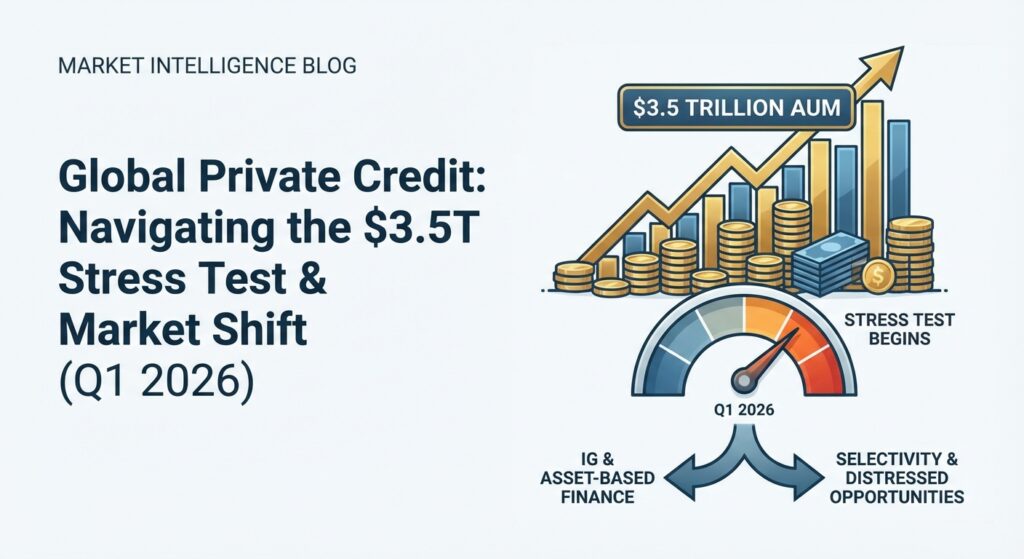
Market Headline: The $3.5 Trillion Stress Test Begins
As of March 1, 2026, the global private credit market has crossed a historic threshold, surpassing $3.5 trillion in assets under management (AUM). However, this milestone comes amid a pivotal shift in market sentiment. After nearly two decades of benign growth, the asset class is facing its first genuine cycle test. Following a series of high-profile bankruptcies in late 2025 (including First Brands and Tricolor) credit discipline is now the primary differentiator between top-tier managers and the broader pack.
While capital deployment surged nearly 78% year-over-year in 2024 to $592.8 billion, the easy money era appears to be closing. Industry leaders like Apollo now characterize the environment as transitioning from a “seller’s market” to a “buyer’s market,” creating complexity for allocators. Despite these headwinds, the asset class is cementing its status as a mainstream portfolio staple, with major institutions like JPMorgan recommending 10-30% allocations to alternatives.
Quantitative Snapshot: Q1 2026
The following metrics highlight the current bifurcation in the credit markets: robust liquidity meets rising default pressure.
| Metric | Current Level (Q1 2026) | Trend / Comparison | Source |
|---|---|---|---|
| Global Private Credit AUM | $3.5 Trillion | Mainstream adoption accelerating | Private Markets Insights |
| Direct Lending Yields (1st Lien) | 8.0% – 8.5% | Down from 10%+ peaks; Spreads compressing | Private Markets Insights |
| Middle Market Default Rate | 5.5% | Rising; 65% of managers expect loss increases | Private Markets Insights |
| IG Private Placement Volume | >$170 Billion (Annualized) | Record pace; Q4 deals 5-10x oversubscribed | Sun Life |
| IG Spreads | Tightened ~5 bps | Compression due to supply-demand imbalance | Sun Life |
Sector Analysis: Rotation to Asset-Based Finance & Distressed Debt
The “Golden Age” of plain-vanilla corporate direct lending is evolving into a more specialized landscape. Two distinct trends are dominating early 2026:
1. The Rise of Asset-Based Finance (ABF)
With corporate margins compressing, lenders are rotating toward collateralized opportunities. Approximately 65% of managers identifies ABF as having the highest growth potential, with total addressable markets projected at $40 trillion alongside rising interest in infrastructure and equipment finance.
2. Distressed & Opportunistic Credit
The 5.5% middle-market default rate has triggered a surge in opportunistic fundraising. Over the last two years, distressed funds have raised more than $100 billion to capitalize on volatility. The “cockroach theory”, where one visible default signals many hidden ones, is driving investors toward managers with restructuring expertise rather than just origination volume. Recent bankruptcies have exposed “underwriting drift,” validating concerns about loose covenants during the aggressive deployment of 2024-2025.
Implications for Market Participants
For Borrowers
Despite rising defaults, the supply-demand imbalance continues to favor issuers in the Investment Grade (IG) and upper-middle market. Deal oversubscription rates of 5-10x in private placements suggest that high-quality borrowers can still command tight pricing. However, borrowers in cyclical industries or those with complex capital structures will face significantly stricter diligence and covenant packages as lenders recoil from late-2025 losses.
For Lenders & Investors
The forward outlook suggests a K-shaped recovery for private credit portfolios. We are observing spread compression in the high-quality segment (IG private placements tightened ~5 bps entering 2026), reducing total return potential to the 8.0-8.5% range. Conversely, the dispersion between top-quartile and bottom-quartile managers is widening. Returns will no longer come from “riding the beta” of the asset class but from credit selection and workout capabilities. Selectivity is now the critical success factor.
Key Market Insights
- Regulation is a Tailwind: Recent executive orders opening 401(k) markets to private credit could unlock a portion of the $12.5 trillion defined contribution market.
- Capital Overhang: With $592.8B deployed in 2024 alone, the pressure to exit vintage loans is building, driving an expected uptick in M&A and refinancing activity.
- Bank Partnerships: Traditional banks are shifting from competitors to partners, committing nearly $100 billion to private credit vehicles to maintain client relevance without holding the paper.
- Performance Dispersion: The rise in payment-in-kind (PIK) toggles is a leading indicator of stress; watch for “zombie” companies masking liquidity problems.
- Europe Rising: Europe now represents 30% of global AUM, signaling that the private credit opportunity set has truly globalized beyond the US middle market.


