
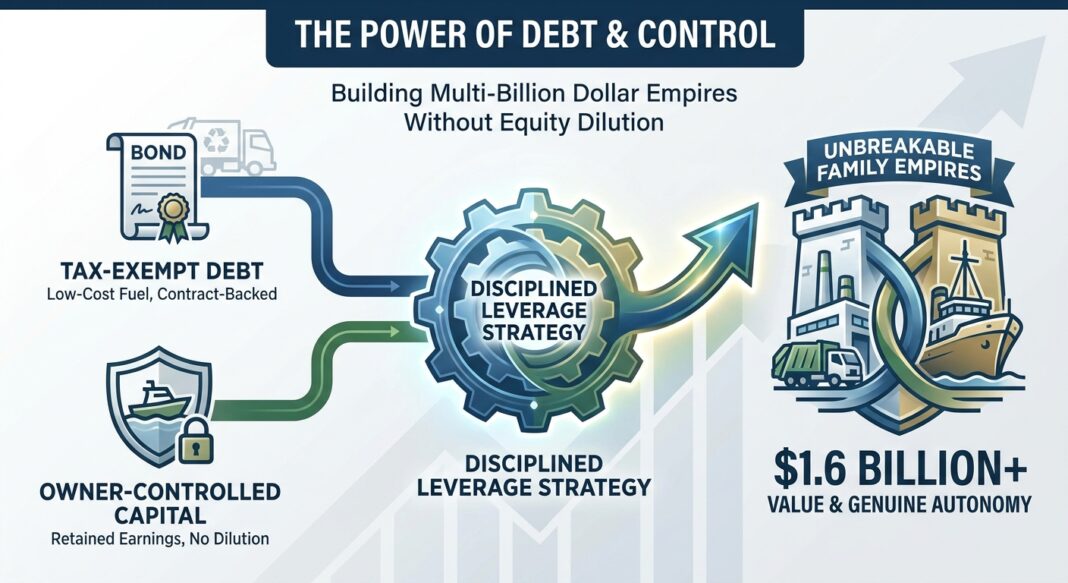
The Story: Two Founders, One Unshakeable Principle
In June 2026, Waste Pro USA closed a $150 million bond issuance: its latest in a series of tax-exempt solid waste disposal revenue bonds that has quietly built one of the most disciplined capital stacks in American private business. The bonds were significantly oversubscribed, bookrun by Barclays with BofA Securities and J.P. Morgan as co-managers. The institutional market was practically begging to lend to a company that had never sold a share of itself to an outside investor.
Meanwhile, just days before this article was published, Eddie Smith Jr. (the 83-year-old owner of Grady-White Boats in Greenville, North Carolina) turned down offers of more than $400 million from private equity buyers and instead gifted his company to a perpetual purpose trust. He walked away from every offer not because the price was wrong, but because a lifetime of ownership without outside investors had given him something PE cannot buy back: the freedom to choose his own ending.
These two stories, unfolding within weeks of each other in July 2026, illuminate the same underlying truth. When founders and family operators choose disciplined debt over dilutive equity, they don’t just preserve their cap table; they preserve their destiny.
The Decision: Debt as a Growth Engine, Not a Last Resort
Waste Pro USA: Building a $736.7M Debt Portfolio to Own $1.6 Billion in Revenue
John Jennings founded Waste Pro in 2001 with a single truck. In its first month, the company earned just $800 in revenue. Today, under his son Sean Jennings as CEO, revenue is projected to exceed $1.6 billion in 2026, and the company operates in twelve Southeastern states with a fleet of more than 4,300 vehicles and over 5,500 employees, all without ever selling equity to an outside party.
The mechanism? A methodical, deliberate pivot toward tax-exempt municipal bond financing. Since completing its first tax-exempt financing in August 2017, Waste Pro has grown its tax-exempt debt portfolio from zero to approximately $736.7 million in under nine years, according to CFO Cort Sabina. The Series 2026 bonds carry an interest rate of just 4.35%: fixed for five years with a maturity of April 1, 2037.
Why does this matter? Solid waste companies hold exclusive long-term municipal contracts. That contracted, recurring, inflation-linked revenue is exactly what bond markets want to underwrite. Rather than bringing in a private equity firm to fund fleet expansion and acquisitions (which would have diluted the Jennings family and imposed a forced exit timeline) Waste Pro instead levered those municipal contracts as collateral and funded growth with patient, fixed-rate, tax-exempt capital.
The result: the Jennings family controls a company with a projected revenue run rate of $1.6 billion and has made more than 50 acquisitions, all without surrendering governance, profit-sharing programs, or the operational philosophy that differentiates them from PE-owned competitors.
Grady-White Boats: Fifty Years of Profitability Without a Single Outside Investor
Eddie Smith bought Grady-White Boats in 1968 at age 26, pulling it back from near-bankruptcy through operational discipline and a relentless focus on product quality. The company has been profitable for 50 consecutive years. Revenue runs in the hundreds of millions. Smith never took an outside investor and never sold a share to the public.
That cap table discipline was not accidental; it was strategic. A clean ownership structure means retained earnings and debt are the entire capital stack. There are no investor liquidation preferences, no board seats held by fund managers with five-year exit horizons, no ratchet provisions triggered by a down cycle. When the company faced a slowdown, U.S. new powerboat retail unit sales fell 8.8% in 2025 to approximately 215,000 units: management could absorb the cycle, reinvest, and protect employees without needing to satisfy an outside return clock.
When Smith ultimately faced succession without an heir, he had something PE-backed founders never get: genuine choice. He chose a perpetual purpose trust over a $400 million sale, and the structure only works because the company throws off tens of millions annually in free cash. That cash generation was itself the product of decades of capital discipline.
The Outcome: What Equity Dilution Would Have Cost
Run the counterfactual on Waste Pro. Had the Jennings family taken a PE minority stake in, say, 2015 (when the company was approaching $500M in revenue and needed capital for fleet expansion) they might have received growth capital in exchange for 30–40% of the equity. A typical PE firm would have sought an exit within five to seven years, almost certainly via a sale to a strategic acquirer or a public listing.
Instead, Waste Pro funded that expansion through tax-exempt bonds at below-market rates. The family retained 100% of the economics on a business now projecting $1.6 billion in revenue. Even at a conservative 6x EBITDA multiple, standard for a business of this type, the equity value preserved by avoiding dilution could easily represent hundreds of millions of dollars remaining in family hands.
On the bond side, the oversubscription of the Series 2026 offering is itself evidence of outcome quality. When institutional investors from Barclays, BofA, and J.P. Morgan’s distribution networks compete to lend to your company at 4.35%, the market is telling you your credit is excellent: a validation that debt-funded growth, done with discipline, builds durable balance sheets.
For Grady-White, the counterfactual is equally stark. Eddie Smith was offered $400 million. He walked away. But here is the critical point: he could only afford to walk away because he owed no outside investors a return. A founder carrying PE minority investors has contractual obligations (co-sale rights, drag-along provisions, return hurdles) that make the $400 million offer not a choice but a mandate. Smith’s 50-year commitment to a clean capital structure gave him the rarest thing in business: genuine autonomy at the moment it mattered most.
The Lessons: A Framework for Operators Facing the Debt vs. Equity Decision
These two stories are not outliers. They are templates. Here is what they teach:
1. Match Your Capital to Your Cash Flow Profile
Both Waste Pro and Grady-White generate predictable, recurring, or contractually supported cash flows. That is the precondition for smart leverage. Tax-exempt bonds work for Waste Pro because municipal contracts are essentially annuities. Retained earnings work for Grady-White because premium boat margins are durable over time, even in cyclical segments. The lesson: debt rewards businesses with revenue visibility; equity penalizes them by pricing in uncertainty the business does not actually have.
2. Understand the True Cost of Equity Dilution
The current private credit market makes this calculus clearer than it has been in a generation. Private credit AUM crossed $1.7 trillion in H1 2026, and direct lending spreads have compressed from their 2024 peaks. For operators with contracted revenue, the fully-loaded cost of a dilutive equity round, measured at exit, often runs 30 to 35 percentage points of the pre-money founder position, versus an 8 to 10 percent after-tax cost of senior secured debt. Founders who still sequence equity first are operating on pattern memory, not current market economics.
3. Clean Cap Tables Preserve Optionality
Smith’s ability to choose a perpetual purpose trust over a $400 million sale was entirely a function of cap table hygiene. As he put it simply: “I do not have a single one who’s happy about what’s happened to their company after they sold.” PE structures are designed around exits, not permanence. A founder who has taken outside equity has, in effect, pre-committed to an exit, whether they know it at signing or not.
4. Debt Discipline Builds Institutional Credibility
Waste Pro’s most recent bond offering was significantly oversubscribed. That does not happen by accident. It is the result of 25 years of disciplined financial management, clean covenants, and a CFO who treats the balance sheet as a strategic asset. When your debt is oversubscribed by institutional buyers, you have achieved something few PE-backed competitors can claim: a direct, relationship-driven cost of capital that compounds in your favor over time.
5. The Succession Problem Dissolves When You Own It All
The most underappreciated benefit of founder-controlled capital structures is that they preserve succession flexibility. Grady-White’s transition to a purpose trust, “the largest in the U.S. since Patagonia’s in 2022 and a first for the marine industry”, was only available to Smith because he controlled 100% of the voting stock. ESOP conversions, purpose trusts, charitable structures, family transfers: all of these sophisticated succession tools require a clean cap table. Outside equity investors contractually close off each of these doors at signing.
Key Insights
- Tax-exempt municipal bonds can be a founder’s best friend. Waste Pro grew from $800/month in revenue to a $1.6B run rate without PE dilution by leveraging exclusive municipal contracts as bond collateral, at rates as low as 4.35% fixed.
- Fifty years of profitability is the ultimate leverage credential. Grady-White’s clean capital structure (no outside investors, ever) meant that when a $400M exit offer arrived, Eddie Smith had genuine optionality. He chose a perpetual purpose trust because he could.
- The fully-loaded cost of a dilutive round is almost always underestimated. When measured at exit, giving up 30–35% of a founder’s pre-money position to a VC or PE fund often costs multiples more than equivalent debt financing would have.
- Oversubscribed debt is a market signal worth reading. When institutional investors compete to lend to your company at below-market rates, they are telling you your credit quality is exceptional, a compounding advantage unavailable to equity-diluted competitors.
- Capital structure is succession planning. Every sophisticated succession tool (purpose trusts, ESOPs, family transfers, charitable structures) requires control of the cap table. Outside equity investors close these options permanently at signing.


