
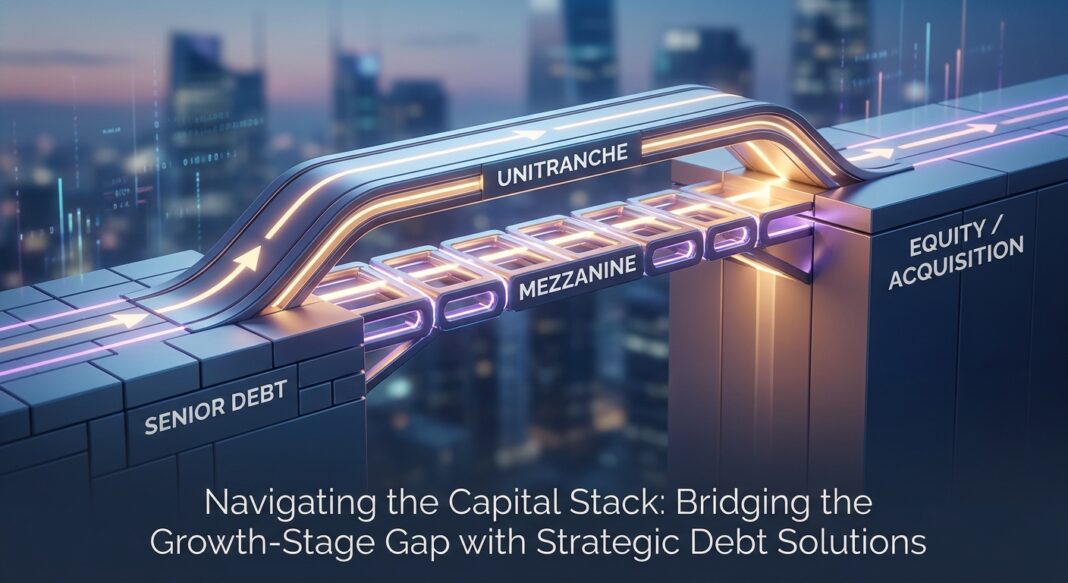
Filling the Growth-Stage Gap: How to Navigate the Capital Stack from Mezzanine to Unitranche When Acquisition Financing Meets Equity Constraints
Bond Capital, August 8, 2026
The Financing Challenge: When Senior Debt Runs Out and Equity Is Too Expensive
A growth-stage business generating $8M in EBITDA identifies an acquisition target at a $40M enterprise value. Its existing bank revolver is tapped. A clean equity raise at current multiples would cost the founders 18–22 points of dilution on a forward revenue basis. And the bank will only stretch to 3.5x leverage on a secured term loan: leaving a $6M–$10M capital gap that sits, unresolved, between what senior debt can provide and what equity should bear.
This is the growth-stage gap: a structural financing problem that emerges precisely when a company is most operationally ready to grow but least able to bridge the capital stack efficiently. It is not a failure of the business. It is a failure of capital sequencing.
The good news: the modern private credit market has purpose-built instruments for exactly this scenario. The challenge is knowing which one to use, when to use it, and how to negotiate the structure so that the cost of capital (inclusive of cash interest, PIK, warrant coverage, and covenant friction) does not consume the value being created by the acquisition itself.
This article maps the full growth-stage capital stack, walks through the mezzanine and unitranche structures in operational detail, and provides a practitioner playbook for quantifying the gap, running the process, and negotiating the final term sheet.
The Cost-of-Capital Spectrum: Mapping the Growth-Stage Stack from Banks to Equity
Before selecting an instrument, operators need a clear map of what each layer of the capital stack costs and what it demands in return. At the growth stage pursuing acquisitions, the relevant spectrum looks like this:
| Layer | Instrument | All-In Cost (2026) | Key Constraint | Best Use |
|---|---|---|---|---|
| 1, Lowest Cost | Bank Revolving Credit / Term Loan | SOFR + 200–300 bps | 3.0–3.5x leverage ceiling; maintenance covenants | Working capital, base operations |
| 2 | First-Lien Unitranche (Direct Lender) | SOFR + 550–625 bps (~10.2% median all-in) | 4.5–5.5x leverage; single maintenance covenant | Acquisitions, LBOs, platform builds ($50M–$200M EV) |
| 3 | Mezzanine / Subordinated Debt | 8–12% cash + 2–4% PIK + warrants = 16–22% all-in IRR | Subordinated; equity kicker dilution | Gap fill below equity; acquisition tranching |
| 4 | Preferred Equity / Growth Equity | 18–25% effective cost (dilution-adjusted) | Board control, liquidation preference | Transformative growth, pre-IPO capital |
| 5, Highest Cost | Common Equity / Founder Dilution | 30%+ implied hurdle at exit | Permanent dilution; governance complexity | Last resort or strategic alignment |
The practitioner imperative is to maximize the use of instruments in layers 1–3 before reaching for layer 4 or 5. In the current environment, this calculus has shifted materially in favor of structured debt. Private credit AUM crossed $2.1 trillion in H1 2026, with roughly 40% of new deployment targeting the lower middle-market growth segment, and direct lending spreads have compressed approximately 175 basis points from Q1 2024 peaks, making structured debt cheaper relative to dilutive equity than at any point in the past 15 years.
Structure Breakdown: Mezzanine vs. Unitranche for a $40M Acquisition
Option A: Unitranche (Single-Instrument Solution)
A unitranche facility combines what would otherwise be a senior secured loan and a subordinated loan into a single instrument with one set of documents, one lender or lender-led syndicate, one interest rate, and one covenant package. There is no intercreditor agreement to negotiate, and execution typically takes 45–90 days versus 90–150 days for a traditional senior-plus-mezzanine syndication, a speed advantage that matters acutely when a purchase agreement is under timeline pressure.
Illustrative Example, $40M Acquisition, $8M EBITDA Target:
- Unitranche Amount: $36M (4.5x EBITDA leverage)
- Pricing: SOFR + 575 bps (~10.75% all-in at current rates)
- Amortization: 1% per annum; bullet at year 5
- OID: 98 (2-point original issue discount)
- Covenants: Single maintenance leverage covenant tested quarterly at 5.25x, with a 30-day equity cure right
- Equity Contribution: $6M (15% of EV) from existing equity
- Warrant Coverage: None (standard for sponsor-backed unitranche)
The unitranche wins on simplicity and speed. The $50M–$200M EV band is the heart of the unitranche market, where direct lenders aggressively compete, pricing is tightest, terms are most flexible, and leverage is most generous. If the unitranche can close 30–45 days faster than a syndicated alternative, sponsors often justify 50–100 basis points of extra spread by avoiding financing gaps or delayed closings that jeopardize purchase agreements.
Option B: Senior + Mezzanine (Tranched Structure)
Where the acquisition requires more leverage than a unitranche lender will provide, or where the sponsor wants to optimize weighted average cost of capital, a tranched senior-plus-mezzanine structure may be appropriate. The mezzanine layer sits below all senior creditors in the payment waterfall and compensates its lenders through a combination of cash interest, PIK interest, and an equity kicker in the form of warrants or a direct equity co-investment.
Illustrative Example, Same $40M Acquisition:
- First-Lien Senior: $28M at SOFR + 325 bps (~8.0% all-in); 3.5x leverage; full maintenance covenant package
- Mezzanine Tranche: $10M at 9% cash interest + 3% PIK; 5-year term; bullet maturity
- Equity Kicker: Warrants representing 3% of fully diluted equity at a strike price set to closing EV
- Mezzanine All-In IRR: Approximately 18–20% (including warrant value at a 6x exit multiple)
- Equity Contribution: $4M (10% of EV)
- Intercreditor Agreement: Required; adds 3–6 weeks to execution
The mezzanine structure conserves equity and can stretch total leverage to 4.75x–5.5x, but it introduces subordination complexity, warrant dilution, and compounding PIK risk. PIK interest accrues as additional principal rather than paying out in cash; if an anticipated liquidity event is delayed, the growing PIK balance creates a larger refinancing burden at bullet maturity. Every warrant granted to a mezzanine lender dilutes existing common equity, a cost that must be weighed against the benefit of reduced upfront equity contribution.
How the Structures Compare: Trade-offs and When Each Wins
Unitranche Wins When…
- EV is between $50M and $200M, where direct lender competition is most intense
- Speed and deal certainty outweigh a modest pricing premium over syndicated alternatives
- The borrower wants a single lender relationship with no intercreditor complexity
- The sponsor is running a roll-up platform with frequent add-ons requiring repeated, fast financing
- The company prefers a single maintenance covenant rather than layered covenant packages
Mezzanine Wins When…
- Required leverage exceeds what a unitary lender will provide (above 4.5x on a standalone basis)
- The borrower has 8%+ revenue growth and predictable free cash flow that can service PIK accrual
- Equity capacity is genuinely constrained and dilution is the primary sensitivity
- A strategic liquidity event is expected within 4–6 years, creating a defined warrant exit mechanism
- The deal is large enough ($20M+ tranche) to justify intercreditor negotiation cost
Mezzanine Loses When…
- Margins are declining or cash flow is cyclical, making PIK compounding dangerous
- The exit timeline is uncertain, leaving warrant dilution open-ended
- A unitranche lender is willing to stretch to the same leverage at lower all-in cost
- The intercreditor negotiation would delay a time-sensitive closing
Traditional senior-plus-mezzanine can achieve a lower weighted cost of capital if the mezzanine carries equity kickers, but intercreditor complexity slows execution and reduces flexibility. Unitranche wins on speed, confidentiality, and single-document control. For EV below $50M, bank senior debt plus seller financing often wins on cost; above $300M EV, broadly syndicated loans become competitive on pricing.
Current Market Terms: What the Data Shows in Mid-2026
The private credit market in 2026 is operating in a compressed-spread, high-competition environment that generally favors quality growth-stage borrowers. Here are the key data points practitioners should anchor their structuring models to:
- Unitranche All-In Pricing (Sub-$100M Tickets): Median all-in coupons on unitranche facilities in the $5M–$50M band are clearing at approximately SOFR + 550–625 bps, with S&P LCD’s US Loan Comparable index confirming this range for sponsor-backed growth companies. Covenant-lite structures now represent 62% of unitranche originations in this band, reflecting continued competitive pressure from direct lenders deploying substantial dry powder.
- Mezzanine All-In Cost (2026): The all-in cost of mezzanine capital for acquisition financing is running at 10–14% on a cash-plus-PIK basis (8–12% cash interest plus 2–4% PIK), with warrant or equity co-investment of 1–5% of fully diluted equity producing a total lender IRR of 16–22%. The cash interest component has compressed modestly from 2023–2024 peaks as more BDCs and specialty mezz funds compete for quality credits.
- Covenant Architecture: Maintenance covenants require borrowers to meet financial metrics on a regular quarterly basis, while incurrence covenants are tested only when a borrower takes a specified action such as raising additional debt or paying a dividend. Covenant-lite institutional leveraged loans represented 91.7% of large-cap new-issue institutional loans in the United States in 2024 (PitchBook LCD), but the lower middle market retains covenant discipline, with lower-middle-market covenant retention rates at approximately 98%, a meaningful differentiation from the large-cap syndicated market. For growth-stage borrowers, maintenance covenants provide early warning signals and serve as functional levers to force engagement if distress emerges.
- EBITDA Add-Back Caps: In 2024, market caps on pro forma cost-savings add-backs clustered around 25–35% of EBITDA in direct lending documents. Borrowers seeking to maximize leverage should understand that lenders are scrutinizing add-back quality more carefully as spread compression has reduced income cushions.
- Private Credit AUM and Competition: Global private credit AUM reached approximately $2.1 trillion in 2025, up from $1.5 trillion the year prior, with Federal Reserve H.4.1 data showing private credit facilities to non-bank borrowers up 34% year-over-year through Q2 2026. Bloomberg DCM desk data indicates direct-lender competition is compressing spreads by roughly 75 basis points per quarter in the middle market, a tailwind for borrowers running competitive processes.
The Gap Capital Playbook: Quantify, Prepare, Run the Process, Negotiate
Step 1: Quantify the Gap
Start with a precise use-of-proceeds model. The gap is not the total acquisition price minus equity; it is the difference between what each layer of the stack can realistically provide and what the deal requires. Map three numbers: (a) maximum senior secured capacity based on trailing twelve-month EBITDA at a 3.5x bank leverage ceiling, (b) available equity without triggering a new priced round, and (c) total deal cost including fees, OID, and integration capital. The gap lives between (a) + (b) and (c). Size it to the dollar before approaching any lender.
Step 2: Prepare the Materials
Direct lenders and mezzanine providers underwrite to three things: quality of free cash flow, defensibility of the revenue base, and management’s demonstrated ability to integrate acquisitions. The information package should include: trailing 24-month audited or reviewed financials, a monthly P&L bridge showing EBITDA add-backs with documentation, a pro forma capitalization table reflecting the proposed structure, debt service coverage ratios at current and stressed EBITDA, and a clear articulation of how the acquisition creates incremental cash flow. Lenders have become more disciplined about EBITDA add-back quality as spread compression has thinned income cushions; clean add-back documentation is now a first-pass screen, not a diligence afterthought.
Step 3: Run a Competitive Process
For unitranche tickets in the $25M–$75M range, a well-prepared borrower should be running four to six direct lenders simultaneously. For mezzanine tranches, the universe narrows to specialty mezz funds and BDCs; a structured process with a three-week indication deadline is standard. The competitive dynamic matters: direct-lender competition for quality credits is compressing spreads materially, and borrowers who run organized processes consistently achieve better pricing and terms than those who approach lenders bilaterally. Request term sheets that specify all-in yield (not just spread), OID, floor rates, covenant levels, equity cure rights, and prepayment penalties in a single comparable format.
Step 4: Negotiate the Structure
For unitranche, the key borrower negotiation points are: (a) covenant headroom, push for 30–35% cushion above the maintenance test level at close; (b) equity cure mechanics, ensure at least two cures per year with no cure proceeds counting toward EBITDA in the next test period; (c) incremental facility baskets, preserve the right to add acquisition debt without full lender consent up to a leverage-based threshold; and (d) prepayment flexibility, soft call protection of 101 in year one is standard; resist hard no-call periods beyond 12 months for growth-stage deals where refinancing catalysts are unpredictable.
For mezzanine, the critical negotiation points are: (a) warrant strike price, negotiate at closing EV, not at a discount; (b) PIK election flexibility, preserve the right to switch between cash-pay and PIK based on operating performance, which conserves cash in lean quarters; (c) warrant coverage percentage, 1–3% is achievable for quality credits versus the 3–5% lenders initially propose; and (d) change-of-control provisions, ensure the mezzanine can be prepaid at par plus accrued PIK on an acquisition exit, without make-whole premiums that penalize a successful exit.
Structuring Guidance: For Operators and Investors
For Operators and CFOs
The single most common structuring error at the growth stage is reaching for equity before exhausting the structured debt stack. For a company clearing a 1.5x debt service coverage ratio with 30% gross margins and predictable contract revenue, the fully-loaded cost of a dilutive equity round is materially higher than the cost of a well-structured unitranche or mezzanine facility. Founders drawing debt against contracted revenue are extending runway, deferring priced equity rounds by 12–18 months, and entering equity conversations at higher revenue and cleaner cap table terms. The math has not favored debt this strongly in fifteen years. Do not sequence equity first out of pattern memory; sequence equity last out of deliberate capital discipline.
For Investors and Credit Professionals
When evaluating a growth-stage borrower running a mezzanine or unitranche structure, the structural risk questions are: Is the maintenance covenant level set with sufficient headroom to absorb a one-quarter EBITDA miss without a technical default? Are EBITDA add-backs capped and documented? Has the borrower negotiated equity cure rights? And on the mezzanine side, has the PIK toggle been modeled at the stress case, not just the base case? PIK compounding creates a structurally larger refinancing obligation at maturity, and if the anticipated liquidity event is delayed, the growing PIK balance can become the dominant risk in the credit. Lenders who can act early, armed with a maintenance covenant, consistently recover more than lenders who discover the problem only at payment default, the gap averages 10 percentage points across multiple default cycles.
Key Takeaways
- Quantify the gap first, then select the instrument. The capital structure decision flows from a precise use-of-proceeds model, not from product preference. Size the gap to the dollar before approaching lenders.
- Unitranche dominates the $50M–$200M EV band. Single-document execution, no intercreditor complexity, and 45–90 day close timelines make unitranche the default choice for mid-market acquisitions where deal certainty outweighs a modest pricing premium over syndicated alternatives.
- Mezzanine is a leverage-extension tool, not a last resort. When senior debt capacity is exhausted and equity dilution is the primary constraint, mezzanine at 8–12% cash + 2–4% PIK with 1–3% warrant coverage is a rational instrument for companies with strong free cash flow and a defined exit horizon within five years.
- Covenant design is a risk allocation decision, not boilerplate. Maintenance covenants provide lenders with early warning signals and genuine intervention rights; incurrence covenants gate borrower actions but offer no periodic monitoring. Negotiate covenant headroom, equity cure mechanics, and add-back caps with the same precision applied to pricing.
- The 2026 market structurally favors quality borrowers. With private credit AUM above $2.1 trillion, direct-lender competition compressing spreads by approximately 75 bps per quarter, and covenant-lite structures now representing 62% of sub-$100M unitranche originations, well-prepared growth-stage companies running competitive processes have genuine pricing and structural leverage they did not have 18 months ago.


