
The Growth-Stage Financing Problem Nobody Solves Cleanly
You have proven product-market fit. Revenue is compounding. Unit economics are tightening in your favour. And yet the capital you need to scale (to hire the sales team, fund the inventory build, or close the tuck-in acquisition) is not arriving cleanly from any single source.
This is the growth-stage gap: the uncomfortable corridor between early-stage equity rounds and the institutional debt markets that serve mature, cash-flowing businesses. It is where most capital strategy mistakes are made, not because operators are unsophisticated, but because the toolset expands dramatically at this stage and the cost-of-capital spectrum widens in ways that are easy to misread.
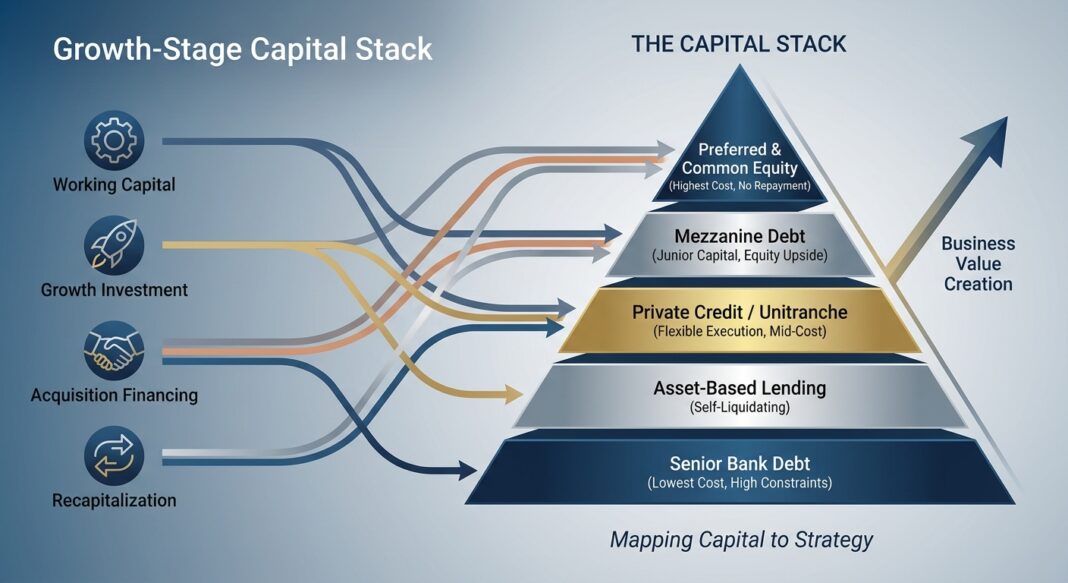
Getting this right starts with one discipline: mapping your use-of-proceeds before you approach any capital source. What you are funding determines which layer of the capital stack is the correct answer. Working capital, growth investment, acquisition financing, recapitalisation, and ownership transition each carry a different risk profile, and therefore a different optimal structure.
The Cost-of-Capital Spectrum at the Growth Stage
Think of the capital stack as a spectrum running from cheapest-with-constraints to most-expensive-with-flexibility. At the growth stage, five layers are typically in play:
- Senior bank debt (cheapest): Term loans and revolving credit facilities secured against assets or cash flows. Availability depends on tangible collateral or demonstrable debt-service coverage. Covenants are maintenance-based, you must stay within defined financial ratios throughout the life of the loan. Suitable for asset-heavy businesses or those with predictable contracted revenue.
- Asset-based lending (ABL): Borrowing capacity tied directly to the liquidation value of receivables, inventory, and equipment. Advances typically run at 70–85% of eligible receivables and 50–70% of eligible inventory. ABL revolvers flex with the business cycle, making them well-suited to working capital financing. The discipline it imposes (clean borrowing base certificates, tight reporting) is operationally valuable.
- Private credit / unitranche: Direct lending funds have moved aggressively into the growth stage, offering single-tranche structures that combine senior and subordinated economics into one facility. Pricing runs higher than bank debt but the execution certainty, covenant flexibility (often incurrence-based rather than maintenance-based), and speed are material advantages. As noted by capitalxo.com, each layer of debt affects total leverage and existing lender relationships, adding a unitranche requires modelling the full intercreditor picture.
- Mezzanine / subordinated debt: Junior capital that sits below senior debt and accepts higher risk in exchange for higher yield, typically in the 12–18% range, often with equity warrants attached. As re-cap.com identifies, junior debt holders receive payment only after senior obligations are met, but they may hold conversion or warrant rights that give them upside participation. Use mezzanine when the senior market is fully drawn and you need to bridge to an equity event or fund a specific value-creation step.
- Preferred and common equity (most expensive): Equity capital carries no mandatory repayment schedule, which is its structural advantage. But as lendity.com makes clear, each equity round resets the liquidation waterfall and can be extraordinarily expensive on a per-exit-dollar basis. Equity is the right tool when you are funding experimental growth, building toward a valuation inflection, or when the business cannot service fixed obligations.
Use-of-Proceeds Mapping: Matching the Need to the Structure
Before approaching any market, answer this question precisely: What is this capital actually paying for, and what is the repayment source?
Working capital and receivables financing: this is a bank or ABL conversation. The asset self-liquidates. You are borrowing against cash you have already earned but not yet collected. Reaching for mezzanine or equity to fund working capital is a structural error that destroys value.
Growth investment (hiring, marketing, product development); this is where the growth-stage gap lives. The repayment source is future cash flow, not a hard asset. Revenue-based financing, private credit with incurrence covenants, or structured equity all become viable depending on how predictable that future cash flow is. The more visibility you have (ARR, contracted revenue, repeat order rates) the further down the cost-of-capital spectrum you can reach.
Acquisition financing: a leveraged buyout or tuck-in acquisition typically supports a blended structure: senior acquisition debt sized to the target’s EBITDA, potentially with a mezzanine or preferred layer to bridge the gap between senior capacity and total enterprise value. The key variable is how quickly the combined entity’s cash flows can service the combined debt stack.
Recapitalisation and ownership transition: when existing shareholders need liquidity, the business must generate enough free cash flow to service the debt that funds the recap. This is fundamentally a mature-stage, cash-flow-lending conversation. Forcing a recap structure onto a growth-stage business that cannot yet service it is one of the most common structural errors in the mid-market.
The Gap Capital Playbook: Four Steps
Step 1, Quantify the gap precisely. Build a 24-month integrated financial model that shows: (a) the base-case cash flow without new capital, (b) the investment required to hit the next value-creation milestone, and (c) the post-investment cash flow available for debt service. This model is the foundation of every lender and investor conversation. Without it, you are negotiating blind.
Step 2, Define your constraint hierarchy. Rank your priorities: minimising dilution, minimising cost of capital, maximising speed of execution, preserving operational flexibility. Different capital sources serve different constraint hierarchies. A founder who ranks dilution minimisation first and speed last has a very different optimal path than one running against a 60-day acquisition closing deadline.
Step 3, Run a parallel process. Approach multiple capital sources simultaneously: senior lenders, direct lending funds, and if appropriate, equity investors. Parallel processes create competitive tension and give you real market data on pricing, terms, and availability. A single-track process leaves you exposed to a single counterparty’s terms with no leverage. As angelinvestorsnetwork.com notes, applying to multiple lenders in parallel is standard practice for sophisticated borrowers.
Step 4, Stress-test the structure before signing. Run the agreed capital structure through three scenarios: base case, 20% revenue miss, and a 40% revenue miss. Identify the point at which covenant triggers are hit or debt service becomes unserviceable. If the downside scenario breaks the structure within 12 months, the structure is wrong regardless of how attractive the base-case economics look.
Negotiation Guidance: Where the Structure Is Actually Won or Lost
The headline rate and the loan amount are not where deals go wrong. The structure lives in four negotiation points that operators frequently underweight:
- Covenant type and headroom: Maintenance covenants require continuous compliance; incurrence covenants are only tested when you take a specific action. Push for incurrence-based packages where possible, and negotiate meaningful buffer above any maintenance covenant threshold, at minimum 20–25% headroom against your base-case projections.
- Prepayment flexibility: Growth-stage businesses refinance frequently as they scale into cheaper capital. Soft-call premiums (e.g., 2% in year one, 1% in year two, none thereafter) are standard in private credit. Understand your exit costs before you commit to a term.
- PIK toggle provisions: In mezzanine structures, the ability to toggle interest payments from cash-pay to payment-in-kind (PIK) during periods of constrained cash flow can be critical. Negotiate this toggle upfront; it has no value if you are trying to add it during a covenant waiver discussion.
- Equity warrant coverage: When subordinated lenders require warrants as a condition of their participation, negotiate both the coverage percentage and the exercise price. Warrants at a fixed price set at today’s valuation are meaningfully more dilutive than warrants with a strike that adjusts upward with equity rounds. The structure of the warrant matters as much as its size.
The capital stack is not a financing detail; it is the architecture of your business’s strategic optionality. Understanding where each layer sits, what it costs, and what it constrains is the prerequisite for every growth decision that follows.


