
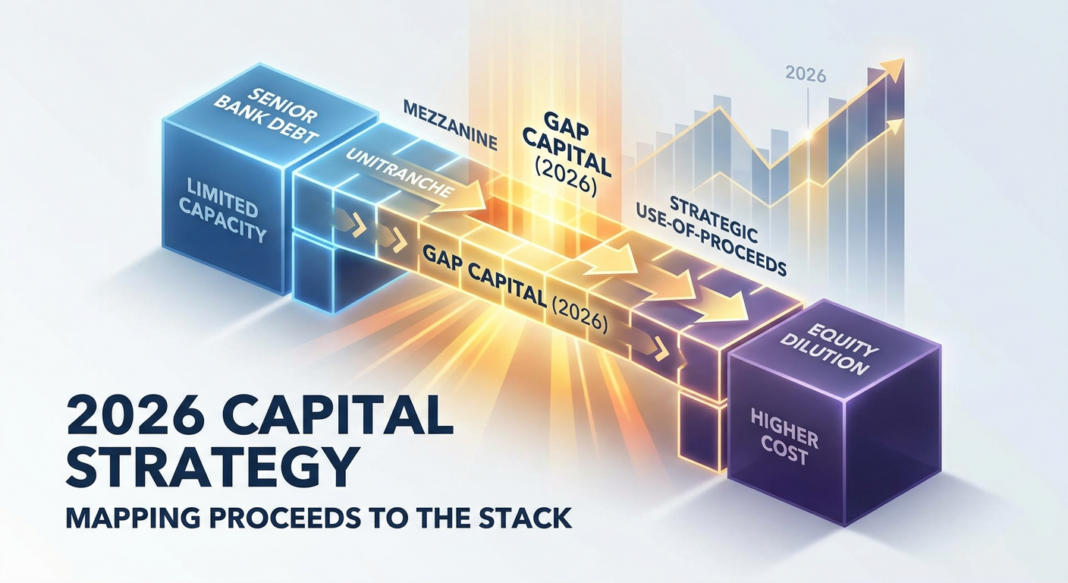
The Financing Challenge: Scaling Beyond Bank Capacity Without Unnecessary Dilution
A founder-led industrial services business has just crossed $8M in EBITDA, won two new regional contracts, and identified an add-on acquisition target priced at $35M. The company’s existing bank relationship covers a $20M senior term loan, roughly 2.5x leverage, and the senior lender will not stretch beyond 3x. That leaves a $10–12M financing gap sitting between senior debt capacity and the point where the founder would need to sell a material equity stake.
This is the defining capital structure challenge for growth-stage companies in 2026: the gap between what banks will lend and what equity investors demand in return is wider (and more expensive on both sides) than it has been in years. Private capital is now a core part of middle market financial planning, with 81% of respondents in KeyBank’s April 2026 Middle Market Snapshot Survey considering private capital at least sometimes when evaluating growth or strategic initiatives. The debate has shifted. The question is no longer whether private capital belongs in the capital stack, companies are now focused on determining when to use it and which partners can help them achieve their objectives.
Getting the answer right requires a stage-by-stage, use-of-proceeds-specific view of the full cost-of-capital spectrum. What follows is that map.
The Cost-of-Capital Spectrum: From Bank Debt to Common Equity
Every capital structure decision involves a trade-off between cost and access. Mapping the spectrum from lowest-cost to highest-cost helps operators understand exactly where they are in the stack, and what they are paying for each layer.
Layer 1: Senior Bank Debt (Lowest Cost, Highest Seniority)
Bank revolvers and amortizing term loans remain the foundation of any capital stack. They carry the lowest all-in rates and the tightest covenant packages, but banks cap leverage at 2.5x–3.5x EBITDA for most middle-market credits. For CFOs, banks still provide relationship continuity and low-cost capital for core operations, while private capital provides the agility to seize opportunities, together forming a stack that is more adaptive and more reflective of the real world businesses operate in.
Layer 2: Unitranche / Direct Lending (Mid-Cost, Execution Certainty)
Unitranche debt is a single-tranche term loan that combines what would otherwise be a senior secured loan and a subordinated or mezzanine loan into one instrument: one loan document, one lender or lender-led syndicate, one set of covenants, one interest rate, and one prepayment schedule. In 2026, unitranche pricing runs SOFR + 500–700bps, plus a 2–3% original issue discount and a 2–3% prepayment fee declining over the first 24 months, with all-in cost of capital for a typical 5x leverage deal running 9.5–11% blended.
The unitranche sweet spot is $25M–$200M enterprise value; below that range, SBA plus senior bank wins on cost, and above $300M, the broadly syndicated loan market wins on cost. If unitranche financing can close 30 to 45 days faster than a syndicated alternative, sponsors often justify 50 to 100 basis points of extra spread by avoiding financing gaps, broken syndications, or delayed closings that jeopardize purchase agreements.
Layer 3: Mezzanine / Subordinated Debt (Higher Cost, Greater Flexibility)
Mezzanine debt sits between senior debt and equity in the capital structure, carrying higher interest rates, 12–20% total yield, in exchange for subordinated priority; it typically features PIK interest paid in additional debt rather than cash, equity kickers (warrants giving 1–5% ownership), and minimal covenants. In 2026, all-in mezzanine cost runs 10–14% (cash coupon 8–11% + PIK 2–4% + warrants), and mezz wins when the deal is too large for SBA, equity capacity is limited, and the target generates predictable free cash flow.
Layer 4: Preferred Equity (Quasi-Equity Returns)
Preferred equity occupies the layer directly above common equity and below all debt. It carries negotiated dividends, liquidation preferences, and sometimes conversion rights, typically targeting returns in the 15–20%+ range. It is the appropriate instrument when the business needs permanent capital without surrendering voting control to common equity investors.
Layer 5: Growth Equity / Common Equity (Highest Cost, Unlimited Upside)
According to Carta’s State of Private Markets data, median dilution sits at approximately 19.5% for seed rounds and 18% for Series A rounds in 2025, figures actually higher than the peak of 2021, reflecting a market where capital has become more expensive and investors are demanding more ownership for the risk they take on. Equity is the instrument of last resort from a cost-of-capital perspective, appropriate only when the use-of-proceeds is exploratory, pre-revenue, or so large relative to enterprise value that debt service would be structurally imprudent.
Use-of-Proceeds Mapping: Matching Capital to Purpose
The most common structuring mistake operators make is selecting a financing instrument without first anchoring it to the specific use-of-proceeds. The capital stack is not a monolithic choice; it is a precision instrument. Here is the mapping:
| Use of Proceeds | Recommended Instrument | Why It Fits |
|---|---|---|
| Working capital / seasonal needs | Bank revolver / asset-based line | Short-duration, self-liquidating; lowest cost |
| Equipment / capex | Senior term loan / equipment financing | Asset-backed; predictable ROI and amortization |
| Organic growth / go-to-market expansion | Unitranche / growth credit | Cash flow-based; flexible covenants; no dilution |
| Bolt-on acquisition (gap above senior) | Mezzanine + PIK toggle | Preserves near-term cash; fills the gap without dilution |
| Platform-building / transformational M&A | Unitranche (stretch) + minority equity co-invest | Maximum leverage capacity; speed of execution |
| Ownership recapitalization | Senior + mezz recap | Founder liquidity without full exit; retains upside |
| Pre-revenue / product development | Venture equity or convertible note | No debt service capacity; equity is the only viable instrument |
A growth debt investment will typically take the form of a senior loan with a very small fraction of equity, with expected returns in the 10–15% range, more expensive than traditional debt options, but allowing entrepreneurs to accelerate growth while minimizing dilution to current owners.
The Gap Capital Playbook: Quantifying, Preparing, and Running the Process
Returning to the $35M acquisition example above: the operator has $8M EBITDA, a $20M senior term loan in place, and a $10–12M gap between senior capacity and total deal need. Here is the step-by-step playbook to fill it efficiently.
Step 1: Quantify the Gap
Run three scenarios (base, downside, and stress) modeling EBITDA, debt service coverage, and leverage at close. Stress-test covenants by modeling quarterly leverage and interest coverage under downside scenarios and planned add-ons, and assume lower add-back realization and delayed synergy capture. Target a minimum debt service coverage ratio of 1.25x in the base case and confirm positive coverage even in the stress scenario before approaching any lender.
Step 2: Build the Materials Package
A lender-ready package for growth-stage gap capital needs: (1) trailing twelve months and forward twelve months EBITDA with clear add-back methodology; (2) a sources-and-uses table showing the full capital stack at close; (3) a 13-week cash flow model post-close showing covenant headroom; and (4) a management presentation on why the acquisition is accretive and the specific integration milestones. The greatest financing challenges often originate within the company itself, internal alignment among owners and board members and the burden of diligence each accounted for 19% of reported delays, with documentation and intercreditor issues following at 15%. Resolve alignment internally before going to market.
Step 3: Identify the Right Instrument
For a $10–12M gap on a $35M transaction with $8M EBITDA, mezzanine is the appropriate instrument. The deal is too large for SBA, senior bank capacity is exhausted, and the predictable industrial cash flows support PIK servicing. In the classic LBO use case, a PE firm acquires at 6x EBITDA, senior lenders cover roughly 3.5x (58% of purchase price), and when the sponsor wants to deploy less equity, a mezzanine fund steps in to cover another layer of the deal: carrying, say, a 13% cash coupon plus 2% PIK plus warrants for 5% equity, targeting a 17% all-in IRR. The same logic applies for non-sponsor-backed operators filling the gap.
Step 4: Run a Dual-Track Process
Contact three to five direct lenders or mezzanine funds simultaneously. Top direct lenders active in the mid-market include Ares Capital, Blue Owl Capital, Antares Capital, Twin Brook Capital Partners, Apollo Global Management Direct Lending, Carlyle Direct Lending, KKR Capital Markets, Golub Capital, and Monroe Capital. Request term sheets within 21 days. Use competing sheets to drive structure, not just rate: the most important variables are covenant cushion, PIK toggle mechanics, and warrant coverage.
Step 5: Understand the True All-In Cost
A mezzanine facility advertised at 14% interest is not a 14% cost of capital; it is 14% plus PIK interest that compounds over a three-to-five year term, plus warrants that give the lender 5–15% of the company, plus 2% upfront fees. Model the full IRR impact, not just the stated coupon. Borrowers favor PIK mechanics primarily to conserve cash during integration periods, capex cycles, or market downturns; mezzanine providers accommodate PIK to achieve a targeted yield, often in combination with warrants; the trade-off is explicit, the borrower preserves near-term liquidity at the cost of increased principal obligations and potentially higher all-in pricing.
Covenant Design: What You Are Actually Agreeing To
Covenant structure is where the real risk allocation happens, and growth-stage borrowers consistently underestimate this dimension of the deal.
Maintenance covenants require borrowers to pass financial tests every quarter regardless of any action taken, while incurrence covenants only apply when the borrower takes a specific action like incurring new debt or paying a dividend, and most syndicated leveraged loans today are covenant-lite (incurrence only), though private credit deals typically retain maintenance covenants for earlier lender intervention.
In the competitive private credit market, many funds are now adopting syndicated loan features (namely less stringent covenant structures, especially in large-cap deals) and providing “covenant loose” terms where, while there is typically at least one maintenance financial covenant such as a quarterly-tested leverage ratio, the cushions set are so generous they would be unlikely to ever be triggered.
For growth-stage borrowers pursuing gap capital, the covenant negotiation sequence should follow this priority:
- Secure EBITDA add-back definitions first. Lenders’ leverage calculations are only as accurate as the EBITDA definition. Negotiate clear, specific add-backs for integration costs, management normalization, and one-time items before discussing the covenant level itself.
- Negotiate the cushion, not just the threshold. A 4.5x leverage covenant means nothing if your pro forma leverage at close is 4.4x. Aim for 20–30% headroom above expected close leverage.
- Insist on an equity cure right. Breaching maintenance covenants does not immediately accelerate debt, most credit agreements provide cure periods (30 days for equity cure, 5–10 days for calculation errors) before defaults become effective. Ensure your agreement includes this standard protection.
- Define PIK trigger mechanics explicitly. Effective PIK structures include carefully tailored triggers: performance-based triggers might require a minimum liquidity threshold, a maximum leverage ratio, or positive free cash flow before permitting cash-pay toggling; time-based triggers may allow PIK for an initial period with a step-down to partial cash-pay thereafter.
Negotiation Guidance: Closing the Deal on the Right Terms
For Operators
Leverage competing term sheets. The gap capital market is a borrower’s market for quality credits in 2026. A brief macro-driven widening early in 2026 has reversed, with competition and thin deal flow reaffirming a borrower’s market in both public and private channels. Use multiple competing term sheets to compress spread and improve structural terms simultaneously.
Price the execution certainty. Compare unitranche or mezzanine all-in yield to a flexed BSL or bond financing after factoring underwriting fees, distribution risk, timing risk, and MAC closing conditions. Speed to close is worth 50–100bps of premium when the acquisition target has a hard closing date.
Negotiate warrant economics carefully. A warrant is a security that gives the holder the right to purchase a company’s stock at a set price in the future: in mezzanine financing, warrants act as an equity kicker, letting lenders share in the company’s upside value if it grows. Negotiate the strike price, warrant coverage percentage, anti-dilution provisions, and exit mechanics with the same intensity as the interest rate.
Underwrite your lender. Assess the lead lender’s restructuring posture, fund liquidity, and track record, including decision speed at credit committee. A lender who is slow at credit committee during closing will also be slow during an amendment, which is precisely when speed matters most.
For Investors Evaluating Structure
When evaluating a mezzanine opportunity, focus on the cash-pay vs. PIK mix, the warrant dilution impact, the bullet maturity refinancing path, the intercreditor terms (blanket vs. springing subordination), and the strength of sponsor support behind the borrower. The MFN (most-favored-nation) clause is also critical for platforms planning follow-on debt issuance. MFN clauses say that if the borrower issues additional debt at a higher spread than the existing unitranche, the existing unitranche spread automatically resets up to match, with standard 2026 terms being a 50bps cushion and a 12-month sunset.
Key Takeaways
- Map proceeds to instrument before approaching the market. Working capital, capex, acquisitions, and recapitalizations each have a natural home in the stack, mismatching instrument to use is the most avoidable structuring error.
- Mezzanine fills the gap when senior capacity is exhausted and equity dilution is unacceptable. At 10–14% all-in cost in 2026, it is expensive, but materially cheaper than surrendering ownership at a growth-stage multiple.
- PIK preserves cash flow during integration but compounds principal, model the full IRR, not the stated coupon. A 14% stated rate with 3% PIK and 5% warrant coverage carries a materially higher true cost of capital when calculated over a 4-year hold.
- Covenant design is where risk is really allocated. Negotiate EBITDA definitions, covenant cushion, PIK toggle triggers, and equity cure rights with the same attention as the interest rate; these terms determine your operational flexibility for the next 3–5 years.
- The 2026 private credit market is a borrower’s market for quality credits. Dry powder is abundant, deal flow is thin for lenders, and competition is compressing spreads, a well-prepared borrower running a dual-track process against multiple lenders has significant structural leverage in today’s environment.


