
The Financing Challenge: Proven Business, Real Acquisition, Structural Gap
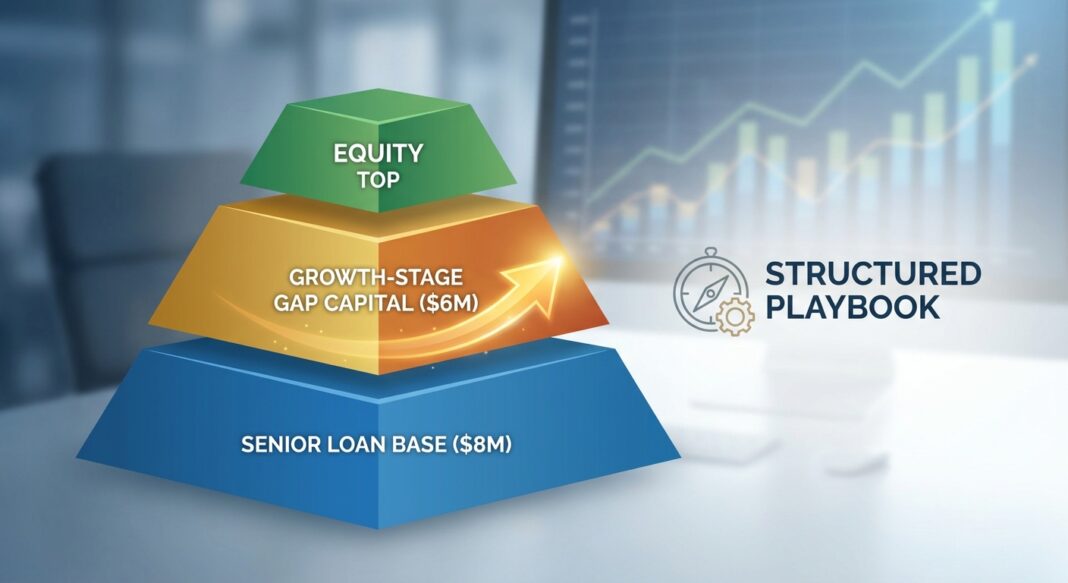
You have $12M in revenue, improving EBITDA margins, and a clear acquisition target priced at $15M. Your senior lender (a regional bank or a direct lender) will stretch to $8M based on your trailing EBITDA and collateral coverage. A seller note captures another $1M. That leaves a $6M gap that no single conventional instrument closes cleanly.
This is the defining capital challenge of the growth stage. The business is too mature for venture equity terms, too small for broadly syndicated leveraged finance, and too acquisitive to rely on organic cash flow alone. The gap cannot be ignored or papered over; it must be engineered. What follows is a practitioner-level framework for mapping use-of-proceeds across the full capital stack, running a structured gap capital process, and negotiating the terms that will govern your business for the next three to five years.
Mapping the Capital Stack: From Senior Debt to Common Equity
The capital stack for a $15M growth-stage acquisition is not a single funding call. It is a sequenced architecture where each layer carries a different cost, seniority, and set of structural obligations. Understanding that spectrum (and where your $6M gap sits within it) is the starting point for every negotiation that follows.
At the top of the stack sits senior debt: first-lien bank loans, SBA instruments, or direct lending facilities. Senior lenders hold first claim on cash flows and collateral, which allows them to price at the lowest rate, typically SOFR plus 250–450 basis points for growth-stage credits in today’s market. The trade-off is restriction: maintenance covenants, collateral requirements, and limited flexibility for operational pivots. In this scenario, senior debt covers $8M of the $15M need. It is the cheapest capital in the stack and the least negotiable in structure.
Below senior debt sits the mezzanine layer: subordinated debt that accepts a junior repayment position in exchange for higher yield and, frequently, equity participation features. Mezzanine providers (including BDCs, credit opportunity funds, family offices, and specialist mezz funds) price to all-in returns of 14–18% annually, blending cash coupon, PIK accrual, and warrant or equity kicker. This layer exists precisely to fill the gap between what senior lenders will provide and what equity investors will fund. It carries more flexibility than senior debt but comes with its own structural disciplines: subordination agreements, intercreditor terms, and often a board observer right.
At the base of the stack sits equity: common or preferred, which absorbs losses first and gets paid last. Preferred equity, in particular, can serve a quasi-debt role: structured with a liquidation preference, a dividend rate (paid or accruing), and minimal covenant interference. It is the most expensive capital in the stack on a cost-of-capital basis, but it carries no mandatory repayment schedule, which provides maximum operational flexibility. As capitalxo.com notes, every capital stack decision involves trade-offs across three dimensions: cost of capital, control, and flexibility to adapt.
Structuring the Gap: Mezz, Preferred, or a Blend
With $6M to fill, the structuring decision is not simply “debt or equity.” It is a scenario analysis across at least three configurations:
- Scenario A, Pure Mezzanine: $6M subordinated term loan at 13% cash coupon plus 2% PIK, with 3–4% warrant coverage on fully diluted equity. Annual debt service is manageable if post-acquisition EBITDA exceeds $2.5M, but warrant dilution is real and accumulates.
- Scenario B, Pure Preferred Equity: $6M preferred instrument with a 14–16% cumulative dividend (PIK in years one and two, cash pay thereafter), no covenant package, no scheduled amortization, and a redemption right at year five. Operationally cleaner, but the cost of capital is higher and the exit waterfall is more complex.
- Scenario C, Blended Structure: $3.5M mezzanine debt at 12% all-in plus $2.5M preferred equity at 15% PIK dividend. Splits the risk between two provider types, preserves some covenant flexibility, and keeps total annual cash interest below $500K in the integration year.
The optimal scenario, as bondtv.vaultai.ca frames it, is the one that maintains debt service coverage above 1.20x FCCR, keeps total leverage below 5.0x EBITDA, and limits equity dilution below 15% of common equity. Model each scenario against your post-close integrated financials before approaching a single provider.
The Gap Capital Playbook: Quantify, Prepare, Run, Close
Step 1: Quantify with Precision
Build a clean sources-and-uses schedule. Acquisition price: $15M. Senior debt: $8M. Seller note: $1M. Gap: $6M. Then extend the analysis: what does post-close leverage look like at each scenario? What is the annual debt service burden in year one, when integration costs are highest? What does the cap table look like at three exit multiples? This is not a pitch exercise; it is a structural discipline that forces you to understand the downstream consequences of every term before a provider names them.
Step 2: Prepare the Provider Package
Gap capital providers (mezz funds, BDCs, family offices, and credit opportunity funds) underwrite to a different thesis than senior lenders. They want to see: a use-of-proceeds memo showing how the acquisition creates EBITDA accretion; a three-year integrated financial model with sensitivity tables on revenue growth and margin compression; a management presentation covering strategic rationale, competitive moat, and exit pathway; and a clean cap table showing pre- and post-transaction ownership. As bondtv.vaultai.ca notes, a clear capital plan and governance narrative materially shortens due diligence timelines with institutional providers.
Step 3: Run a Competitive Process
Approach four to six gap capital providers simultaneously, not sequentially. Create competitive tension. Issue a structured term sheet request with a defined response deadline, 10 to 14 business days is standard. Require each provider to specify coupon structure (cash pay versus PIK split), warrant coverage or equity participation, covenant package, board observer rights, and any change-of-control provisions. Evaluate responses across all five dimensions. A 14% all-in mezz facility with a 3% warrant and maintenance covenants may be more operationally restrictive than a 16% preferred instrument with no covenants and no scheduled repayment, depending on your growth profile.
Negotiation Guidance: The Five Terms That Define the Structure
Once you have competing term sheets, negotiation begins in earnest. The most consequential terms (and where experienced operators focus their leverage) are the following five:
- PIK vs. Cash Pay Split: Push for maximum PIK in years one and two to preserve integration-period cash flow. A 13% all-in rate structured as 9% cash / 4% PIK in year one and 11% cash / 2% PIK in year two is materially better for liquidity than 13% fully cash pay from day one.
- Warrant Coverage: Negotiate coverage as a percentage of fully diluted equity, not a fixed dollar amount tied to loan principal. As maccelerator.la notes, fixed share counts give you certainty; percentage-of-loan structures can become disproportionately expensive if you raise a subsequent equity round at a higher valuation. Know the cap table impact at three exit scenarios before signing any warrant agreement.
- EBITDA Definition in Covenants: Ensure the covenant EBITDA definition includes pro-forma synergies from the acquisition and excludes non-recurring transaction costs. A covenant tested on trailing unadjusted EBITDA will create false breach risk in the integration quarter.
- Call Protection Schedule: A 2%/1%/0% step-down over three years is market standard. A no-call period in year one may be available for creditworthy borrowers with strong EBITDA visibility, worth negotiating, as it preserves optionality if a strategic acquirer or refinancing opportunity emerges earlier than expected.
- MAC Clause Scope: Material Adverse Change clauses can give providers the right to accelerate repayment on broad, subjective grounds. As maccelerator.la advises, push to define MAC narrowly (financial metrics only, with specific numerical thresholds) rather than open-ended business condition language that could be triggered by ordinary operational decisions.
Key Takeaways
- The gap is a structural problem, not a pricing problem. Filling a $6M acquisition gap requires scenario analysis across mezzanine, preferred equity, and blended structures, not simply calling the provider who quotes the lowest rate.
- Run a competitive process across four to six providers simultaneously. Sequential conversations eliminate the negotiating tension that produces better economics and more borrower-friendly terms.
- PIK flexibility in years one and two is often worth more than 100 basis points of coupon reduction. Preserving cash flow during integration is a structural priority, not a cosmetic negotiation point.
- Model warrant and equity dilution at three exit scenarios before signing. The cap table impact of a 3% warrant at today’s valuation looks very different at a 4x exit multiple than it does at a 2x exit.
- Covenant definitions and MAC clauses are as important as pricing. The terms that govern what triggers a default or accelerates repayment define your operational freedom for the life of the facility, negotiate them with the same rigour as the interest rate.


