
The First Question Every Private Credit Lender Asks
Before a private credit fund commits a single dollar to a deal, it asks one foundational question: how much equity sits below us? That buffer, the equity cushion: is the single most important variable in determining whether a senior secured lender gets repaid in full, recovers partially, or suffers a principal loss. Understanding how this cushion works, how it is measured, and how current market conditions are reshaping it is essential for both investors evaluating private credit funds and business owners seeking non-bank capital.
What the Equity Cushion Actually Is
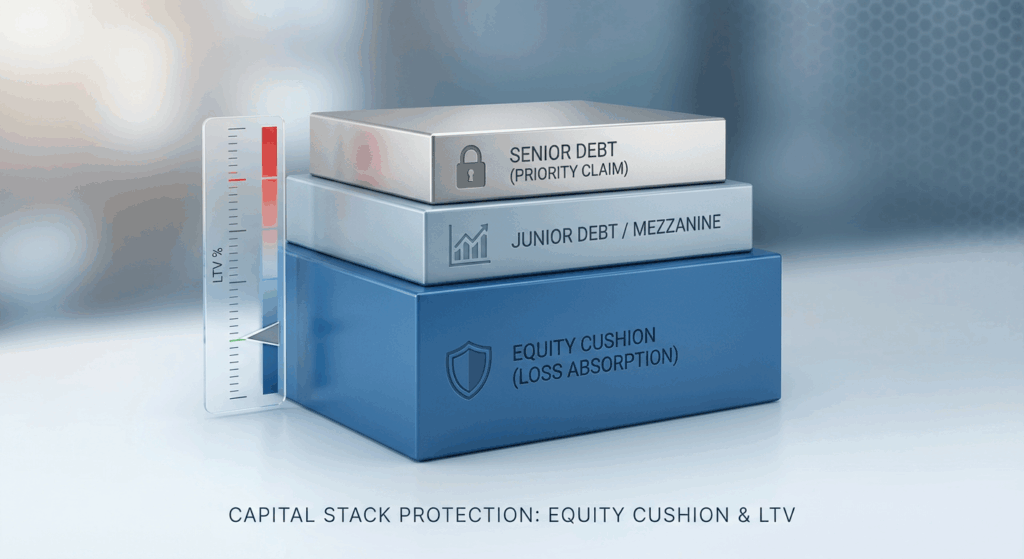
Every company that borrows money has a capital stack: a layered hierarchy of financing sources organized by repayment priority. At the top sits senior debt, which gets paid first. At the bottom sits common equity, which gets paid last and absorbs losses first. The equity cushion is simply the dollar value of equity (and any subordinated debt) sitting below a lender’s position.
This is measured using the Loan-to-Value (LTV) ratio: the loan amount divided by the total enterprise or asset value of the borrower. A 60% LTV means the lender has advanced 60 cents for every dollar of enterprise value, leaving a 40% equity cushion beneath them. If the company’s value declines by 30%, the senior lender is still fully protected. If it declines by 50%, the lender faces impairment.
According to Corporate Finance Institute, senior debt is considered the safest form of capital precisely because lenders hold first-priority claims on both cash flows and collateral, making the size of the equity layer below them a direct proxy for their downside protection.
The relationship is intuitive: the larger the equity cushion, the more enterprise value must evaporate before a senior lender loses a dollar of principal. Conversely, thin equity means lenders are exposed much sooner when a borrower runs into trouble.
A Concrete Example: Two Deals, Same Loan, Very Different Risk
Consider two middle-market companies, each borrowing $6 million from a private credit fund.
Company A has a total enterprise value of $10 million. The $6 million senior loan represents a 60% LTV, leaving a $4 million equity cushion (40%). If the business deteriorates and enterprise value falls 35% to $6.5 million, the lender is still covered.
Company B has the same $6 million loan but a total enterprise value of only $7.5 million. That is an 80% LTV, leaving just a $1.5 million equity cushion (20%). A 25% decline in enterprise value, to $5.6 million, leaves the lender exposed to a principal shortfall of roughly $400,000.
Same loan amount. Same borrower revenue. Dramatically different risk profiles. The equity cushion is what separates them.
This logic also explains why lenders at different levels of the capital stack demand different rates. As AdaptCFO notes, senior debt typically carries rates of 4–8%, mezzanine debt 10–15%, and common equity demands uncapped returns, each reflecting how far down the repayment waterfall that capital sits, and how thin the cushion beneath it is.
Current Market Relevance: The Cushion Is Being Tested
Private credit has grown from a niche institutional strategy into a $2+ trillion asset class, with projections from Long Angle’s 2026 Private Credit Investment Guide suggesting the market could reach $4.5 trillion by 2030. That growth has brought structural shifts that directly affect equity cushion dynamics.
- Private credit AUM: $2+ trillion globally, Long Angle, 2026
- Direct lending share of private credit capital raised (H1 2025): 38%: Long Angle, 2026
- Historical direct lending default rate since 2021: under 4%: Proskauer Private Credit Default Index via Long Angle
- Bank lending as share of U.S. GDP: 44% (Q1 2025), down from 59% in Q4 2008, Long Angle, 2026
- Typical senior commercial real estate LTV cap: 75%: AdaptCFO
Two structural trends are putting equity cushions under pressure. First, as Shell Capital Management highlights, floating-rate loan structures mean that as base rates rise 3–5%, borrower interest expense rises equivalently: compressing free cash flow and, ultimately, enterprise value. A business worth $10 million when rates were near zero may be worth less today, shrinking the cushion without any change to the loan balance.
Second, the rapid influx of capital into private credit has, in some segments, compressed spreads and loosened underwriting standards, a dynamic that can allow borrowers to enter deals with thinner equity contributions than lenders would have historically required. Maturity walls building into 2026–2028 and the growing use of payment-in-kind (PIK) interest structures are signs that some equity cushions are being managed rather than rebuilt.
Decision Framework: Investors and Operators
For Investors Evaluating Private Credit Funds
- Ask for weighted average LTV across the portfolio. A fund reporting average LTVs above 70–75% in senior secured deals warrants closer scrutiny of underwriting standards and borrower equity contributions.
- Understand how enterprise value is being calculated. Cushions measured against peak EBITDA multiples may look healthy on paper but erode quickly if multiples compress.
- Distinguish between cushion from equity and cushion from junior debt. Subordinated debt absorbs losses before senior lenders, but it behaves differently from true equity; it has fixed maturity obligations that can trigger restructuring events.
- Track covenant quality alongside LTV. A well-maintained equity cushion is only part of the protection package. Financial maintenance covenants, which require borrowers to meet ongoing performance tests, give lenders early warning and intervention rights before the cushion erodes.
For Business Owners Seeking Capital
- Your equity contribution directly affects your cost of capital. Lenders price risk based on LTV. A stronger equity position (even if assembled through retained earnings or co-investor equity) typically unlocks tighter pricing on senior debt.
- Understand the full capital stack before adding layers. As CapitalXO explains, adding mezzanine debt increases total leverage and may trigger covenant violations on existing senior facilities. Model the full stack, not just the new instrument.
- Thin equity creates optionality for lenders, not owners. When enterprise value approaches the loan balance, lenders gain structural leverage in negotiations. Maintaining a healthy equity buffer preserves the owner’s seat at the table.
Key Takeaways
- The equity cushion is the primary loss-absorption mechanism in any private credit deal. LTV ratio is its most direct measurement.
- Lower LTV = lower lender risk = lower borrowing cost. Every percentage point of equity below a senior loan is protection that lenders price into their rate.
- Rising rates compress enterprise values and free cash flow, thinning cushions without any change to loan balances, a risk that floating-rate structures do not eliminate.
- Investors evaluating private credit funds should look beyond headline yield to portfolio LTV, covenant quality, and how enterprise value is being assessed in underwriting.
- Business owners who understand the cushion dynamic can negotiate more effectively, a stronger equity contribution is not just a requirement, it is a cost-of-capital lever.


