
Why the Equity Beneath Your Loan Matters More Than the Rate Above It
When evaluating a private credit investment or structuring a business loan, most attention flows toward the obvious variables: the interest rate, the term, the covenants. But seasoned lenders will tell you that none of those terms matter as much as one foundational question, how much equity sits between my loan and zero?
This is the concept of the equity cushion, and its companion metric, the loan-to-value ratio (LTV). Together, they represent the single most durable form of downside protection in senior secured private credit. They are not a guarantee against loss, no metric is, but they define the distance a borrower’s enterprise value must fall before a lender’s principal is impaired. In a market where bank lending standards are tightening and middle-market companies increasingly turn to private credit for capital, understanding this mechanism is foundational for both investors evaluating allocations and operators deciding how to structure their debt.
This article breaks down how equity cushion and LTV protection actually work, walks through a concrete numerical example, and connects the concept to where the private credit market stands today.
The Mechanism: What the Equity Cushion Actually Does
A loan-to-value ratio expresses a loan’s outstanding balance as a percentage of the underlying asset or enterprise value it is secured against. The formula is simple:
LTV = Loan Amount ÷ Collateral or Enterprise Value
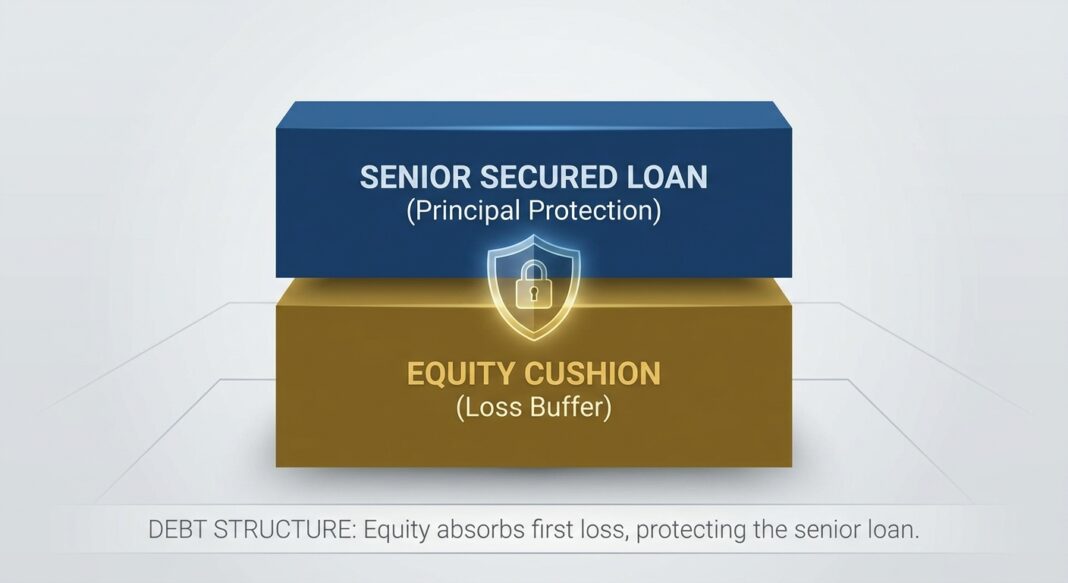
If a private credit fund lends $40 million against a business valued at $100 million, the LTV is 40%. The remaining 60%, the portion not financed by debt, is the equity cushion. That cushion is the first layer of capital to absorb losses if the business deteriorates. The lender’s principal is only threatened once losses exceed that 60% buffer.
This structure reflects a core principle of the capital stack: equity holders bear losses first, debt holders bear losses last (among the senior secured tier). When a private credit lender holds a senior secured, first-lien position, they sit at the very top of the repayment hierarchy. Every dollar of equity capital contributed by the private equity sponsor (or the business owner) acts as a buffer protecting the lender’s position.
The equity cushion is not static. It expands when enterprise value grows and contracts when it shrinks. Rising EBITDA, multiple expansion, or operational improvements all increase the cushion. Earnings declines, multiple compression, or sector headwinds erode it. This is why lenders monitor the cushion continuously, not just at origination.
A Concrete Example: Seeing the Cushion Under Stress
Consider a hypothetical middle-market manufacturing company with the following profile at origination:
- Enterprise Value: $100 million (implied by a 10x EBITDA multiple on $10M EBITDA)
- Senior Secured Loan: $45 million
- Equity Contributed by Sponsor: $55 million
- LTV at Origination: 45%
- Equity Cushion: 55%
Now stress the scenario. A demand slowdown hits the sector. EBITDA falls 30%, from $10 million to $7 million. The market re-rates the sector, compressing the EBITDA multiple from 10x to 8x. The new enterprise value is $56 million.
- Post-Stress Enterprise Value: $56 million
- Outstanding Loan: $45 million (unchanged)
- Post-Stress LTV: 80%
- Remaining Equity Cushion: $11 million, or 20%
The cushion compressed sharply, but the lender’s $45 million principal is still covered by $56 million in enterprise value. The equity holder absorbed roughly $44 million in value destruction before the lender’s position was impaired. This is the equity cushion working exactly as designed: sponsor equity acts as a first-loss tranche, absorbing downside before it reaches the senior secured lender.
If the loan had been structured at 70% LTV instead, a $70 million loan against $100 million, that same stress scenario would have pushed the LTV to 125%, leaving the lender with an impaired position and the borrower underwater. The difference between a 45% and a 70% LTV is not just a number; it is the difference between a loan that survives a downturn and one that does not.
Current Market Reality: What the Data Says in 2026
The equity cushion concept is not merely theoretical; it is actively shaping underwriting discipline and investor confidence in today’s private credit market. Several real data points illustrate where things stand:
Data Snapshot: Private Credit Equity Cushion & Market Metrics (2026)
| Metric | Data Point | Source |
|---|---|---|
| Average LTV, Cliffwater Corporate Lending Fund | ~41% | Swedroe / Cliffwater, Apr 2026 |
| Average LBO Equity Contribution at Origination | ~50% (up from ~35% in 2013) | Partners Group, May 2026 |
| Senior Secured Loans w/ Financial Maintenance Covenant | 100% (private middle market) | Kayne Anderson BDC 10-Q, Q1 2026 |
| Bank C&I Lending Standards (Q1 2026) | Net tightening, all firm sizes | Federal Reserve SLOOS, Apr 2026 |
| Global Private Credit AUM | ~$3.2 trillion | PIMCO, Jun 2026 |
| Private Credit AUM Projected by 2030 | $4.5 trillion | Preqin via IQ-EQ, Feb 2026 |
Two trends stand out. First, equity cushions have grown meaningfully over the past decade. According to Partners Group (May 2026), average equity contributions at LBO origination have climbed from approximately 35% in 2013 to around 50% today, meaning sponsors are putting substantially more of their own capital at risk ahead of the lender. That increase directly expands the equity cushion protecting senior debt.
Second, lenders have maintained underwriting discipline. According to the Heron Finance Private Credit Benchmark Report (Q2 2026), LTV ratios across private credit segments remain conservative, with stable readings indicating that lenders have not materially loosened underwriting standards over the past three years. Critically, fund-level leverage currently sits at a manageable 1.0x debt-to-equity ratio, though analysts note the figure warrants monitoring if it trends toward 1.2x.
The bank lending backdrop reinforces private credit’s structural role. The Federal Reserve’s April 2026 SLOOS reported that banks, on balance, tightened lending standards for commercial and industrial loans to firms of all sizes in Q1 2026, a continuation of a multi-quarter pattern. As traditional bank credit contracts, middle-market companies increasingly depend on private credit lenders who structure deals with explicit equity cushion discipline.
It is worth noting that stress is not absent. Non-accrual rates have edged higher, reaching 1.4% in Q1 2026 according to Heron Finance, concentrated among smaller borrowers. This is precisely where thin equity cushions and higher LTVs tend to surface first. Conservative LTV underwriting is not an academic exercise; it is the variable that separates recovering loans from impaired ones in a stress cycle.
Decision Framework: How Both Audiences Should Use This Concept
For Investors Evaluating Private Credit Funds
Equity cushion and LTV are screening tools, not guarantees. When evaluating a private credit allocation, investors may consider asking:
- What is the portfolio’s weighted average LTV? Figures below 50%, as seen in funds like the Cliffwater Corporate Lending Fund at ~41%, represent substantially more protection than portfolios running 60–70% LTVs.
- What percentage of loans are first-lien senior secured? First-lien position means the lender holds the legal claim at the top of the repayment hierarchy. Subordinated lenders have a smaller effective cushion.
- Has LTV discipline held across vintages? In competitive fundraising environments, managers sometimes stretch LTVs to win deals. Reviewing LTV trends across fund vintages reveals whether underwriting standards have drifted.
- What is the sponsor equity commitment? Higher sponsor equity at origination (and the accountability it creates) is a qualitative signal alongside the quantitative LTV.
For Business Operators Seeking Capital
Business owners and CFOs benefit from understanding how lenders think about equity cushion when they approach private credit markets for financing:
- Lenders price risk against your equity buffer, not your income statement alone. A business with strong EBITDA but little hard asset value (or a thin sponsor equity contribution) will face tighter terms or lower advance rates than a comparable business with 50% equity in the deal.
- Sponsor equity is a negotiating signal. Increasing the equity contribution at origination, even modestly, can improve loan pricing, reduce covenant burden, or increase the lender’s willingness to provide growth capital.
- Understand your implied LTV before entering negotiations. Calculate your enterprise value using a conservative EBITDA multiple, divide your requested loan by that figure, and understand whether your LTV is likely to be viewed as conservative (<50%), moderate (50–65%), or stretched (>65%) by the lender you are approaching.
Key Takeaways
- The equity cushion is the lender’s primary buffer. It defines how far enterprise value must fall before a senior secured loan faces principal impairment, making it more structurally important than the interest rate itself.
- LTV discipline has held in 2026. Data from Heron Finance (Q2 2026) and Cliffwater indicates that average LTVs across private credit portfolios remain conservative, with the Cliffwater Corporate Lending Fund reporting a ~41% average LTV across more than 4,000 loans.
- Sponsor equity contributions have grown significantly. Average LBO equity at origination has risen from roughly 35% in 2013 to approximately 50% today, according to Partners Group, a structural improvement in cushion depth that benefits senior lenders.
- Bank tightening amplifies private credit’s role. The Federal Reserve’s April 2026 SLOOS confirmed continued tightening of C&I lending standards, pushing more middle-market borrowers toward private credit structures, where equity cushion discipline governs deal terms.
- LTV is a screening metric, not a guarantee. Stress scenarios can compress cushions rapidly, as the manufacturing example illustrates. Investors evaluate both the starting LTV and the lender’s ability to restructure early when cushions erode, a capability that direct lenders with bilateral relationships are structurally better positioned to exercise than public market participants.


