
The Architecture of Risk: Introducing the Capital Stack
In the evolving landscape of corporate finance, the shift of lending from traditional commercial banks to private investment funds has introduced entirely new vocabularies to both investors and operators. At the very core of this asset class lies a foundational concept that dictates every return profile, every risk metric, and every legal contract in the industry: the capital stack.
The capital stack is the hierarchical structure of all capital invested in a company. It is essentially an organized waiting line that determines precisely who gets paid first (and who takes the loss first) when a company generates cash flow or faces financial distress. For investors evaluating private credit opportunities, understanding where a loan sits in this stack is the primary driver of predictable yields. For business owners and operators, determining which slice of the stack to utilize dictates their cost of capital, operational flexibility, and ultimate ownership dilution.
The Concept: Seniority and Subordination
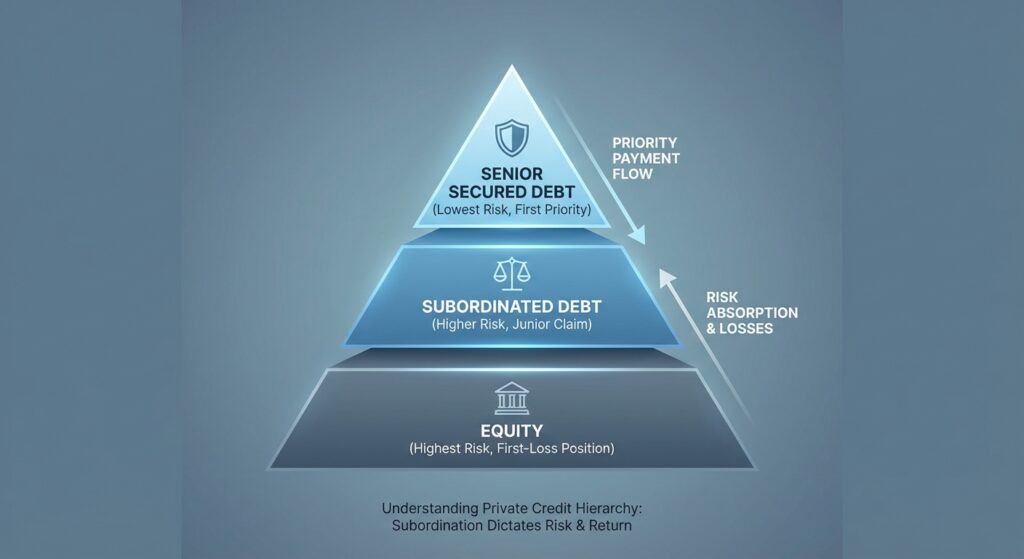
To conceptualize the capital stack, visualize a pyramid. Capital at the top is the safest, and capital at the bottom is the riskiest. This hierarchy is defined by two interlocking principles: seniority and subordination.
Senior Secured Debt sits securely at the peak of this pyramid. It holds the “first lien,” meaning it has the absolute first claim on a company’s assets, intellectual property, and cash flows. Because of this heavily protected position, senior debt carries the lowest comparative risk and, consequently, the lowest interest rate in the debt structure.
Directly beneath senior debt is Subordinated Debt (often referred to as mezzanine or junior debt). Subordination is a legal agreement stating that junior lenders will not receive their principal back during a liquidation or bankruptcy until the senior lenders are entirely made whole. Because subordinated lenders take on this elevated structural risk, they demand a higher yield to compensate for the possibility of capital impairment.
At the absolute foundation of the pyramid lies Equity. Equity holders (founders, venture capitalists, or private equity sponsors) own the upside of the business but sit in a “first-loss” position. If everything goes right, equity reaps the largest reward. If a company fails, equity holders lose their entire investment before any debt holder loses a single dollar.
How It Works: The Flow of Capital and the Equity Cushion
The mechanics of the capital stack are best understood through a stress-test scenario. Imagine a mid-sized enterprise software company with an Enterprise Value (EV) of $100 million. To fund a transformational acquisition, the company requires $60 million in debt financing.
The capital stack for this transaction is structured as follows:
- Senior Secured Debt: $40 million (targeting a 10% yield)
- Subordinated Debt: $20 million (targeting a 14% yield)
- Equity Value: $40 million (the remaining company value held by shareholders)
Under this structure, the senior debt has an equity cushion of $60 million (the $20M sub debt + $40M equity). This means the company’s value would have to plummet by 60% before the senior lender’s principal is threatened. This dynamic provides a deep protective moat, also known as Loan-to-Value (LTV) protection.
Now, consider a severe market contraction where the company is severely mismanaged and forced into liquidation. The company’s underlying assets are sold, generating only $55 million in total enterprise value. Because of the subordination agreements, the losses are distributed from the bottom up:
- The Equity Layer (The Bottom): Shareholders absorb the first $40 million in losses. Their position is completely wiped out, resulting in a 0% recovery.
- The Subordinated Layer (The Middle): After the equity is depleted, the remaining $5 million shortfall hits the subordinated lenders. They receive $15 million, taking a 25% loss on their principal.
- The Senior Layer (The Top): Because the liquidated value of $55 million is more than enough to cover their $40 million position, the senior lenders receive 100% of their principal and accrued interest. Their position was successfully insulated by the layers of capital beneath them.
Current Market Relevance
The prioritization of capital and structural downside protection has rapidly expanded the private credit sector as broader macroeconomic volatility persists. According to industry data tracked by Mayer Brown (2025), global private credit assets under management (AUM) surpassed the $1.7 trillion mark at the end of 2023 and are actively projected to balloon to approximately $3 trillion by roughly 2028. This growth is driven heavily by the stability of the senior secured position.
Allocators across the spectrum are recognizing the yield-to-risk benefits of senior-secured positions in the modern interest rate environment. The UBS Global Family Office Report 2025 revealed that family offices effectively doubled their private credit allocations from 2% to 4% over a single year, making it the fastest-growing allocation within their portfolios. Current market conditions emphasize why this reach for senior debt makes mathematical sense: senior direct lending facilities have consistently paid out yields of 10% to 12%+ while the underlying SOFR rate sat near 4.3%.
Furthermore, innovations like the Unitranche structure have emerged heavily over recent years, according to Umbrex. Unitranche blending combines both the senior and subordinated tranches into a single loan facility with a single, blended interest rate. This streamlines the complexities of the capital stack for borrowers while allowing lenders to manage the underlying risk-reward internally among their own fund structures.
Decision Framework
Understanding where a financial instrument legally resides in the capital stack is critical for both the investors providing the capital and the operators utilizing it to scale a business.
For Investors and Capital Allocators:
Investors evaluate private credit strategies primarily by balancing their required rate of return against their appetite for capital impairment. LPs seeking reliable cash flows, lower volatility, and strong downside protection typically target funds focused on Senior Secured Debt strategies. While the headline yields may be lower than opportunistic credit, the presence of a strong equity cushion minimizes default severity. Conversely, allocators needing higher target yields to meet portfolio mandates might deploy capital into Subordinated Debt or Mezzanine funds. They accept the higher risk of loss in a downside scenario in exchange for elevated interest rates and potential equity “kickers” like warrants.
For Business Operators and Founders:
Entrepreneurs evaluate their capital stack decisions based on the cost of capital, cash flow requirements, and ownership preservation. Senior debt is the cheapest form of non-dilutive capital available, but it often mandates strict financial maintenance covenants, heavy cash interest payments, and regular principal amortization, meaning it drains current cash flow. Subordinated debt, while carrying a significantly higher interest rate, frequently offers far more operational flexibility. It often features less restrictive covenants and may employ Payment-In-Kind (PIK) interest, where the interest expense is added to the principal balance rather than paid in cash today. This acts as a bridge, allowing operators to prioritize growth without immediately diluting their own equity stake.
Key Takeaways
- Seniority Provides Absolute Priority: Capital structured at the top of the stack (Senior Secured Debt) holds the very first legally protected claim on business assets and cash flows.
- Downside Protection Derives from the Cushion: A lender’s safety is dictated by the amount of subordinated capital and equity directly positioned beneath them to absorb initial enterprise value losses.
- Risk and Return Must Mathematically Align: Subordinated debt is fundamentally riskier than senior debt; therefore, it requires undeniably higher yields or structural enhancements to justify the first-loss exposure.
- Unitranche Simplifies the Stack: Innovations like unitranche lending blend senior and junior debt into a single solution, offering business transitionary capital with enhanced execution speed.
- Dilution vs. Cost of Capital is the Ultimate Tradeoff: For operators, choosing between equity, subordinated debt, and senior debt requires balancing current cash requirements with long-term ownership dilution boundaries.


