
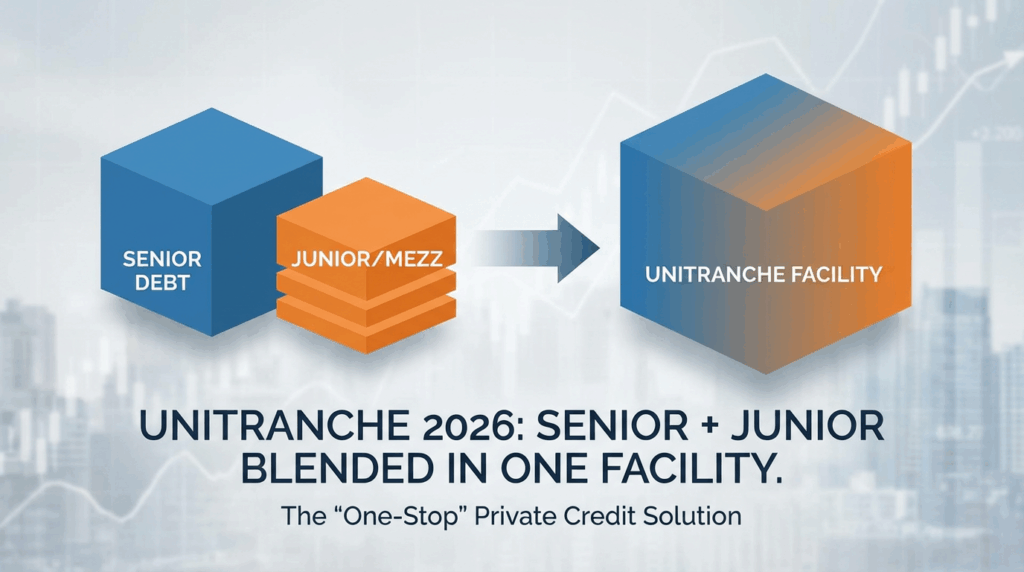
The Financing Challenge: Certainty vs. Cost
In the middle-market buyout landscape of 2026, sponsors and operators face a recurring structural dilemma: optimize for the lowest cost of capital or prioritize execution speed and certainty. Traditional financing stacks, pairing a senior bank loan with a mezzanine tranche, often offer a lower weighted average cost of capital (WACC) on paper. However, the complexity of intercreditor negotiations and multi-party diligence can introduce deal risk.
Unitranche financing has emerged as the dominant solution to this friction. By blending senior and junior risk into a single instrument, unitranche structures offer a “one-stop” debt solution. While historically viewed as a more expensive product for distressed or complex credits, it is now the standard bearer for high-quality middle-market leverage, commanding massive market share due to its efficiency and the massive growth of private credit funds.
Structure Breakdown: Components and Mechanics
At its core, a unitranche facility is a single credit agreement with one set of covenants, one interest rate, and one collateral package. Unlike a senior-mezzanine structure, where two distinct groups of lenders hold different liens and rights, the unitranche borrower interfaces with a single administrative agent.
The “Behind the Scenes” Bifurcation
While the borrower sees a seamless loan, the risk is often tranched internally among lenders via an Agreement Among Lenders (AAL). This document creates a “First Out” (senior risk) and “Last Out” (junior risk) waterfall without the borrower needing to sign separate documents.
- First Out (FO): Typically held by banks or low-cost credit funds. Receives lower interest but gets paid first in a liquidation.
- Last Out (LO): Held by higher-yield private credit funds or BDCs. Carries higher risk and return.
Example Term Sheet: $50M Unitranche
Consider a hypothetical software company with $10M EBITDA being acquired for $100M (10x EV). A typical unitranche financing package might look like this:
- Total Facility: $55M (5.5x Total Leverage)
- Pricing: SOFR + 5.75% (Floating)
- Floor: 1.0%
- Upfront Fee: 2.0%
- Amortization: 1.0% per annum
- Call Protection: 102/101/100 (Hard call for 1 year, soft call year 2)
- Covenants: Single financial maintenance covenant (e.g., Total Net Leverage Ratio not to exceed 6.5x)
In this structure, the “blended” rate of S+575 simplifies the capital stack, removing the need for warrants (common in mezzanine) or complex intercreditor standstills.
How It Compares: Unitranche vs. Senior-Mezz
The choice between unitranche and a split structure comes down to the trade-off between simplicity/leverage and pricing/dilution.
Unitranche Strategies
Pros:
- Speed: Median sign-to-fund time is approximately 45 days, compared to nearly 70 days for senior-mezzanine transactions financl-group.com.
- Higher LTV: Unitranche deals often secure 55-65% LTV, whereas senior bank loans typically cap out at 40-50%, forcing borrowers to find expensive junior capital to fill the gap.
- No Equity Kickers: Unlike structural mezzanine debt, which often requires 5-15% warrant coverage, unitranche is pure debt, preserving equity upside for sponsors and founders.
Cons:
- Blended Cost: The coupon is higher than a senior bank loan. If the company de-levers quickly, they may be overpaying for a risk premium they no longer need.
- Prepayment Penalties: Private credit lenders demand yield protection, often requiring stricter call protection than commercial banks.
Current Market Terms (2025-2026)
As of early 2026, the unitranche market has stabilized following the aggressive rate hikes of previous years. Private credit assets under management have surpassed $2 trillion, driving competition and compressing spreads for high-quality borrowers privateequitybro.com.
Standard Market Terms:
- Spreads: SOFR + 475 to 575 basis points for core middle-market credits.
- Leverage: Total leverage ratios are hovering around 5.0x to 6.0x EBITDA for healthy businesses.
- Documentation: “Document-light” is a misconception; while there is only one credit agreement, covenant packages have tightened slightly compared to the 2021 peaks. However, “covenant-lite” (incurrence only) structures remain available for larger middle-market issuers ($50M+ EBITDA).
- Refinancing capability: The “portability” of debt (allowing a change of control without triggering repayment) is a key negotiation point in current term sheets.
Structuring Guidance & Negotiation
For Operators & Borrowers
When negotiating a unitranche facility, focus on the definition of EBITDA. Private credit lenders are often more flexible than banks regarding “add-backs” (adjustments for synergies, one-time costs, etc.). A surprisingly high nominal leverage ratio (e.g., 6.0x) might effectively be 4.5x if the EBITDA definition is strict. Negotiate for:
- EBITDA Cushions: Ensure financial covenants are set with at least a 25-30% cushion to your base case model.
- Delayed Draw Term Loans (DDTL): secure a committed line for future acquisitions at closing pricing to avoid renegotiating when you want to grow.
For Investors & Lenders
If participating in a unitranche syndicate (specifically in a Last-Out position), the Agreement Among Lenders (AAL) is critical. Ensure you understand:
- Voting Rights: Does the First-Out lender have the sole right to declare a default? Alternatively, can the Last-Out lender block waivers that erode their collateral protection?
- Buyout Rights: Can the Last-Out lender buy out the First-Out position at par in a distress scenario to take control of the workout?
Key Takeaways
- Speed Premium: Unitranche closes ~35% faster than bifurcated structures, crucial for competitive auctions.
- Blended Efficiency: Combining senior and junior risk removes intercreditor friction and warrant dilution.
- Leverage Depth: Offers deeper leverage (up to 6.0x) than traditional bank constraints allow.
- Private Tranching: Risk is split via an AAL, invisible to the borrower but critical for lender risk management.
- Cycle Resistant: As banks retreat during volatility, unitranche funds (Direct Lenders) provide consistent liquidity.


