
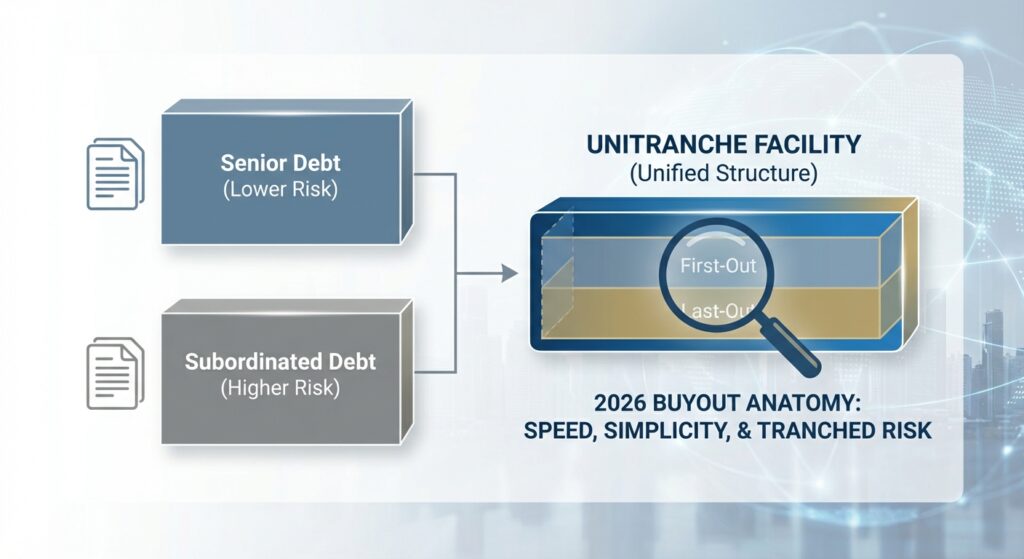
For middle-market operators and sponsors in 2026, the financing landscape often presents a binary choice: prioritize speed and certainty with a single lender, or prioritize the lowest cost of capital by stitching together a syndicate. While the broadly syndicated loan (BSL) market has reopened significantly since the volatility of previous years, the unitranche facility remains the dominant instrument for middle-market buyouts, largely due to its structural simplicity and execution speed.
The unitranche (a hybrid loan structure combining senior and subordinated debt risks into a single instrument) has evolved from a niche product into a fundamental tool for acquisition finance. This article deconstructs the anatomy of a modern unitranche facility, examining its internal mechanics, current pricing trends, and strategic trade-offs compared to traditional senior-mezzanine stacks.
Anatomy of the Structure
At its core, a unitranche facility is a single debt instrument governed by one credit agreement with one interest rate. However, the simplicity facing the borrower often masks complex engineering behind the scenes.
The “One-Doc” Advantage
Unlike a traditional capital stack that requires an intercreditor agreement between senior banks and mezzanine lenders, a unitranche requires only one set of loan documents. This eliminates the friction of negotiating conflicting covenants, cure rights, and enforcement mechanics between competing creditor classes. According to PipelineRoad, this consolidation allows for a single lender relationship and removes the need for a public intercreditor agreement, collapsing the entire capital structure below equity into a single instrument.
The Bifurcation: First-Out / Last-Out
While the borrower pays a blended rate (e.g., SOFR + 575 bps), the risk is often privately tranched among lenders through an Agreement Among Lenders (AAL). Make no mistake: the subordination still exists, it is just invisible to the borrower.
- First-Out Tranche: Typically held by a bank or low-cost institutional fund, taking the first 3.0x-3.5x of leverage at a lower rate (e.g., SOFR + 450 bps).
- Last-Out Tranche: Held by a credit fund or BDC, taking the remaining leverage (up to 5.5x-6.0x) at a premium returns profile (e.g., SOFR + 900+ bps).
Deal Profile: $100M Enterprise Value Buyout
To illustrate the mechanics, consider a hypothetical software buyout with a $100M Enterprise Value (EV) and $10M EBITDA.
The Term Sheet:
- Facility Size: $55M Unitranche Term Loan (5.5x leverage)
- Pricing: SOFR + 575 bps (Blended)
- OID (Original Issue Discount): 98.0
- Amortization: 1.0% per annum
- Tenor: 6 years
- Call Protection: 102, 101, Par (Soft call protection for 2 years)
- Financial Covenant: Single maintenance covenant (Net Leverage Ratio), set with 35% headroom.
In this structure, the sponsor locks in 5.5x leverage in a single motion. If they had pursued a traditional bank loan, they might have secured 3.5x senior leverage at SOFR + 350 bps, requiring a separate mezzanine slice of 2.0x to fill the gap. That mezzanine tranche would likely require 11-13% coupons plus Payment-In-Kind (PIK) or warrants.
Strategic Comparison: Unitranche vs. Senior-Mezz
Choosing between unitranche and a bifurcated structure is rarely just about the interest rate. It is a functional decision regarding deal certainty and dilution.
1. Execution Speed and Certainty
Data from Financely indicates a significant “speed premium” in the current market. The median sign-to-fund timeline for a unitranche is approximately 45 days, compared to nearly 70 days for a senior-mezzanine dual track. In competitive auctions, saving 25 days can be the difference between winning and losing a bid.
2. Dilution and Cost
While the headline spread on a unitranche (SOFR + 550-600) is higher than a senior bank loan (SOFR + 350-400), the all-in cost must account for the mezzanine layer. Mezzanine debt often demands equity warrants (kickers) ranging from 1-5% of the fully diluted equity to achieve target IRRs. A unitranche structure is typically non-dilutive, preserving 100% of the upside for the sponsor and management.
3. Flexibility
Unitranche lenders generally offer more flexibility on “add-on” acquisitions. Since there is only one lender to convince, upsizing the facility (an “accordion” feature) to fund a bolt-on acquisition is administratively simpler than aligning a conservative senior bank and an aggressive mezzanine fund.
Current Market Terms (Q1 2026 Trends)
As of March 2026, the private credit market has stabilized following the rate volatility of previous years. Market participants note the following trends:
- Spreads: Average unitranche spreads have compressed slightly to SOFR + 525-600 bps for high-quality middle-market borrowers. PE Bro notes that sponsors are often willing to pay 50-100 basis points of extra spread over syndicated options to avoid “financing gaps” or broken syndications.
- Leverage: Total leverage levels are holding steady at 5.0x – 6.0x EBITDA, with lenders focusing heavily on free cash flow conversion rather than just headline multiples.
- Mega-Unitranches: The market is seeing an increase in “jumbo” unitranches exceeding $1B – $2B, as direct lending clubs pool capital to take private larger public companies without tapping the high-yield bond market.
- Documentation: “Document-light” processes are becoming standard, with many sponsors recycling incumbent documentation for refinancings to reduce legal costs.
Structuring & Negotiation Guidance
For Operators & Sponsors
When negotiating a unitranche, focus on the Incremental Facility (accordion) flexibility. Ensure you have a pre-agreed path to draw additional capital for acquisitions without triggering a full repricing. Additionally, scrutinize the definition of EBITDA carefully; lenders may offer a high headline leverage multiple but cap “add-backs” aggressively, effectively lowering your borrowing capacity.
For Investors & Lenders
In a club deal or first-out/last-out structure, the AAL is paramount. If you are the last-out lender, ensure you have “purchase rights” to buy out the first-out lender at par in a distress scenario. This prevents the risk-averse first-out lender from forcing a liquidation that destroys your junior capital value.
Key Takeaways
- Speed is Value: Unitranche deals close ~25 days faster than multi-tranche executions, justifying a higher spread in competitive M&A.
- Hidden Nuance: While borrowers sign one document, the risk is often tranched internally via an Agreement Among Lenders (AAL).
- No Dilution: Unlike mezzanine financing, unitranche rarely requires equity warrants, preserving upside for owners.
- Leverage Profile: Current market typically supports 5.0x-6.0x EBITDA, blending senior (3.5x) and junior risk tolerances.
- Covenant Efficiency: A single financial maintenance covenant allows for easier monitoring and waiver negotiation compared to multi-layered creditor classes.


