
The Buyback Nobody Saw Coming
In 2021, Francis Pedraza did something almost no VC-backed founder had the nerve (or the math) to attempt. With his AI-powered outsourcing startup Invisible Technologies finally generating real revenue, Pedraza decided he didn’t want more venture investors on his cap table. He wanted the existing ones off it. So he borrowed money to buy them out.
Over three years, Pedraza borrowed $20 million: first from growth lender Level Equity, later from JPMorgan, and used it to purchase shares from early passive investors at a valuation he helped set. The result: his employees collectively own 55% of a company now valued at $500 million, and Pedraza controls the ship without a VC boardroom second-guessing every move. According to forbes.com.au, Invisible grew from $3 million in revenue in 2020 to $134 million in 2024, generating $15 million in EBITDA, on just $23 million in total equity raised across its entire life.
It is one of the most striking founder-led leveraged recapitalizations of the modern startup era. And it stands in almost perfect contrast to a story unfolding at exactly the same moment, one that would end very differently.
The Capital Decision: When Debt Buys Freedom
Pedraza’s logic was straightforward, even if the execution was unusual. Invisible’s early investors had written their positions down to near zero during the company’s lean years. When the business finally inflected (fueled by contracts with DoorDash, OpenAI, Amazon, and Microsoft) those same investors held valuable equity but had no obvious path to liquidity. Pedraza saw an arbitrage.
“I believed that our equity would 10x in value, so it was an amazing arbitrage,” Pedraza told forbes.com.au. By setting the buyout valuation at $50 million in 2021 and borrowing against a business generating strong EBITDA, he was effectively acquiring a future dollar for a fraction of its forward value, using leverage to do it.
Yes, the Level Equity loan carried an effective interest rate as high as 20%. That sounds expensive. But consider the alternative: raising another equity round at a dilutive valuation, surrendering board seats, and accepting the VC clock, the implicit five-to-seven-year exit pressure that reshapes every strategic decision a founder makes. Pedraza chose the interest payments. He chose the debt. And in doing so, he chose the company’s direction.
The structure was disciplined. Invisible was EBITDA-positive. The debt was sized against real cash flows. The buyout unlocked employee ownership at scale, 300 current and former staff now hold stakes worth roughly $1 million apiece. Leverage here wasn’t reckless. It was precise.
The Counter-Story: When Debt Consumes Everything
Now flip the frame entirely. In October 2021, the same period Pedraza was engineering his buyback, rent-to-own startup Divvy Homes was closing $735 million in debt financing on top of hundreds of millions in venture equity. The company had just raised a $200 million Series D from Tiger Global at a $2.3 billion valuation. The model seemed airtight: buy homes, rent them back to aspiring owners, let appreciation do the heavy lifting in a zero-rate world.
When rates surged in 2022, the model broke. Divvy executed three rounds of layoffs, paused new acquisitions, and in January 2025 was acquired by Brookfield Properties for approximately $1 billion. As saastr.com reported, after repaying the $735 million in debt, covering transaction costs, and satisfying preferred equity liquidation preferences, founders, employees, and most investors received zero proceeds.
A billion-dollar exit. Nothing for the builders.
The math is brutal in its simplicity. Every dollar of debt sits senior to every dollar of equity in a liquidation waterfall. At Divvy, the line ran out of money before it ever reached common shareholders. CEO Adena Hefets acknowledged as much in her letter to shareholders, a document that reads as a masterclass in what happens when capital structure assumptions are not stress-tested against downside scenarios.
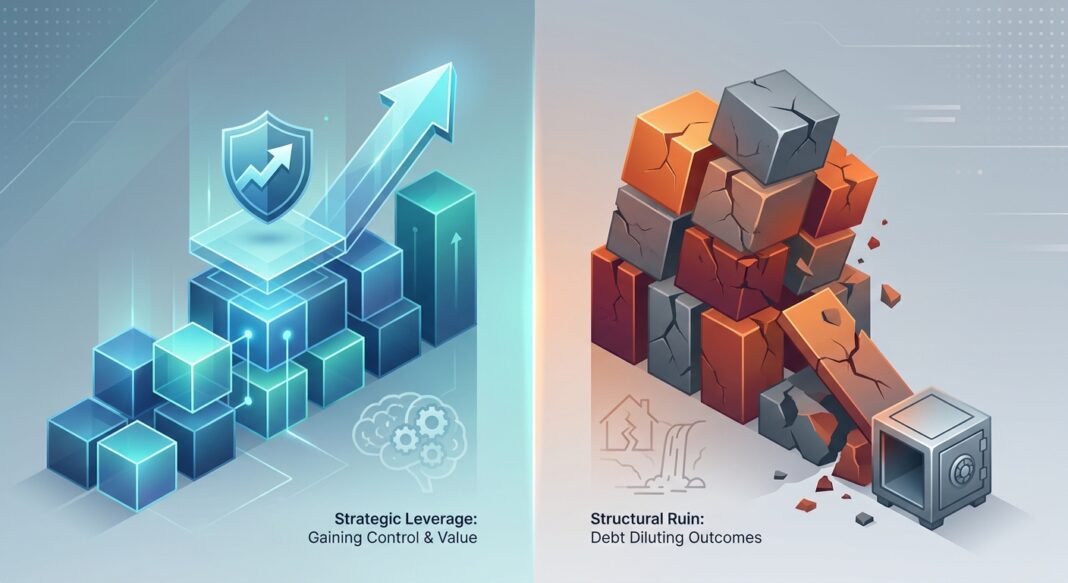
The lesson is not that Divvy’s founders were reckless. It is that debt doesn’t dilute ownership; it dilutes outcomes. At sufficient scale, relative to realistic exit scenarios, it can make ownership mathematically worthless.
The Middle Path: Non-Dilutive Capital in Smaller Hands
The Invisible vs. Divvy contrast plays out at a macro scale, but the same dynamics are reshaping founder decisions at every stage of company building. Two case studies from TIMIA Capital illustrate the principle at the growth-stage level.
Florida-based weapons detection startup SafePointe: founded by the father-son team of Greg and Timothy Holifield, secured a $1 million venture debt facility in September 2022. The capital solved a working capital bottleneck caused by hardware-embedded licensing: the company needed cash to fund the physical equipment before recurring revenue could be recognised. Within 12 months, SafePointe had tripled its monthly recurring revenue and was acquired by Nasdaq-listed SoundThinking (SSTI). According to timiacapital.com, the equity capital taken alongside the TIMIA debt delivered 10x returns to investors in nine months, while the debt cost only a fraction of that in interest.
Retail sales enablement platform Myagi followed a similar arc. Co-founder Simon Turner drew down a $2.5 million non-dilutive facility from TIMIA in 2021, using the capital to expand sales and marketing while preserving his cap table. ARR grew from $2.4 million to $4.4 million, and in 2023, Myagi was acquired by Rallyware. As timiacapital.com noted, Turner later reflected that he would “really weigh up the impact, time, and challenges of bringing on venture capital” if building again, particularly the growth-at-all-costs pressure that VC timelines impose on businesses with natural, sustainable cadences.
In both cases, debt was modest, targeted, and matched precisely to a revenue-generating use case. The waterfall never became a problem because the debt was sized to be repaid from operating cash flows, not from a future exit event.
The Principles That Separate Smart Leverage from Structural Ruin
Across these stories, a framework emerges for founders and operators navigating the debt-versus-equity decision:
1. Model Your Waterfall Before You Sign Anything
Every founder should be able to answer one question with precision: At what exit price do I personally receive zero? Divvy’s founders needed an outcome above their peak $2.3 billion valuation just to see a single dollar. If your debt load raises that zero-threshold to an unrealistic number, you are not building equity, you are building a call option that will almost certainly expire worthless.
2. Match Debt to Cash-Flow-Positive Use Cases
SafePointe borrowed to fund hardware that directly generated recurring revenue. Myagi borrowed to fund sales expansion in a proven land-and-expand model. Pedraza borrowed against EBITDA to acquire equity at a steep discount to forward value. In each case, the debt was attached to a mechanism that would service it from operations, not from a future raise or exit. Divvy’s $735 million was attached to an asset class whose refinancing and appreciation assumptions broke simultaneously.
3. Debt Is Cheaper Than Equity: Until It Isn’t
SafePointe’s Greg Holifield made the point plainly: when there are no warrants, debt is genuinely cheaper than equity. Pedraza paid up to 20% interest rates, and still came out miles ahead of what another dilutive round would have cost him in ownership percentage and strategic control. But “cheaper” is a statement about the cost of capital, not the risk of capital structure. Large debt relative to realistic exit scenarios is not cheap at any interest rate.
4. VC Clocks Reshape Strategy in Ways Founders Underestimate
Simon Turner’s reflection on VC pressure, that it pushes founders to grow faster than their market can sustain, is underappreciated in capital structure conversations. Debt is not emotionally neutral either, but its demands are financial, not strategic. A lender wants interest payments on schedule. A VC wants a markup to show their LP quarterly. These are different pressures, and they produce different decisions at the board level.
Key Insights
- Debt doesn’t dilute ownership; it dilutes outcomes. Owning 100% of a company burdened by $735 million in senior debt can be worth precisely zero at a billion-dollar exit, as Divvy Homes demonstrated in January 2025.
- Leveraged buybacks are a legitimate founder tool. Francis Pedraza borrowed $20 million to buy out passive VCs, retained strategic control, and distributed $275 million in equity value to 300 employees, without a single additional dilutive round.
- Size debt relative to operating cash flows, not to exit hopes. SafePointe and Myagi used debt facilities of $1–2.5 million against businesses with tangible recurring revenue, ensuring repayment came from operations, not from a future event that might not materialise.
- Model the waterfall at every plausible exit price before committing to debt. The single most overlooked discipline in startup finance is stress-testing capital structure against downside and median exit scenarios, not just optimistic ones.
- Non-dilutive capital preserves more than ownership; it preserves optionality. Founders who avoid unnecessary equity dilution retain the freedom to choose their own timeline: grow organically, sell on their terms, or hold indefinitely. That freedom is itself a form of return.


