
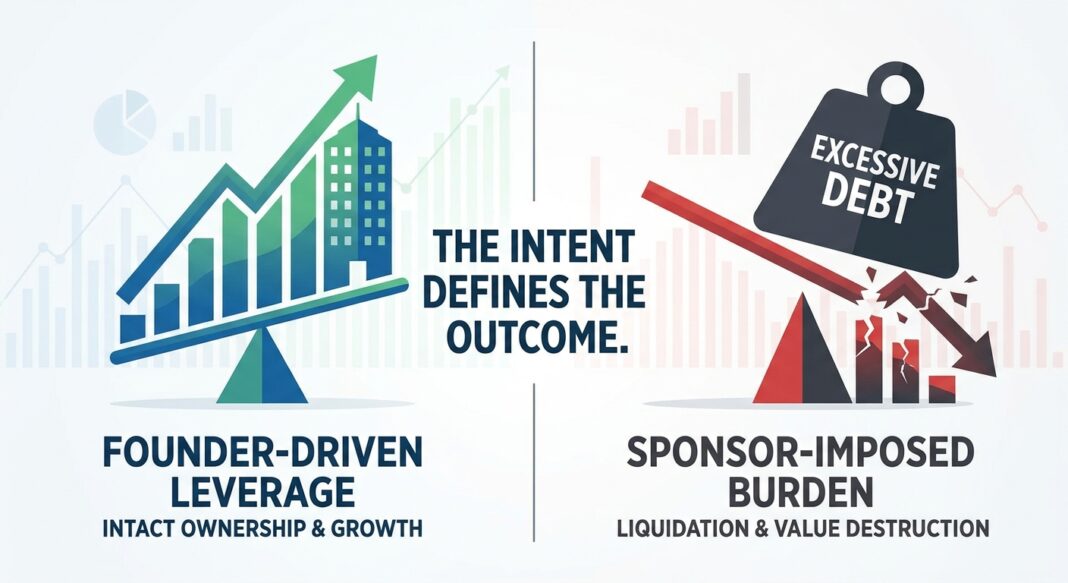
Debt as a Tool vs. Debt as a Weapon: Two Capital Structures, Two Opposite Outcomes
One founder used $2.5M in non-dilutive debt to grow ARR by 83% and sell on his own terms. One private equity firm used $2.5B in LBO debt to strip a beloved retailer, twice. The difference wasn’t the instrument. It was the intent behind it.
The Story: Same Instrument, Different Hands
In early 2021, Simon Turner (co-founder of Myagi, a Denver-based retail sales enablement SaaS platform) faced a decision that defines every capital-efficient founder’s career. His company had product-market fit, a growing customer base, and a land-and-expand model built for scale. What he needed was fuel. What he did not need was a venture capitalist sitting across a boardroom table, resetting his growth clock and taking 20 to 25 percent of his cap table to fund a sprint he wasn’t sure he wanted to run.
Turner had been through the venture capital world. He understood it intimately, and had grown skeptical of it. As he would later reflect after the Myagi exit: “Venture capitalists will challenge you to grow at all costs. One thing venture capital doesn’t take into account is that many businesses have a natural cadence at which they grow.” He chose a different path.
Now rewind fourteen years earlier, to 2007. In a very different boardroom, Apollo Global Management closed a $3.1 billion leveraged buyout of Claire’s, the mall-based teen accessories retailer founded by Rowland Schaefer’s family. Apollo loaded the acquired company with $2.5 billion in debt. Claire’s didn’t choose that capital structure. It was chosen for them, by a sponsor with its own return timeline, its own LP obligations, and no particular incentive to steward the business across a decade of shifting consumer behavior.
Same instrument, debt, deployed by two entirely different actors, with two entirely different purposes. The stories that followed couldn’t be more different.
The Decision: Who Controls the Debt Controls the Destiny
Myagi: Founder-Driven, Purposeful Leverage
Turner turned to TIMIA Capital for a $2.5 million non-dilutive investment facility. The capital was deployed directly into the business levers that mattered for Myagi’s model: a referral-based sales expansion, improved software capabilities, and enhanced customer success initiatives, the core components of the land-and-expand motion that defined how Myagi grew. No board seats changed hands. No liquidation preferences were stacked into the cap table. The repayment structure was tied to revenue performance, keeping debt service aligned with the business’s natural cash generation cycle.
Critically, Turner retained full ownership and full control. The decision to borrow, the amount borrowed, the deployment of proceeds, and the eventual timing of any exit, all of it remained in his hands. The debt was a tool in service of his strategy. Compare that to what a $2.5M equity round in 2021 would have required: equity dilution in the range of 20–25%, board governance changes, investor reporting obligations, and an implicit clock ticking toward a VC-mandated exit at a VC-preferred valuation multiple.
Claire’s: Sponsor-Driven, Extractive Leverage
When Apollo acquired Claire’s for $3.1 billion in 2007, it financed the purchase the way LBOs have always been financed, by placing the debt on the acquired company, not on the acquirer’s balance sheet. Claire’s, a profitable mall retailer with a loyal teenage customer base, suddenly found itself carrying an obligation it had not chosen and could not easily escape. The company was immediately capital-constrained: debt service consumed the cash flows that should have funded digital transformation, store experience investment, and competitive adaptation as consumer behavior began shifting away from malls.
The leverage ratio was high from day one. Eleven years later, Claire’s filed for bankruptcy for the first time, crushed under $2.1 billion in long-term debt. A restructuring passed the company to creditors. Seven years after that, in August 2025, Claire’s filed for bankruptcy a second time, with over $1 billion in liabilities remaining, and began liquidating its North American stores.
The Outcome: Numbers Don’t Lie
Myagi: 83% ARR Growth, Clean Exit, Founder Equity Intact
The results of Turner’s $2.5 million non-dilutive facility arrived quickly and cleanly. Myagi’s annual recurring revenue grew from $2.4 million to $4.4 million, an 83% increase that materially repositioned the company’s valuation ahead of any acquisition conversation. Seventeen months after the TIMIA facility was put in place, Myagi was acquired by Rallyware, a performance enablement platform for large-scale sales forces, in May 2023. Turner’s equity was largely intact at exit. The founding team was rewarded. The culture they had built over years was preserved in the combination. There were no liquidation preferences in front of the founders, no ratchets, no preferred stack diluting the common. The debt had been repaid through operations. The cap table told the same story at exit as it had on day one of the financing.
The counterfactual is instructive: had Turner raised a traditional $2.5M equity round in 2021, he would likely have surrendered between 20% and 25% of the company to do it. At exit, that dilution would have been permanent and compounding. Ownership retained at exit is the most direct measure of capital strategy success, and Myagi’s story validates that principle with real numbers.
Claire’s: Double Bankruptcy, Brand Liquidation, Stakeholders Left Behind
Apollo’s 2007 LBO-era debt structure held back every investment Claire’s needed to make as the retail landscape transformed. By mid-2025, the company was behind on rent and supplier payments. The debt that had financed a private equity acquisition nearly two decades earlier had never truly been resolved: only restructured, passed between creditors, and reloaded. The second bankruptcy filing in August 2025 was the final verdict. Moody’s noted in 2024 that private equity-backed companies defaulted at twice the rate of non-private equity-backed companies, and Claire’s illustrated exactly why: aggressive use of debt in service of sponsor returns, combined with rising interest rates and a declining operating environment, created a cycle the business couldn’t escape.
It is worth noting: the debt itself was not the villain. Plenty of retailers have carried meaningful leverage and built shareholder value with it. The problem was the purpose of the debt, the quantum of the debt relative to the business’s organic capacity to service it, and, most critically, the misalignment between who made the borrowing decision and who bore the consequences of it.
The Lessons: A Framework for Operators Facing a Capital Decision
These two stories, separated by more than a decade and vastly different in scale, converge on the same set of principles. Whether you’re a founder running a $3M ARR SaaS business or a family-owned manufacturer doing $15M in EBITDA, the framework applies.
1. Who initiates the debt matters as much as how much debt is taken on.
Turner chose his debt. Claire’s had it chosen for them. Founder-initiated leverage (sized to the business’s cash flow capacity and deployed toward owner-defined strategic goals) is fundamentally different from sponsor-imposed leverage sized to a sponsor’s acquisition price. The former is a tool. The latter is often a transfer of risk from buyer to company.
2. Debt preserves the cap table. Equity permanently dilutes it.
Compounding dilution through successive equity rounds (amplified by liquidation preferences and anti-dilution provisions) can dramatically reduce founder proceeds at exit. Debt, by contrast, leaves the cap table unchanged. For operators with proven cash flows and a clear deployment plan, debt is structurally superior to equity as a growth instrument.
3. Sizing discipline is everything.
Lower middle market leveraged recapitalizations typically close at 3x to 5x EBITDA in total debt. Staying within that band while maintaining adequate interest coverage is the discipline that separates successful transactions from distressed ones. Claire’s was loaded at multiples of what its operating cash flow could sustainably service. Staying within a serviceable leverage ratio (with room for a revenue cycle or an interest rate shift) is not a conservative instinct. It is a survival one.
4. The debt recap market is active, and growing.
This is not a niche strategy. Leveraged loan issuance tied to dividend recaps grew 11% year-over-year to $74.3 billion in 2025, following a 326% year-over-year surge in 2024. Private equity sponsors pulled over $34.7 billion out of portfolio companies through dividend recaps in the year ending September 2025, without selling a single share. The mechanism works at scale. For founder-owners who haven’t yet explored it, the market infrastructure is deep, the lender appetite is real, and the private credit expansion has extended access down into the lower middle market in ways that simply didn’t exist a decade ago.
5. Aligned debt is better than misaligned equity.
The cleanest lesson from both stories is this: the alignment between who makes the capital decision and who operates the business is the most important variable in any financing transaction. Turner’s debt was aligned; he chose it, he deployed it, he benefited from it. Apollo’s debt was misaligned, the sponsor benefited from the acquisition financing structure while the operating company carried the cost. Founders and operators should demand that alignment, whether they are borrowing through a non-dilutive facility, executing a leveraged recap, or evaluating a partial sale to a private equity partner.
Key Insights
- The instrument is neutral. Intent is everything. Debt deployed to serve the operator’s strategy preserves equity and optionality. Debt deployed to serve a sponsor’s acquisition economics transfers risk to the business without proportionate reward.
- Non-dilutive capital can be a direct path to exit. Myagi used a $2.5M revenue-based debt facility to grow ARR by 83% and achieve an acquisition exit in under two years, with founder equity intact at close.
- PE-imposed leverage at acquisition is structurally different from operator-initiated leverage. Claire’s double bankruptcy is not a story about debt being bad. It is a story about debt sized beyond serviceable capacity, placed on a business that didn’t choose it, with the proceeds flowing to a buyer rather than into operations.
- The recap market is institutional and growing. Leveraged loan issuance for dividend recaps hit $74.3 billion in 2025. Founder-owners who dismiss this mechanism as a PE-only tool are leaving a structurally advantaged liquidity option on the table.
- Sizing and alignment are the two variables that determine whether leverage creates or destroys value. Keep debt within 3x–5x EBITDA, deploy proceeds toward operational levers with measurable ROI, and ensure the person making the borrowing decision is the same person operating the business.


