
The Buyback Nobody Saw Coming
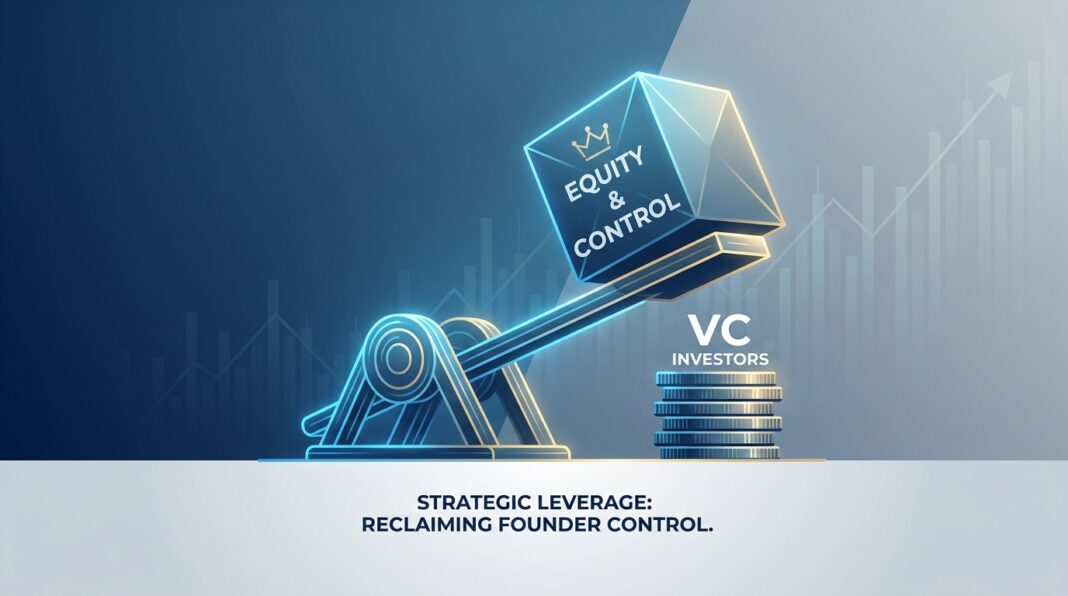
In 2021, Francis Pedraza did something almost no VC-backed startup founder does: he borrowed money specifically to buy his investors out.
Invisible Technologies, the AI-and-human-hybrid outsourcing firm that had quietly grown from $3 million to $134 million in revenue without ever raising a meaningful venture round, had finally attracted the kind of attention that most founders spend years chasing. But Pedraza wasn’t interested in handing more of the company to passive capital. He was interested in getting it back.
His tool of choice wasn’t a secondary share sale or a strategic acquirer. It was debt. First a $20 million facility from growth lender Level Equity, later refinanced through JPMorgan. With those borrowed dollars, Pedraza bought out his early venture investors at a valuation he himself helped set, around $50 million at the time, while the company was already on its way to a $500 million valuation. According to Forbes Australia, early angel investor Edward Lando, who had written one of the first checks at a $5 million valuation, later admitted: “The company keeps doing really well, and I often wish I hadn’t sold part of my position.”
For the founders and the 300 employees who collectively hold 55% of Invisible’s equity, the move was transformational. For the early VCs, it was a clean, if premature, exit. For everyone studying capital structure, it’s a clinic.
The Capital Decision: Dilute Again, or Borrow and Own?
The setup is familiar. A startup has outgrown its earliest backers. The early investors (angels, seed funds, a handful of small VCs) are sitting on paper gains but have little influence on the company’s direction. The founder wants to grow on their own terms. The obvious move, in Silicon Valley’s playbook, is another equity round: bring in a Series B or C, give up 20%, and use the fresh capital to scale.
Pedraza rejected that script entirely. His reasoning, as reported by Forbes Australia, was essentially an arbitrage calculation: “I believed that our equity would 10x in value, so it was an amazing arbitrage.” If the equity was going to appreciate dramatically, then borrowing at even a high interest rate, Level Equity’s facility carried an effective rate reportedly as high as 20%, was still cheaper than giving away a compounding share of future value.
The math holds up. A 20% interest rate on $20 million costs $4 million annually. But selling 15% of a company that goes from $50 million to $500 million in value costs $67.5 million in foregone appreciation. Debt, in this context, is not the expensive option. Equity is.
This is the insight that most founders miss when they reach reflexively for venture capital: the cost of equity is not the dilution percentage. It’s the compounding value of everything that percentage will be worth at exit, and every subsequent round in between. Pedraza understood this. He borrowed, paid interest, and kept the upside.
The Outcome: A $500 Million Company, Still Founder-Controlled
As of 2024, Invisible Technologies is valued at $500 million. Pedraza holds an estimated 10% stake. His 300 or so current and former employees, whom he calls “partners”, collectively own 55%, worth approximately $275 million in aggregate, or roughly $1 million per person on average. The company is profitable, with $15 million in EBITDA on $134 million in revenue, according to Forbes Australia. It has raised a total of just $23 million from outside investors, a fraction of what peers like Scale AI ($1 billion raised at a $14 billion valuation) have taken in.
More importantly, Pedraza controls his own timeline. He has publicly stated he has no intention of selling the company or pursuing an early IPO. That optionality, the freedom to grow on his own terms without a VC board pressing for liquidity, is itself a form of value that doesn’t appear on any cap table.
Compare this to the cautionary tale of Divvy Homes, which took on $735 million in debt in October 2021 to fund a capital-intensive rent-to-own housing model. When interest rates surged in 2022, the model broke. Brookfield acquired Divvy for approximately $1 billion in early 2025, but after repaying the debt, covering transaction costs, and satisfying preferred liquidation preferences, founders and common shareholders received nothing. As SaaStr put it bluntly: “$1 billion in. $0 out. For the builders.” The contrast is stark, and instructive. Debt used to reclaim equity in a profitable, cash-generative business is a fundamentally different instrument than debt used to prop up an inherently capital-intensive model exposed to macro risk.
The Broader Lessons: When Leverage Serves the Founder
The Invisible Technologies story doesn’t stand alone. A growing body of founder case studies points to the same conclusion: non-dilutive capital, used with precision and discipline, consistently outperforms the equity-first default, particularly for profitable or recurring-revenue businesses.
SafePointe, the AI-based weapons detection company founded by Greg and Timothy Holifield, used a $1 million debt facility from TIMIA Capital to triple its monthly recurring revenue before being acquired by Nasdaq-listed SoundThinking. As TIMIA Capital documented, the equity investors who co-invested alongside the debt facility made 10x returns in nine months, but the debt cost only a fraction of that in interest. Greg Holifield’s verdict: “When there are no warrants associated with debt, it is truly fantastic money, and much cheaper than equity.”
Ken Hoppe, CEO of Modigi, took a similar path. He used $400,000 in revenue-based financing from Founderpath to fund his first sales and customer success hires, reaching $1.7 million in ARR with six employees and zero equity dilution, according to Founderpath. His founding team retained 100% ownership. The capital was underwritten against monthly recurring revenue: no board seats, no warrants, no covenants that would distort incentives.
These stories reveal a pattern. Debt works as a founder tool when: the business generates predictable, recurring revenue that services the debt; the amount borrowed is modest relative to realistic exit scenarios; the proceeds either fund growth or buy back equity, not sustain a broken model; and the founder has modeled the exit waterfall clearly and knows exactly where their $0 threshold sits.
Debt destroys founders when it’s used to fund operating losses in a macro-sensitive business, when the total debt load eclipses realistic exit prices, or when no management carve-out exists to protect the team in a distressed sale.
A Framework for Founders Facing the Same Decision
The question isn’t whether to use debt or equity. The question is whether the asset you’re financing, your equity, is worth more than the cost of borrowing against it. If you believe your company will be worth materially more in three to five years, and your business generates enough cash flow to service debt today, then borrowing to preserve or reclaim equity is not a bold bet. It’s basic arithmetic.
Before reaching for another equity round, ask three things. First, what is my equity actually worth at the exit price I’m building toward, and how much of it am I giving away per dollar raised? Second, can my business cash-flow service debt at a cost below my expected equity appreciation rate? Third, have I modeled my waterfall at every realistic exit price, including the disappointing ones, and do I know exactly when debt tips from friend to enemy?
Francis Pedraza answered all three questions and borrowed $20 million. His early VCs got their money back. His employees got life-changing equity. And he kept control of a half-billion-dollar company without ever running a Series B process.
That is what leverage, used correctly, looks like.
Key Insights
- Debt can be a buyback weapon, not just a growth tool. Invisible Technologies used $20 million in borrowed capital to repurchase VC stakes and concentrate equity among founders and employees, a move that preserved hundreds of millions in future value without a single dilutive round.
- The true cost of equity compounds silently. A 20% interest rate on debt is expensive in absolute terms, but it is fixed and finite. Giving up 15% of a company that 10x’s costs you 150% of your initial valuation in foregone gains, and that cost never appears on a term sheet.
- Non-dilutive capital works best in recurring-revenue businesses. SafePointe, Modigi, and Swayable all used debt or revenue-based financing to fund growth milestones without equity dilution, and all three achieved their targets with the capital intact and ownership preserved.
- Debt becomes lethal when it exceeds a realistic exit floor. Divvy Homes’ $735 million debt load required a near-peak-valuation exit just to break even for common shareholders. When exit prices compressed, the entire founder and employee equity was wiped out, a structural outcome, not an operational one.
- Control is a form of capital. The freedom to set your own timeline, avoid forced liquidity, and decline acquisitions on unfavorable terms has real economic value. Founders who preserve control through strategic leverage often make better long-term decisions than those beholden to VC liquidation timelines.


