
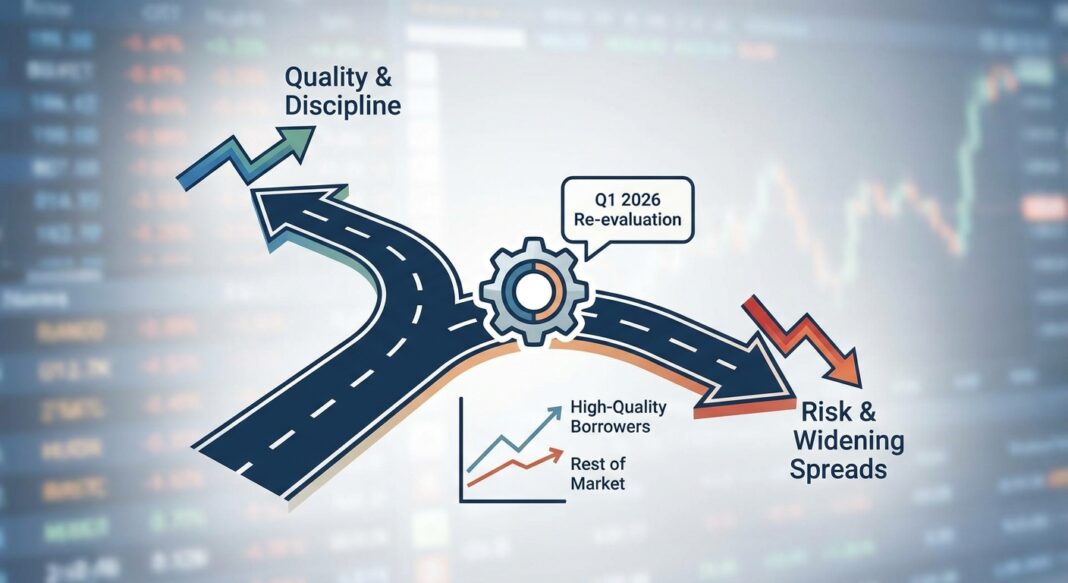
The Big Picture: A Selective Market Replaces a Forgiving One
Q1 2026 delivered a decisive verdict: the era of indiscriminate credit availability is over. What began as an anticipated shift from refinancing-led issuance toward M&A-driven deal flow instead became a stress test of credit discipline, exposing deep fault lines between high-quality borrowers and the rest of the market. Macro headwinds (persistent tariff-driven inflation, geopolitical uncertainty, a stalled Fed rate-cut cycle, and acute AI-related disruption in the software sector) converged to widen spreads, soften demand, and concentrate lender appetite at the upper end of the credit quality spectrum.
The signal for operators and institutional investors is clear: underwriting standards are tightening in practice, even where covenant structures have not formally changed. Lenders are pricing risk more honestly, and borrowers who cannot demonstrate durable cash flows, defensible business models, and conservative leverage are finding capital either unavailable or prohibitively expensive.
Quantitative Market Snapshot: Spreads, Volumes, and KPI Benchmarks
The pricing and volume data from Q1 2026 tell a story of a market that is open, but selectively so.
| Metric | Current Value (Q1 2026) | Prior Period | Source |
|---|---|---|---|
| Private Credit (Unitranche) Spread | SOFR + ~450 bps | SOFR + ~497 bps (Nov 2025); broadly compressing through late 2025 | mondaq.com |
| Direct Lending 1st Lien Spread | ~493–504 bps (Oct–Nov 2025 baseline) | ~583 bps (Jan 2021 peak); 524 bps (Dec 2024) | antares.com / Cliffwater CDLI |
| BSL Single-B New Issue Spread | SOFR + ~319 bps (late Nov 2025 low); widened ~100 bps Feb–Mar 2026 | SOFR + 317 bps (Jan 2025) | mondaq.com |
| Total Institutional Loan Issuance (Q1 2026) | ~$241 billion | ~$354 billion (Q1 2025); +54% vs. Q4 2025 | portagepointpartners.com |
| Net New (Non-Refinancing) Issuance (Q1 2026) | ~$70 billion | Modestly below Q1 2025; above 2-year quarterly average | sikich.com |
| Weighted Average Loan Price (Feb 2026) | 94.17 cents on the dollar | Below Apr 2025 “Liberation Day” lows | invicocapital.com / PitchBook LCD |
| Private Credit Shadow Default Rate (incl. PIK) | ~6.1% (vs. sub-2% in 2021) | Formal payment default: 1.25% (BSL, Nov 2025) | mondaq.com |
The spread premium that private credit commands over the BSL market, historically 100+ bps, continues to hold, but is being tested by BSL repricing fatigue and renewed risk aversion. Lenders are now demanding tighter FCCR floors (generally 1.10x–1.20x minimum) and are scrutinizing debt-to-EBITDA multiples more aggressively, particularly for software and tech-adjacent borrowers where AI disruption risk is rewriting forward earnings assumptions. Average U.S. buyout EBITDA multiples have already contracted from 15.53x in 2021 to 11.76x in 2025, per mondaq.com, reflecting a broad recalibration of leverage tolerance.
Sector Analysis: Where Capital Is Flowing, and Where It Is Retreating
Software & Technology: The most acute stress in Q1 originated in software. AI-related disruption, specifically concerns about business model durability for post-COVID underwritten loans at elevated debt-to-EBITDA multiples, triggered a sharp repricing of risk. Software credit contributed meaningfully to the loan price decline to 94.17 cents in February, per invicocapital.com. Lenders are now requiring demonstrably recurring, defensible revenue streams before extending credit in this space. Deals with significant ARR concentration or platform dependency on legacy models face the highest scrutiny.
Healthcare & Financial Services: These sectors remain standout destinations for capital. As noted in mondaq.com‘s Q1 analysis, investors actively sought healthcare and financial services exposure as a hedge against macro uncertainty. Lender appetite here is broadly constructive, with leverage tolerances holding and spread premiums remaining moderate for established operators with predictable EBITDA and strong fixed charge coverage.
AI Infrastructure & Energy: Capital is flowing decisively toward AI infrastructure build-out and adjacent energy demand plays. Strategic investments in AI-related infrastructure saw significant volume increases, per mondaq.com. For lenders, these assets offer hard collateral, contractual offtake structures, and long-duration cash flows, exactly the profile that commands favorable terms in the current environment.
Lower Middle Market: The most structurally challenged segment. Non-accrual rates for borrowers with under $25M EBITDA reached 3.15% in Q3 2025, compared to just 0.24% for borrowers with $75M+ EBITDA, per mondaq.com. PIK usage is rising as a liquidity management tool, pushing the shadow default rate to 6.1%. Lenders at this tier are increasingly resorting to debt-for-equity swaps, signaling a structural recalibration in how distress is being resolved.
Implications for Institutional Investors and Operators
For Borrowers: The repricing wave in BSL markets is largely exhausted, spreads widened approximately 100 bps in February and March alone, per sikich.com, reversing months of favorable conditions. Borrowers rated BB or higher retain strong market access, but lower-rated credits face a structurally narrower window. Operators should prioritize FCCR strengthening, maturity runway extension, and covenant compliance headroom, particularly as maturity pressure concentrates among weaker credits with limited refinancing options. Dual-track processes (BSL vs. private credit) remain a viable tool for larger transactions, but the 100+ bps cost advantage of BSL over private credit will remain a decisive factor for well-rated issuers.
For Institutional Investors & Lenders: The bifurcation in credit quality creates a genuine selection alpha opportunity. As antares.com notes, direct lending performance has outperformed leveraged loans and nearly matched high yield YTD, with BB-rated loans posting positive returns of 0.71% versus CCC-rated loans declining 4.94%, per invicocapital.com. Portfolios positioned up in quality are demonstrating materially superior risk-adjusted outcomes. Private credit lenders with disciplined origination and strong sponsor relationships are capturing deal flow at spreads that remain structurally attractive relative to public alternatives.
Forward-Looking View: Q2–Q3 2026
Liquidity in the credit markets remains adequate but is being allocated with greater discipline than at any point since 2023. The pipeline of PE-backed exits, estimated at 31,764 portfolio companies globally as of Q3 2025 per mondaq.com, continues to create structural deal flow pressure that will eventually convert into financing demand. However, the pace of that conversion depends heavily on rate stability and a resolution of tariff-driven macro uncertainty.
CLO formation remains relatively resilient and will continue to anchor BSL demand, but retail fund outflows, which fell to a three-year low in measurable loan demand per sikich.com, represent a structural headwind for the near term. The opening of the $12 trillion 401(k) market to private credit, expected via new regulatory guidance, could provide a significant long-term demand catalyst that rebalances flows back toward direct lending vehicles.
The dominant theme for the next two quarters will be divergence: quality credits accessing capital at manageable costs, weaker credits facing mounting maturity stress, and lenders with the underwriting discipline and sector expertise to navigate that gap generating the strongest risk-adjusted returns.


