
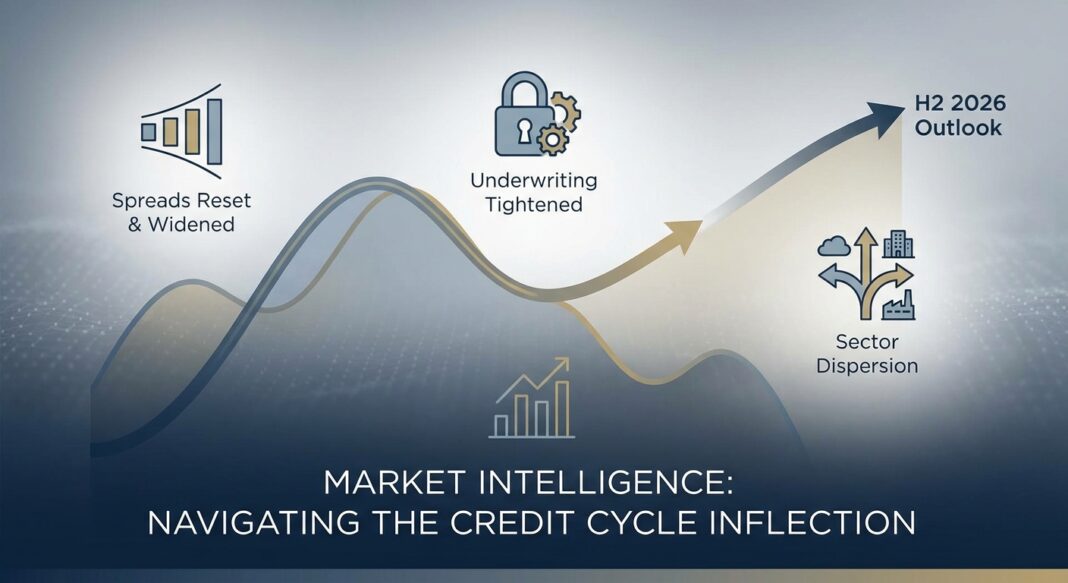
Market Headline: The Lender-Friendly Reset Is Real, and Durable
Private credit markets entered the second half of 2026 having passed through one of their most turbulent first-half periods in recent memory. Geopolitical shocks, AI-driven disruption fears across software portfolios, elevated redemption activity in semi-liquid vehicles, and a string of high-profile individual credit events collectively pushed the market back into price discovery mode after two years of borrower-friendly spread compression.
The macro backdrop is clear: spreads in private credit have re-widened to the S+500 context, up from mid-400 bps levels that prevailed throughout much of 2024 and into late 2025. That 50–100 basis point reversal, according to PitchBook data cited by Lord Abbett, has been accompanied by measurably improved covenant terms, tighter documentation, and a more conservative approach to leverage, hallmarks of a cycle that has firmly shifted power back to disciplined lenders.
Critically, this is not a systemic credit crisis. Hamilton Lane notes that headline issues have been company-specific, not systemic, a distinction that matters enormously for capital allocation. But it is a genuine structural reset: one that operators, sponsors, and institutional allocators must navigate with updated assumptions about cost, structure, and availability of debt capital.
Regulatory pressure is compounding market forces. On 6 May 2026, the Financial Stability Board published its first comprehensive report on vulnerabilities in private credit, flagging valuation opacity, leverage stacking, liquidity mismatches in semi-liquid vehicles, and deepening interconnections between private credit funds and banks, insurers, and private equity firms as areas requiring closer supervisory attention. The FSB did not declare an imminent crisis but was explicit: the market has never been tested at its current size, scope, and sectoral concentration in a severe economic downturn.
Quantitative Market Snapshot: As of 17 September 2026
| Metric | Current Level | Prior Period | Change | Source |
|---|---|---|---|---|
| Middle Market Direct Lending Spread (Unitranche) | S+500 bps (context) | S+450–475 bps (late 2025) | +25–50 bps wider | Hamilton Lane, 2026 |
| New-Issue Unitranche All-In Yield (Q1 2026) | ~9.3%–10.5% | ~12.5% (2023 peak) | Compressed ~175 bps from peak | CTA Acquisitions / Preqin, 2026 |
| Software Sector Secondary Spread Premium (vs. B-rated loan index) | ~+229 bps above index | Near parity (YE 2025) | ~+245 bps wider than YE levels | PitchBook LCD via VRC, June 2026 |
| Healthcare Direct Lending Spread (Q4 2025 avg.) | ~S+500 bps | S+450–475 bps (prior quarters) | Only sector with no year-over-year tightening | Octus Direct Lending Analytics, 2026 |
| Lower Middle Market Spread Premium (vs. Large-Cap) | +232 bps | Narrower in prior cycle | Premium widening | Avante Capital Partners / PitchBook, 2026 |
| Private Credit Default Rate (Proskauer Index, Q1 2026) | 2.73% (by loan count) | 1.84% (Q3 2025) | +89 bps in two quarters | Proskauer Private Credit Default Index, via Forbes |
| BDC Median Interest Coverage (EBITDA/Interest) | 1.6x (Q1 2026) | Marginally lower Q4 2025 | Modest improvement | Coller Private Credit Secondaries N-CSR, SEC, 2026 |
| Typical Max Leverage Covenant (new transactions) | ~4.0x–4.5x EBITDA | 5.0x–6.0x EBITDA (peak cycle) | Tightening to more conservative levels | Investing.com / VRC Q2 2026 |
| 3-Month Term SOFR (Q2 2026) | 3.68% | Lower in Q1 2026 | +1 bps QoQ; higher-for-longer outlook | VRC Q2 2026 Private Markets Report |
| 5-Year U.S. Treasury Yield (June 2026) | 4.23% | 3.92% (March 2026) | +31 bps in one quarter | VRC Q2 2026 Private Markets Report |
Data represents most recently available as of publication date. Spreads reflect indicative market levels; individual transaction pricing will vary by credit quality, sector, and structure.
KPI Context: What Underwriters Are Actually Requiring
Beyond headline spreads, the most operationally significant shift in H1 2026 is at the underwriting level. A typical direct lending transaction today carries a first-lien senior secured structure at SOFR plus 400–600 bps, with maximum leverage covenants around 4x EBITDA and minimum interest coverage near 2.5x, tighter than the 5x–6x leverage multiples that characterized the 2021–2022 vintage. Lenders are now underwriting to forward-looking Fixed Charge Coverage Ratios (FCCR) that incorporate rate expectations, which constrains available debt quantum even for otherwise high-quality credits. EBITDA add-back treatment has become a key negotiation point, with lenders applying greater scrutiny to management adjustments.
Sector Analysis: Where Capital Is Flowing, and Where It Is Pulling Back
🟢 Healthcare: Perennial Anchor, Premium Pricing Intact
Healthcare led all sectors in private credit deal volume in 2025, accounting for 19% of all direct lending deals, and has retained that position into 2026 on the back of continued M&A activity and non-cyclical service models. Crucially, it was the only major sector where spreads did not compress year-over-year, lenders are pricing healthcare at approximately S+500 bps, reflecting both the premium for complexity and the genuine demand for the asset class. However, institutional investors should note that Morgan Stanley maintains a significant underweight to healthcare, noting it has led all sectors in loans placed on non-accrual status over the past year, a reminder that aggregate demand and granular credit performance can diverge sharply.
🔴 Software & Technology Services: Risk-Off and Actively Repricing
Software sector secondary spreads are approximately 245 basis points wider than year-end 2025 levels and roughly 229 basis points above the broader B-rated loan index, reflecting continued uncertainty related to AI-driven disruption. This is not a temporary technical dislocation; it reflects a structural reassessment of business model durability for software companies facing AI substitution risk. Heightened volatility was driven in part by concerns that new AI tools could disrupt existing software business models, contributing to investor redemptions and valuation mark-downs across the sector. New originations in software require case-by-case underwriting with meaningful spread premium over comparable industrial or services credits.
🟢 Infrastructure & Asset-Backed Finance: The Structural Growth Vector
The most significant capital rotation story of 2026 is the shift away from core corporate direct lending into collateral-backed strategies. Direct lending’s share of private debt fundraising fell from 58.4% in 2024 to roughly 31% by Q1 2026, with capital flowing into infrastructure debt, real estate credit, special situations, and asset-backed strategies. Specialty finance raised $37 billion in 2025 alone, more than the prior two years combined, as allocators sought collateral-backed exposure.
The AI infrastructure build-out is the dominant driver. Sustained demand for AI capacity is expected to continue driving growth in data centers, power supply, and fiber networks. Morgan Stanley expects approximately $20 billion of AI-related deals in leveraged finance markets in 2026, with JPMorgan projecting $150 billion in leveraged finance exposure over the next five years. Private credit funds have emerged as major providers of construction and bridge capital in this ecosystem, attracted by contract-backed cash flows and real asset collateral.
🟡 Industrials & Manufacturing: Geopolitical Overlay Creates Two-Speed Market
Industrials present a bifurcated picture. Defense-adjacent and onshoring-driven manufacturing continue to attract capital at competitive terms, supported by government spending tailwinds. Energy-intensive industrials, by contrast, face tighter underwriting following elevated energy costs linked to Middle East geopolitical developments. Lenders have tightened standards for businesses where leverage was predicated on stable input costs, and oil price movements remain a key variable in deal structuring for this cohort through year-end.
Regulatory Forces: The FSB Report and Its Market Consequences
The FSB’s May 2026 report identified interconnections between private credit funds and banks, insurers, and private equity firms as deepening, raising potential vulnerabilities. Four vulnerability clusters were flagged: bank interlinkages, borrower credit risk and valuation opacity, leverage and liquidity mismatches, and data gaps that frustrate effective regulatory monitoring. The FSB cited the industry’s lack of standardized data and opaque valuation practices as bringing vulnerabilities to broader markets.
The practical near-term consequence is a shift in how large institutional lenders calibrate their own lending to private credit vehicles. The April 2026 SLOOS showed banks reporting tighter standards for all categories of nondepository financial institution (NDFI) loans over the prior year, a direct signal that banks are pulling back from their behind-the-scenes role as warehouse and leverage-facility providers to private credit funds. By Q2, however, the picture stabilized: the July 2026 SLOOS reported basically unchanged standards for commercial and industrial loans to firms of all sizes, with banks reporting stronger demand from large and middle-market firms. For C&I loans specifically, banks reported that current standards are easier than the midpoint of their historic range, a meaningful stabilization signal after the Q1 tightening episode.
Implications: What This Means for Borrowers, Lenders, and Operators
For Borrowers and Operators
The era of borrower-friendly terms that characterized 2023–2024 has materially closed. Operators seeking debt capital in H2 2026 should operationalize several updated assumptions: (1) all-in debt costs are 50–100 basis points higher than equivalent transactions priced in late 2025; (2) lenders are requiring tighter covenant packages, including financial maintenance covenants tied to leverage and FCCR thresholds; (3) EBITDA add-back treatment is under greater scrutiny; and (4) companies with software-revenue concentration or significant energy cost exposure face a meaningfully higher bar and wider pricing than peers in healthcare, infrastructure, or stable industrial sectors. Despite elevated redemption activity and a more hawkish rate outlook, lending activity remains competitive for higher-quality deals, the market is selective, not closed.
For Institutional Investors and Lenders
Capital has become more selective, spreads are wider, covenants and documentation are improving, and managers with dry powder can be more selective about the credits they finance, the classic hallmarks of a lender-favorable vintage. Competition remains strong for the highest-quality borrowers, but today’s market increasingly rewards lenders with broad origination capabilities and the flexibility to provide customized financing solutions. Institutional allocators with long time horizons, pensions and insurers in particular, continue to increase exposure to private credit, attracted by income generation, diversification benefits, and historically attractive risk-adjusted returns in the higher-rate environment.
The private credit illiquidity premium relative to public high yield, however, has compressed. In 2019, private credit offered approximately 350 basis points of spread over public high yield for comparable risk; today, that spread has compressed to roughly 150–200 basis points. The investment case remains positive but is narrower than the prior cycle, reinforcing the need for rigorous manager selection and deal-level diligence over passive asset-class allocation.
Forward-Looking View: H2 2026 and Into 2027
Market expectations continue to reflect a higher-for-longer rate environment, with the forward curve broadly flat as of June 2026. Against that backdrop, the second half of 2026 is likely to be defined by dispersion: between sectors, between vintage years, and between managers with and without the origination infrastructure to source quality credits at the current spread level.
Buyout volume is expected to improve, but not set records, amid a pick-up in M&A activity, greater sponsor confidence in the macro environment, and pent-up demand. Over time, new deal demand together with a large refinancing wave is expected to gradually overtake private credit supply, creating an imbalance that allows lenders to preserve discipline, strengthen terms, and capture the illiquidity premium to public markets.
On the regulatory front, the Basel III endgame re-proposal (which reduced capital burdens on bank commercial and industrial lending) could allow large U.S. banks to lean back modestly into middle-market lending starting in 2027, adding competitive pressure to private credit spreads at the upper end of the market. The re-proposal is currently in comment period and is unlikely to bind before 2027, giving private credit managers a tactical window before bank competition intensifies.
Key Market Insights: Actionable Intelligence
- The spread reset is structural, not transient. Private credit spreads at S+500 bps represent a 50–100 bps widening from late 2025 levels, driven by geopolitical risk, AI disruption fears, and higher base rate expectations, not a temporary supply imbalance. Managers underwriting at these levels are entering one of the most structurally favorable origination environments since 2022. (Hamilton Lane; Lord Abbett)
- FCCR and forward leverage are the new gating criteria. Lenders are now applying forward-looking Fixed Charge Coverage Ratio tests incorporating rate expectations, with maximum leverage covenants tightening toward 4x EBITDA for new transactions. Operators who modeled debt capacity at 5x–6x leverage face a materially different refinancing environment. (Investing.com; VRC Q2 2026)
- Software credit risk is idiosyncratic, not systemic, but concentration kills. Secondary software spreads trading 229 bps above the B-rated loan index confirm that AI disruption risk is being priced in deal by deal. Portfolios with vintage 2021–2022 software concentration require active mark and potential restructuring analysis. (PitchBook LCD via VRC)
- Asset-backed finance and infrastructure debt are the decade’s rotation trade. Direct lending’s share of private debt fundraising has already fallen from 58% to 31% of new capital in 18 months. The $7 trillion global asset-based finance market, currently only 5% penetrated by private capital, and the AI infrastructure build-out represent multi-year origination runways for diversified credit platforms. (Investing.com; InsuranceAUM Infrastructure Outlook)
- The private-vs-public premium compression demands selectivity. At 150–200 bps of spread premium over public high yield, down from 350 bps in 2019, private credit no longer offers a structurally wide margin of safety over liquid alternatives. Institutional investors should anchor allocation decisions on manager origination quality, covenant strength, and portfolio vintage composition rather than on asset-class-level yield comparisons. (Owners.pe)


