
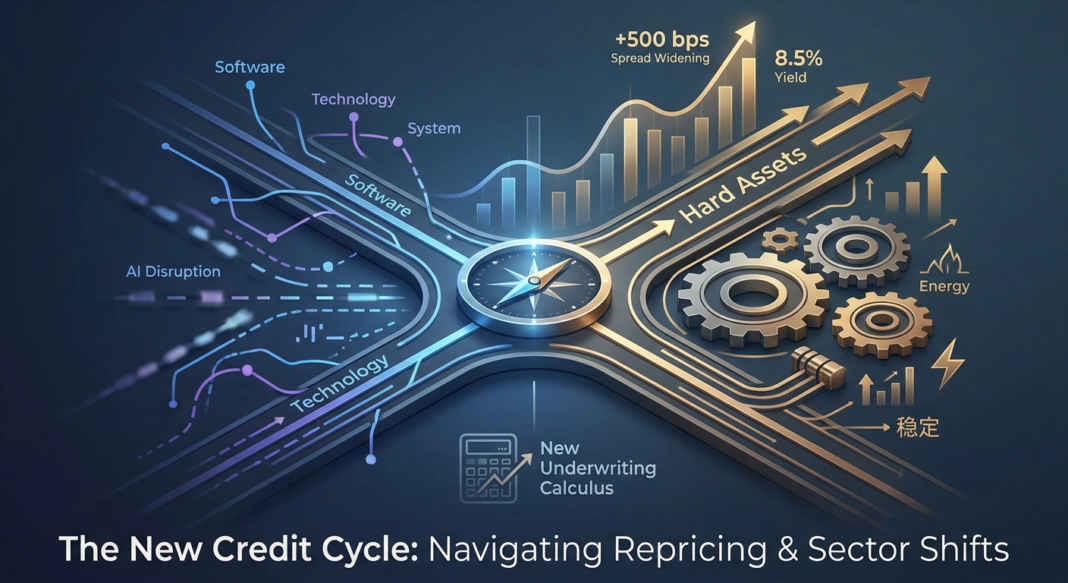
Market Headline: Price Discovery Returns as Volatility Resets the Credit Clock
The first quarter of 2026 delivered a rude awakening to a credit market that had grown accustomed to tight spreads and reliable deal flow. Three converging shocks (a U.S.-Iran military conflict triggered in late February, an AI-driven reassessment of software sector credit quality, and a wave of BDC and private credit fund redemptions) compressed deal activity, repriced risk across both public and private markets, and forced lenders back into active price discovery for the first time since the post-pandemic normalization.
The headline numbers tell a stark story. Overall institutional leveraged loan value fell 22.5% year-over-year in Q1 2026, according to PitchBook’s U.S. Credit Markets Quarterly Wrap. Refinancing issuance (the dominant driver of leveraged loan volume throughout 2024 and 2025) collapsed, with refinancing activity falling 40.6% year-over-year and repricing value dropping approximately 38.6% in the same period. Yet underneath the volatility, private credit demonstrated structural resilience: direct lending deal volume in Q1 2026 rose 26% from a year ago and 8% over Q4 2025, per Carlyle’s Q2 2026 Global Private Markets Quarterly, while private credit market-wide CLO issuance reached $9.5 billion, near the record pace set in Q1 2024. For institutional investors and operators, the emerging environment is one where capital remains available, but the terms are changing rapidly and the market is bifurcating sharply between well-structured, high-quality credits and everything else.
Quantitative Market Snapshot
Data Box: Key Credit Market Metrics, Q1 2026 vs. Prior Period
| Metric | Current Value (Q1 2026) | Prior Period (Q3–Q4 2025) | Direction | Source |
|---|---|---|---|---|
| Private Credit Direct Lending Spreads (senior secured) | S+500 bps (re-widened from mid-400s) | ~S+450 bps (mid-2025 tights) | ↗ Widening | Hamilton Lane, April 2026 |
| Direct Lending All-In Yield (first lien, typical) | ~8.5% (SOFR 3.73% + ~480 bps) | ~11%+ at 2022–2023 peak | ↘ Compressed vs. cycle peak; stabilizing | Fortune / Lincoln International, Feb 2026 |
| BSL / Leveraged Loan Secondary Spread (B-rated) | ~67 bps wider than year-end 2025 | Near multi-year tights at year-end 2025 | ↗ Widening | Valuation Research Corp., April 2026 |
| High Yield Bond Spreads (OAS, US market) | ~285 bps | ~250 bps (late 2025 tights) | ↗ Modestly wider but not distressed | InvestmentGrade.com, May 2026 |
| Private Credit Default Rate (direct lending, estimated) | 1.6%–4.7% (headline 1.5%–2.0%; adj. ~5%) | Below 2% headline (2024–2025) | ↗ Rising; KBRA projects 2.0% by year-end | Northleaf Capital / KBRA, April 2026; With Intelligence, 2026 |
| Fed SLOOS, Net % Banks Tightening C&I Standards (Large & Mid-Market Firms) | +5.3% net tightening (Q1 2026) | Near neutral (Q3 2025) | ↗ Incremental tightening | Fed SLOOS / FRED, Feb 2026 |
| Direct Lending Transaction Volume (Full-Year 2025) | $247B (2025 full year, 2nd busiest on record) | $278B+ (2024 record) | ↘ Down 11% YoY; deal count down 16% | DLA Piper Private Credit Pulse Q1 2026 / PitchBook LCD |
| Private Credit AUM (Global Estimated) | $1.5T–$2.0T | ~$1.3T–$1.5T (2024) | ↗ Continued expansion | Financial Stability Board, May 2026 |
The spread environment captures the market’s current tension: private credit pricing has re-widened to the S+500 bps context: a meaningful recovery from the mid-400s seen at mid-2025 tights, yet all-in yields of approximately 8.5% remain materially below the 11%+ peak of the 2022–2023 rate-shock era. Northleaf Capital’s Q1 2026 market update notes that broadly syndicated and high-yield loan spreads on new issues widened by approximately 15–30 basis points from Q4 2025 to Q1 2026, while private credit new loans priced roughly 25 basis points higher. The Fed’s April 2026 SLOOS confirmed a modest but broadening tightening bias, with net shares of banks also reporting tighter standards across all categories of non-depository financial institution (NDFI) loans, a direct signal of tighter conditions for the private credit fund financing ecosystem itself.
From a KPI lens, the rate environment continues to pressure fixed-charge coverage ratios. Lincoln International has documented how lenders are increasingly underwriting to a forward-looking FCCR that incorporates interest rate expectations, constraining leverage multiples accordingly. With EBITDA growth slowing to 4.7% in Q4 2025 (down from 6.5% in Q2 2025) and only 48.2% of private credit portfolio companies now generating 15%-or-higher earnings growth (versus 57.5% in 2021), coverage cushions are narrowing across the credit stack.
Sector Analysis: Rotation From Software to Hard Assets
The most consequential structural development in Q1 2026 credit markets is a decisive sector rotation away from software and technology-exposed credits toward industrials, energy infrastructure, defense, and asset-backed finance. This is not a temporary risk-off trade; it reflects a fundamental reassessment of revenue durability, collateral quality, and AI disruption risk.
Technology & Software, Tighter Credit, Case-by-Case Underwriting: Valuation Research Corp.’s Q1 2026 update documents a sharp selloff in software and technology services across loan, bond, and equity markets on concerns that new AI tools could disrupt existing business models. Technology and software services loans now price at wider-than-average premiums, with lower implied enterprise values driving higher loan-to-value ratios quarter-over-quarter. Lenders are evaluating AI-impacted borrowers on a case-by-case basis, a material departure from sector-level underwriting frameworks of prior years. The Fed’s January 2026 SLOOS explicitly noted that a major net share of banks reported being less likely to approve loans to firms adversely affected by AI. Morgan Stanley Investment Management disclosed maintaining a significant underweight to healthcare, which has led all sectors in loans placed on non-accrual status over the past year.
Industrials, Energy, and Hard-Asset Sectors, Capital Flowing In: Carlyle’s Q2 2026 Global Private Markets Quarterly reports that “hard” industries (utilities, energy, chemicals, and machinery) accounted for 46% of transaction volumes in Q1 2026, compared to just 13% a year ago. This dramatic rotation reflects both the supply-chain resiliency narrative and near-term defense spending tailwinds. Paul Weiss’s 2026 outlook identifies energy infrastructure, digital infrastructure (data centers, AI buildout), defense and national security, and next-generation manufacturing as the priority private credit deployment sectors for 2026.
Asset-Based Finance, The Structural Breakout: DLA Piper’s Q1 2026 Private Credit Pulse reports that asset-based finance is now larger than all other private credit markets combined, supported by bank retrenchment, insurance demand for rated assets, and AI/data center financing needs. Nearly one-third of U.S. insurer assets, approximately $2 trillion of the $6 trillion in invested assets, are now deployed across private credit sub-asset classes, driving demand for rated structures, CLOs, and rated note feeders.
Consumer & Healthcare, Selective Lender Appetite: Both Moody’s and Morgan Stanley flag rising stress in consumer and healthcare credits. Lenders are applying tighter underwriting standards in consumer sectors exposed to softening labor market conditions (U.S. unemployment at 4.4% in February 2026) and healthcare segments where reimbursement uncertainty and policy risk are compressing EBITDA visibility. Energy-intensive industries are also facing tighter standards, as Capstone Partners’ Q1 2026 report notes that lenders have responded by tightening underwriting for businesses whose leverage was predicated on stable energy costs.
Implications for Institutional Investors and Business Operators
For Borrowers and Operators
The recalibration of FCCR thresholds and leverage multiples is the most operationally significant shift for middle-market borrowers. With lenders applying forward-looking coverage tests that incorporate current SOFR levels and potential rate volatility, companies that were marginally creditworthy under 2024 underwriting standards may find their borrowing capacity meaningfully constrained in 2026. Specifically, operators should expect lenders to scrutinize EBITDA add-backs more aggressively, industry analysis notes that add-backs representing 30% or more of reported EBITDA are not uncommon, and that PIK interest exclusions can allow leverage to rise silently while FCCR optics remain intact. Borrowers refinancing 2021-vintage debt should expect materially higher all-in costs and tighter covenant packages. Proactive lender engagement, ideally 12–18 months ahead of maturity, is now a strategic imperative, not a precautionary measure.
Operators in software and AI-exposed sectors face heightened lender scrutiny regardless of near-term financial performance. Demonstrating an explicit AI strategy (both how the business uses AI and how it is protected from AI disruption) has become a standard analytical component in new underwriting, per Capstone Partners’ Q1 2026 analysis.
For Institutional Investors and Lenders
The re-widening of private credit spreads back to the S+500 context is a structurally attractive entry point for investors with dry powder and patient capital. Hamilton Lane explicitly notes that volatility periods benefit senior direct lending through both yield premium recovery and improved negotiating dynamics. SG Analytics documents that private credit has historically delivered 200–400 basis points of excess return over liquid credit markets across multiple rate cycles. The approximately 300 basis point yield advantage of private credit over high-yield bonds: with first-lien direct lending yields expected to floor in the 8.0%–8.5% range, remains compelling on a risk-adjusted basis, particularly given the maintenance covenant protections that high-yield bonds structurally lack.
The critical risk for investors is manager selection and vintage-year exposure. With Intelligence and Moody’s both flag that when selective defaults and liability management exercises are included, the “true” private credit default rate approaches 5%, well above the sub-2% headline figure. Investors should pressure-test FCCR covenants for PIK leakage and EBITDA add-back inflation, and prioritize managers with demonstrated cycle experience over 2021–2023 market entrants who have yet to navigate a full credit downturn.
Regulatory and Structural Considerations
The competitive landscape between banks and private credit is shifting meaningfully. The April 2026 SLOOS introduced new questions on NDFI lending, revealing that significant net shares of banks reported tighter standards for loans to business and consumer credit intermediaries, essentially tightening the funding lifeline for private credit fund infrastructure. Simultaneously, potential weakening of Basel III Endgame implementation could enable banks to recapture market share in large-cap leveraged buyout financing. CNBC reported in March 2026 that banks’ share of buyout financings above $1 billion has already recovered from a low of 39% in 2023 to just over 50% in 2025. The regulatory tailwind for banks is real, but private credit’s structural advantages in speed, flexibility, and covenant control ensure the asset class retains its core value proposition in the middle market.
Forward-Looking View: The Next 3–6 Months
The macro backdrop for the second half of 2026 is one of constrained but not closed credit markets. Northleaf Capital notes that the Federal Reserve held its target range at 3.50%–3.75% in Q1 2026, with market participants now projecting limited easing for the remainder of the year, reinforcing the higher-for-longer rate environment. Moody’s places GDP growth at roughly 1.5%, historically the “stall speed” below which defaults tend to accelerate, leaving virtually no margin of safety against growth disappointment. UBS forecasts private credit defaults of 9%–10% by end of 2026 when adjusting for the broadest measure of credit impairment, compared with 3.5%–4% for leveraged loans, a divergence that reflects both structural opacity and the higher-risk cohort of credits that migrated into private markets during the 2021–2023 borrower-friendly era.
Three dynamics will define the credit environment through year-end: (1) the pace of geopolitical de-escalation and its effect on energy costs and inflation expectations; (2) whether AI-related disruption fears stabilize or accelerate spread widening in technology-exposed credits; and (3) the speed at which the private equity exit market reopens to unlock a significant refinancing wave. Morgan Stanley Investment Management forecasts that new deal demand together with a refinancing wave will gradually overtake private credit supply, creating a lender-favorable dynamic that supports stronger terms and preserved illiquidity premium. For well-capitalized investors with dry powder, this is the environment where disciplined deployment has historically generated the strongest risk-adjusted outcomes across private credit cycles.
Key Market Insights
- Spread Repricing Is Real and Accelerating: Private credit spreads have re-widened to the S+500 bps context, up from mid-400s at 2025 tights, and market participants expect a further 25–50 bps of widening for lower-quality or sector-challenged credits through H2 2026. Lenders with dry powder are in a structurally advantageous pricing position for the first time since 2023.
- FCCR and Forward-Looking Coverage Tests Are the New Underwriting Standard: With EBITDA growth slowing and SOFR-linked interest costs elevated, lenders are prioritizing forward-projected FCCR over trailing adjusted EBITDA multiples. Borrowers carrying material PIK interest, aggressive add-backs, or leverage predicated on peak earnings will face meaningful pushback on new loans and refinancings.
- Hard Assets Are the New Safe Harbor: Industrials, energy infrastructure, defense, and asset-based finance are capturing the majority of fresh private credit deployment in 2026, with hard-asset sectors representing 46% of Q1 buyout deal volumes, up from 13% a year ago. Operators in these sectors have clear structural advantages in accessing capital on favorable terms.
- Software and AI-Exposed Credits Face Structural Re-Rating: AI disruption risk is now a mandatory analytical variable in private credit underwriting. Technology-exposed credits are pricing at wider-than-average premiums, with reduced enterprise value support creating LTV compression. Borrowers must proactively demonstrate AI resilience, or face bifurcated access to capital at sharply higher costs.
- The Bank-Private Credit Tug-of-War Is Intensifying: Regulatory easing is enabling banks to recapture share in large-cap lending, while the Fed SLOOS confirms tighter bank standards for private credit fund financing itself, squeezing the cost of fund-level leverage for private credit managers. The structural divide is sharpening: banks regain competitive ground in jumbo, investment-grade-adjacent deals; private credit retains dominance in the middle market and complex, covenant-heavy structures where relationship and execution advantages are decisive.


