
Bond Capital, Market & Sector Intelligence, 13 September 2026
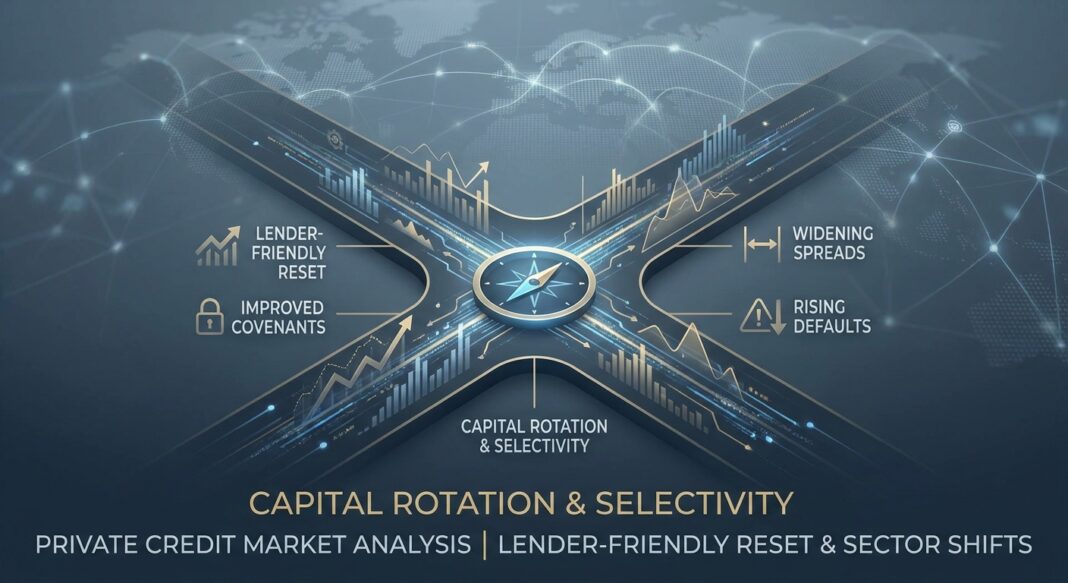
Credit at the Crossroads: Private Markets Enter a Lender-Friendly Reset as Spreads Widen, Defaults Rise, and Capital Rotates
From macro cycle signals to deal-level KPIs: the data every operator and institutional investor needs right now.
I. Market Headline: A Lender-Friendly Reset Takes Hold
Private credit is in the middle of its most consequential repricing cycle since the post-GFC era. After a prolonged period of spread compression through 2024 and into 2025, a confluence of forces (geopolitical shock, AI-driven sector disruption, building redemption pressure, and regulatory escalation) has fundamentally altered the risk-reward calculus for lenders and borrowers alike.
The macro setup entering September 2026 is distinctly lender-friendly in structure, even as it demands heightened vigilance. Spreads have reset materially wider. Covenant quality has improved. Capital selectivity has returned. And a bifurcated market has emerged: well-capitalised institutional lenders with long-duration mandates are gaining share, while retail-oriented vehicles face redemption headwinds that constrain their origination capacity.
The Federal Reserve has held rates in a higher-for-longer posture, with the Fed funds rate holding steady and three-month SOFR sitting at approximately 3.75% as of late July 2026, a rate environment that continues to stress older-vintage, floating-rate borrowers while rewarding disciplined new-money underwriting. At the same time, the regulatory backdrop has intensified: the Financial Stability Board’s landmark May 2026 report formally flagged private credit vulnerabilities as a systemic concern, putting fund managers and their bank counterparties on notice.
For institutional investors and operators, the central question is not whether private credit is entering stress; it clearly is, in pockets. The question is whether the current environment represents a cycle correction within a structurally sound asset class, or the opening act of broader deterioration. The data, examined below, suggests it is the former, but with important sector-level and vintage-specific caveats that demand active portfolio management.
II. Quantitative Market Snapshot
The following data box synthesises the most current market metrics available as of the publication date. All figures are sourced from third-party institutional providers and public regulatory data.
| Metric | Current Value | Prior Period | Change | Source |
|---|---|---|---|---|
| Middle Market Private Credit Spread (Unitranche) | SOFR + ~500 bps | SOFR + 450–475 bps (late 2025) | +25–50 bps | Hamilton Lane, 2026 |
| All-In Yield, New-Issue Unitranche (Q1 2026) | ~9.3%–10.5% | ~12.5% (2023 peak) | -175 bps from peak | CTA Acquisitions / Preqin, July 2026 |
| 3-Month SOFR (Base Rate) | 3.75% | 3.68% (Q2 2026) | +7 bps | Fidelity / Bloomberg, July 2026 |
| High Yield (ICE BofA) Option-Adjusted Spread | ~266 bps | ~230–250 bps (year-end 2025) | +16–36 bps | Britannica Capital / ICE BofA via FRED, Sep 2026 |
| Software Sector Secondary Spread (vs. B-Loan Index) | +229 bps premium | At index (year-end 2025) | +245 bps vs. YE | VRC / PitchBook LCD, June 2026 |
| Private Credit Default Rate (Proskauer Index) | 2.73% (Q1 2026) | 1.84% (Q3 2025) | +89 bps | Forbes / Proskauer, May 2026 |
| Typical Max Leverage Covenant (Direct Lending) | ~4.0x EBITDA | 4.5–5.5x (2021–2022 vintage) | Tightened | Investing.com, Aug 2026 |
| Min. Interest Coverage (FCCR proxy, Direct Lending) | ~2.5x | ~2.0–2.2x (2022 vintage) | Tightened | Investing.com, Aug 2026 |
| Lower Middle Market Spread Premium vs. Large-Cap | +232 bps | +180–200 bps (2024) | Widened | Avante Capital Partners, Feb 2026 |
Regulatory & Structural Context
The July 2026 Federal Reserve Senior Loan Officer Opinion Survey (SLOOS) reported that bank C&I lending standards were essentially unchanged in Q2 2026, following a period of tightening in Q1. Notably, the SLOOS found that bank C&I standards are currently easier than the midpoint of their historic range since 2005, a constructive signal for borrowers at larger institutions. However, the April 2026 SLOOS revealed that banks have materially tightened terms on loans to non-depository financial institutions (NDFIs), directly impacting private credit fund facilities: higher risk premiums, stricter covenants, shorter maturities, and lower maximum credit line sizes were all widely cited.
On the regulatory front, the Financial Stability Board’s May 2026 report on private credit vulnerabilities marked a watershed moment. The FSB formally warned that the sector’s complexity, multi-layered leverage, and growing interconnections with banks and insurers could amplify stress in adverse scenarios. Four formal international workstreams have been initiated to close data gaps and enhance cross-border supervisory coordination. Meanwhile, the re-proposed U.S. Basel III Endgame rule, still in its comment period, may allow large banks to re-enter middle-market lending modestly by 2027, adding a new competitive variable to private credit spread dynamics.
On the KPI front, lenders have demonstrably tightened underwriting parameters. A typical new-issue direct lending transaction in mid-2026 carries maximum leverage covenants of approximately 4.0x EBITDA (down from 4.5–5.5x in the 2021–2022 vintage) and minimum interest coverage near 2.5x. These tightened FCCR and leverage thresholds represent a structural upgrade in credit quality for new originations, even as older-vintage credits face mounting stress from a higher-rate environment.
III. Sector Analysis: Where Capital Is Moving, and Where It Is Retreating
📈 Healthcare: The Market’s New Anchor Sector
Healthcare has emerged as the single largest sector for U.S. direct lending, accounting for approximately 22% of all direct lending issuance year-to-date through Q1 2026, up from 18% in 2025, according to RSM. Separately, healthcare captured a record 12.4% of institutional broadly syndicated loan issuance in H1 2026, the sector’s highest share since 2015. Lenders are attracted by defensive demand characteristics, government-backed reimbursement streams, and predictable cash flows. Private credit is actively filling gaps for hospital systems, physician platforms, behavioral health providers, and post-acute operators. However, a critical caveat applies specifically to healthcare roll-ups: KBRA data shows that approximately 36% of 111 monitored healthcare roll-ups face maturities before year-end 2026, nearly double the rate for the broader borrower universe, with the majority carrying CCC+ or lower credit assessments.
💻 Software & Technology: The Sector in Disfavor
Software’s fall from grace has been sharp and data-confirmed. The sector’s share of broadly syndicated loan issuance fell to just 8.8% year-to-date, down from 17.6% in 2025 and its lowest level since 2013. Secondary spreads for software credits are approximately 245 basis points wider than year-end levels and roughly 229 basis points above the broader B-rated loan index, per PitchBook LCD data as of June 2026. Morgan Stanley projected that AI-driven disruption could push direct lending default rates toward 8% in the software segment specifically. Many lenders are now either risk-off on new software commitments or demanding a 75–100 basis point spread premium above standard yield matrix ranges for new transactions.
🏠 Asset-Based Finance & Infrastructure: The New Alpha Frontier
As core corporate direct lending becomes more crowded at the top of the market, capital is rotating aggressively into asset-based finance (ABF) and infrastructure credit. Data from Wellington / PitchBook shows that direct lending’s share of private debt fundraising fell from 58.4% in 2024 to just 31% by Q1 2026, with the balance flowing into infrastructure debt, real estate credit, special situations, and other asset-backed strategies. Invesco research notes that ABF strategies currently offer spread premiums of 650–1,000 basis points over SOFR, representing 150–400 basis points above comparable direct lending, with structural protections including hard collateral, amortizing payments, and overcollateralisation. Moody’s projects ABF will lead the next phase of private credit growth, with alternative managers expanding into consumer loans, equipment leases, and data infrastructure credit. Ares Management estimates the addressable ABF market at $28 trillion globally. European opportunities are also attracting new capital: with bank lending comprising approximately 70% of total European lending, the incoming Basel IV framework is expected to accelerate a structural shift toward private debt funds on the continent.
🏯 Below Single-B Credits: Spread Widening Accelerates
The most pronounced spread widening is concentrated in lower-quality credits. Solomon Partners’ capital advisory group confirmed spreads on below single-B rated risk have widened 200–250 basis points relative to historic levels. At the lower end of the market, the spread premium for lower middle market ($5M–$25M EBITDA) borrowers over large-cap private credit has widened to 232 basis points, a divergence that Avante Capital Partners argues is the structural story most market commentary is missing. For allocators with the infrastructure to originate in this segment, the combination of wider spreads, tighter covenants, and succession-driven deal flow presents a compelling setup.
IV. Implications for Borrowers and Institutional Investors
For Borrowers & Operators
The repricing environment has meaningfully shifted the cost and structure of new credit. Operators seeking refinancing or new acquisition financing must contend with higher all-in costs, tighter leverage covenants at approximately 4.0x EBITDA, and more demanding FCCR thresholds near 2.5x. For companies that originated in the 2021–2022 low-rate window, the math is increasingly punishing: with SOFR above 3.75%, companies that borrowed at SOFR+300 in 2021 now face substantially higher annual interest burdens on unchanged principal balances, and rising interest expense is consuming 30–40% of operating income in heavily leveraged deals. Operators in software and technology sectors face compounded pressure from both spread widening and fundamental uncertainty. Operators in healthcare, industrials, and non-cyclical services are in a relatively stronger negotiating position, while those in lower-rated segments or facing near-term maturities should proactively engage lenders on amendment and extension options before year-end maturity walls arrive.
For Institutional Investors & Lenders
The mid-2026 environment favors institutional lenders with stable, long-duration capital, disciplined underwriting, and the origination capacity to act while retail-oriented vehicles retrench. As Lord Abbett’s midyear outlook observed, the private credit market has reset in a more lender-friendly direction: spreads are wider, covenants have improved, and managers with dry powder can exercise selectivity. The critical differentiation factor, however, is manager discipline in sector selection and vintage management. Portfolios with heavy exposure to 2021–2022 vintage software credits face materially higher credit loss scenarios. PIK usage across public BDCs has risen to approximately 8% of investment income on average, an early-warning signal of compounding credit stress that bears monitoring. Investors should also monitor the NAIC’s proposed capital charge clarification for life insurer general account holdings in private structured credit: if adopted in 2026, it could reduce insurance-sector demand for CLO and structured credit positions, affecting a key source of private credit funding.
V. Forward View: The Next 3–6 Months
Looking into Q4 2026 and early 2027, several structural forces will define the lending environment:
- Maturity wall pressure intensifies. Approximately $68.1 billion in BDC-held debt (at cost) matures in 2026–2027, per PitchBook data through June 30. While this is down from $75.7 billion at year-end 2024, reflecting borrower progress in addressing near-term obligations, the remaining refinancing demand will stress credits unable to meet current lender KPI thresholds.
- Deal flow normalization continues, unevenly. Middle market PE activity has shown a 10.7% year-over-year increase in deal value, per PitchBook Q2 2026 data, but overall private equity deal volumes remain approximately 5.6% below June 2025 and 52% below January 2026 levels. The H2 2026 outlook is defined by dispersion, not broad recovery.
- Bank re-entry adds competitive pressure, but not yet. The U.S. Basel III Endgame re-proposal is in comment period and unlikely to bind before 2027. Banks have begun returning to the upper middle market in Q2 2026, alleviating some spread pressure in larger deals, but the structural retreat from lower middle market lending remains intact.
- Regulatory escalation is a 12–24 month risk. The FSB’s four new workstreams on private credit oversight, combined with the Fed’s formal inquiry into large bank exposures to private credit funds, signal that data disclosure requirements and risk-weighting changes are on the horizon. Managers should expect more rigorous reporting obligations.
- ABF and infrastructure debt will capture a growing share of institutional allocations. With direct lending’s fundraising share falling to 31% by Q1 2026, the structural rotation into ABF and infrastructure credit is no longer a forecast; it is an observable market dynamic. Private credit is projected to reach $2.8 trillion by 2028 from approximately $1.7 trillion today, with ABF leading the incremental growth.
📌 Key Market Insights (Actionable)
- Spreads have reset 25–50 bps wider since late 2025, with middle market unitranche pricing near SOFR+500 as of mid-2026. New-money lenders are being compensated at levels not seen since the 2022–2023 peak cycle. Selectivity, not volume, is the operative discipline.
- Default optics are misleading. Headline rates of ~1.5–2% grossly understate true credit stress. Fitch’s broader methodology placed the U.S. private credit default rate at 5.8% for the 12 months through January 2026. Investors must scrutinize PIK usage, distressed exchanges, and selective defaults alongside reported figures.
- Software is a credit-quality red flag for this vintage. Spreads for software credits are 245 bps wider than year-end levels, issuance share has collapsed to 8.8%, and AI disruption risk to business models is still being repriced into loan valuations. New-money exposure to legacy software credits should carry premium hurdle rates.
- Healthcare is the largest direct lending sector by volume but not without its own risks. The sector commands strong lender appetite for acute care, behavioral health, and non-cyclical services platforms, but healthcare roll-up structures face concentrated near-term maturity risk and elevated CCC-rated concentrations that require careful diligence.
- The ABF rotation is structural, not cyclical. With direct lending’s share of private debt fundraising falling to 31% in Q1 2026 from 58.4% in 2024, the rotation into asset-based finance, infrastructure debt, and real estate credit reflects both yield-seeking behaviour and genuine portfolio risk management. ABF spreads of SOFR+650–1,000 bps represent a compelling premium for collateral-backed structures relative to increasingly crowded corporate direct lending.


