
What a Covenant Actually Does, and Why It Matters
When a private credit fund wires money to a borrower, it is not simply trusting that the business will stay healthy and make payments. It is installing a system of contractual guardrails, known as covenants: that give the lender early warning signals and, when needed, legal leverage to intervene before a problem becomes a loss. Understanding how these covenants work is foundational for anyone evaluating private credit as an investment or seeking private credit as a source of capital.
Covenants are often described as the lender’s “safety net.” That analogy is close, but incomplete. A covenant is less like a net that catches a falling borrower and more like a smoke detector; it triggers an alert early enough that both sides can act before the house burns down. In a market where pitchgrade.com estimates private credit funds now provide more than 75% of leveraged buyout financing for deals below $500M in EBITDA, those smoke detectors are doing a lot of work across the economy.
The Three Types of Covenants in a Private Credit Loan
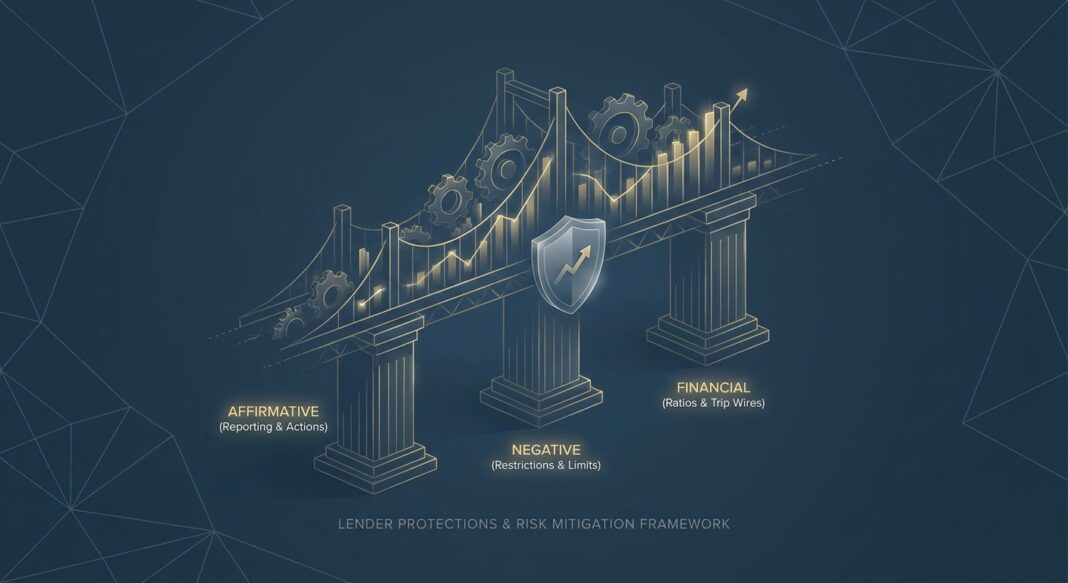
Private credit loans generally carry three categories of covenants, each serving a distinct protective function. As outlined in institutional research from demarche.com (January 2026), these categories are affirmative, negative, and financial.
- Affirmative covenants require the borrower to take specific actions. Common examples include delivering monthly or quarterly financial statements to the lender, maintaining adequate insurance, and notifying the lender of any material change to the business. These are the lender’s visibility rights; they keep the fund informed throughout the life of the loan.
- Negative covenants restrict what the borrower can do without lender approval. A company might be prohibited from incurring additional debt beyond an agreed threshold, pledging new liens on key assets, making large dividend payments to its equity holders, or completing acquisitions above a certain dollar amount. These restrictions protect the lender’s priority position in the capital structure.
- Financial covenants are quantitative trip wires. The borrower must maintain specific financial ratios, such as a minimum Debt Service Coverage Ratio (DSCR), a maximum Leverage Ratio (Debt/EBITDA), or a minimum liquidity floor, tested on a regular schedule. If the company breaches a financial covenant, the lender gains the right to renegotiate terms, accelerate the loan, or take other protective action.
A Concrete Example: How Covenants Work in a Live Deal
Consider a private equity-owned industrial distribution company with $20M in annual EBITDA seeking a $100M unitranche loan from a direct lending fund, a single blended loan that combines first-lien and second-lien debt in one instrument, as described by pitchgrade.com. The starting leverage ratio is 5.0x Debt/EBITDA, which is within acceptable range under the OCC and Federal Reserve’s Leveraged Lending Guidance that effectively discourages banks from underwriting loans above 6.0x.
The loan agreement includes the following covenant package:
- Maximum Leverage Covenant: Debt/EBITDA must not exceed 6.25x, tested quarterly. This gives the business a 1.25x cushion but creates an early warning threshold well before insolvency.
- Minimum DSCR Covenant: The company must generate at least $1.20 of operating cash flow for every $1.00 of debt service. A drop below this signals the company may struggle to service the loan.
- Negative Covenant on Dividends: No dividend or distribution to equity holders unless the leverage ratio is below 4.5x and no covenant violation is outstanding.
- Affirmative Reporting: Monthly management accounts delivered within 30 days of month-end, annual audited financials within 90 days of fiscal year-end.
Now assume the company’s EBITDA drops from $20M to $15M due to a supply chain disruption in Year 2. The leverage ratio rises from 5.0x to 6.67x, breaching the 6.25x maximum. This breach does not automatically trigger a default or forced sale. Instead, it triggers a covenant cure period: typically 30 to 60 days, during which the borrower can inject equity capital to reduce debt or cure the ratio. The lender, now in a legally empowered position, uses this moment to renegotiate pricing, tighten restrictions, or demand an equity cure contribution from the private equity sponsor. The covenant functioned exactly as designed: it created a checkpoint before a 6.67x leverage situation could deteriorate further toward default.
Current Market Reality: Covenant Intensity Tracks Credit Conditions
The strength of a covenant package is not static; it reflects market conditions and the relative bargaining power of lenders and borrowers. According to pitchgrade.com (2026), global private credit AUM has surpassed $1.7 trillion as of Q1 2026, and top managers including Ares Management, Apollo Global, Blackstone, Blue Owl, and HPS Investment Partners collectively oversee more than $800 billion of this total. At this scale, competition among lenders for the most attractive deals has, in some segments, led to lighter covenant packages, a dynamic investors must assess carefully.
Meanwhile, direct lending spreads for middle market borrowers have been running at approximately SOFR + 500–650 basis points, with large-cap direct lending tighter at SOFR + 425–500 basis points, per pitchgrade.com. As longangle.com’s 2026 Private Credit Guide notes, historical default rates for senior secured direct lending have remained under 4% since 2021 according to Proskauer’s Private Credit Default Index, a figure that reflects both sound underwriting and the protective role covenants play in enabling early intervention before defaults crystallize.
Investors evaluating managers should pay close attention to covenant discipline. As blackstone.com notes in its direct lending overview, strong manager selection and borrower due diligence are non-negotiable factors in delivering risk-adjusted returns in this asset class. A fund with 150 loans and weak covenant packages across its portfolio is a materially different risk profile than one with tightly structured protections, even if headline spreads look similar.
Decision Framework: Investors and Operators
For investors evaluating a private credit fund: Ask specifically about the fund’s covenant philosophy. Does the manager consistently require maintenance financial covenants (tested every quarter) or does it accept incurrence-only covenants (triggered only when the borrower takes a specific action)? Maintenance covenants give lenders earlier intervention rights and are generally considered stronger protection. Also evaluate the manager’s track record of covenant enforcement, not just origination volume. A lender who has never had to exercise covenant rights has either been lucky or avoided situations where protections were actually needed.
For business operators seeking private credit capital: Understand that covenants are negotiable at origination, but become binding once signed. Operators should model downside scenarios against any proposed financial covenant thresholds before accepting terms. A DSCR covenant set at 1.15x for a business with seasonal revenue volatility could trigger a technical default in a slow quarter even when the business is fundamentally healthy. Operators who understand their own financial covenant headroom can negotiate cure mechanisms and seasonal adjustment provisions that give them flexibility without sacrificing the lender relationship.
Key Takeaways
- Covenants are early-warning systems, not penalties. Their primary function is to give lenders visibility and negotiating leverage before a problem becomes a loss, not simply to punish borrowers.
- Three covenant types work together: Affirmative covenants provide information, negative covenants restrict risky behavior, and financial covenants set quantitative trip wires tied to operating performance.
- Covenant strength varies by market cycle. In competitive lending environments, covenant packages can thin out. Investors should assess covenant discipline as a key differentiator among fund managers.
- Maintenance covenants outperform incurrence covenants as a protective tool because they are tested regularly, not only when the borrower takes a specific action, giving lenders earlier intervention rights.
- For operators, covenant modeling matters as much as pricing. The interest rate on a private credit loan matters less if a technical covenant breach disrupts operations during a slow quarter. Negotiate headroom and cure provisions before signing.


