
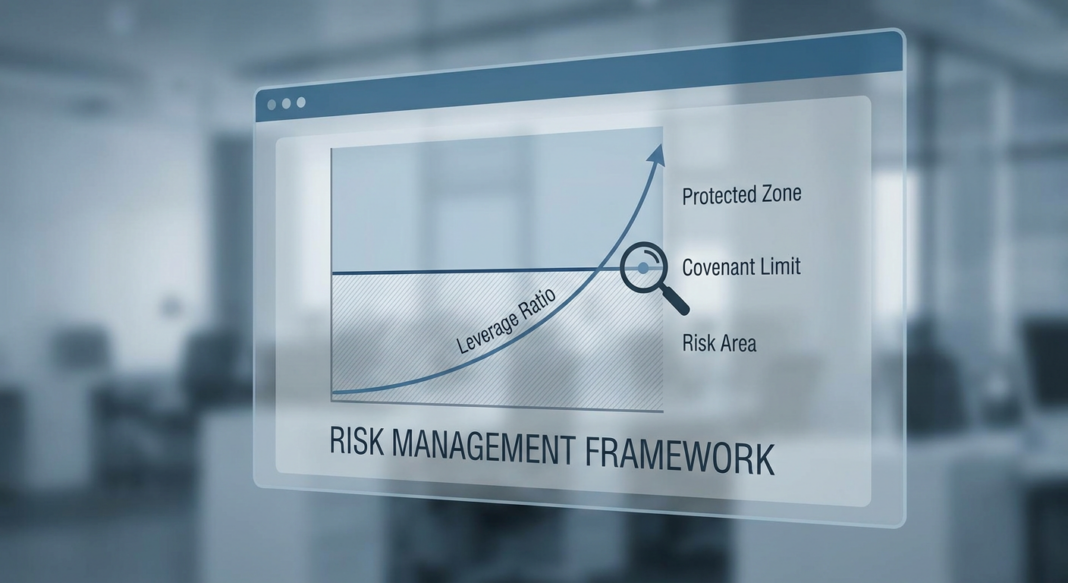
The Underwriting Challenge: When Covenants Exist in Name Only
Consider a $40 million senior secured term loan closed at 5.0x total leverage. The credit agreement contains a maintenance leverage covenant, tested quarterly, capped at a maximum of 8.25x. The borrower’s EBITDA would need to fall nearly 40% before a single lender right is triggered. Is this a protected credit, or a loan operating without a safety net?
This is the central tension in modern covenant design. S&P Global Ratings found in April 2025 that over a third of credit-estimated middle market borrowers with actively tested leverage-based maintenance covenants had headroom exceeding 40% at their most recent compliance test, levels so wide they offer lenders little practical early-warning protection. In their analysis of more than 2,000 borrowers, the distribution of companies with wide covenants was significantly higher in the upper (52%) and core (44%) middle market segments than in the lower middle market (29%).
For underwriters, the discipline is not simply confirming that a covenant exists; it is ensuring that the covenant is calibrated precisely enough to give the lender meaningful intervention rights before the borrower’s liquidity deteriorates beyond recovery. This article walks through the practitioner framework for designing, calibrating, and monitoring covenants across the credit lifecycle.
The Analytical Framework: Three Covenant Layers
Well-structured loan agreements operate across three covenant layers, each serving a distinct risk-management function.
Layer 1: Maintenance Covenants (Financial Tests)
Financial covenants consist of ratio-based tests that measure a company’s cash flow against its obligations, with EBITDA serving as the most commonly used cash flow proxy. The three most common financial covenant tests are the leverage ratio (Total Debt / EBITDA), the interest coverage ratio (EBITDA / Interest Expense), and the fixed charge coverage ratio (FCCR), which nets capital expenditures and cash taxes from EBITDA before dividing by total fixed charges.
Maintenance covenants are tested on a fixed schedule, typically quarterly, regardless of what actions the borrower has or has not taken. Per Sidley Austin’s March 2026 private credit analysis, leverage-based maintenance testing remains the structural backbone of most private credit agreements, even as broader market structures have evolved.
Worked Example, $10M EBITDA Manufacturer at 4.0x Leverage:
- Total Debt: $40M | EBITDA: $10M → Leverage Ratio: 4.0x
- Interest Expense (8.5% blended): $3.4M → Interest Coverage: 2.94x
- Fixed Charges (interest + $1.5M amortization + $2.0M capex): $6.9M → FCCR: 1.45x
- Maintenance covenant set at 5.5x leverage → Headroom: 27.5% (EBITDA could fall ~$2.7M before breach)
This structure preserves a meaningful early-warning cushion. Setting that same covenant at 7.0x leverage, a level now common in upper middle market deals, would require EBITDA to collapse by 43% before the lender gains any contractual remedies.
Layer 2: Incurrence Covenants (Negative Restrictions)
Incurrence covenants only apply when a borrower takes a specific action: incurring additional debt, paying dividends, making acquisitions, or granting liens. They do not require ongoing financial maintenance. A borrower can experience significant EBITDA deterioration without breaching an incurrence covenant, provided it takes no restricted action. This distinction is foundational to covenant-lite structuring and has profound implications for lender governance during distress.
Layer 3: Affirmative and Reporting Covenants
Reporting covenants require borrowers to deliver financial statements, compliance certificates, and management discussion on a defined schedule. Per the Federal Reserve and OCC Interagency Guidance on Leveraged Lending, lender management should receive comprehensive reports on leveraged loan characteristics and trends at least quarterly, with summaries provided to the board of directors. Transactions should be reviewed at least quarterly to determine variance from plan, risk implications, and accuracy of risk ratings.
Walking Through Covenant Calibration: Setting Levels That Matter
Covenant levels are typically set with deliberate headroom relative to the sponsor’s base case projections. Per Sidley Austin, trailing 12-month constructs, seasonal cushions, and staged step-down schedules are commonly used to preserve the covenant’s early-warning function without triggering repeated technical breaches driven by predictable business cycles.
The critical calibration question is: how much EBITDA deterioration must occur before the covenant is breached, and is that a level at which the lender can still protect its recovery? According to Proskauer’s private credit team, while headroom of 25% was historically the norm, nearly all deals today carry 30%+ headroom, with 35%+ considered "cov-loose" and 40%+ common in aggressive large-cap documentation.
Scenario Analysis: Headroom Erosion Across Downside Cases
| Scenario | Revenue Shock | EBITDA (est.) | Leverage Ratio | Covenant Set at 5.5x | Covenant Set at 7.5x |
|---|---|---|---|---|---|
| Base Case | +5% YoY | $10.0M | 4.0x | ✅ 27.5% headroom | ✅ 47% headroom |
| Downside | −10% YoY | $8.4M | 4.8x | ✅ 12.7% headroom | ✅ 36% headroom |
| Stress | −25% YoY | $6.1M | 6.6x | ⚠️ Breach triggered | ✅ 12% headroom |
This table illustrates the structural difference between a tightly calibrated covenant and a "cov-loose" structure. When the stress case triggers a breach at 5.5x, the lender has intervention rights (the ability to demand amendment fees, require additional collateral, or initiate restructuring dialogue) at a point where the business still has going-concern value. At 7.5x, the borrower can reach a DSCR below 1.0x without triggering any contractual protection.
A critical operational risk: research by A Faster Exit notes that S&P Global data shows typical leverage covenant cushions range from 0.25x to 0.75x, but that cushion only holds if the EBITDA underlying the calculation survives scrutiny. Aggressive add-backs can make apparent headroom illusory when a lender applies its own QoE adjustments at renegotiation.
Industry Standards: What Institutional Lenders Are Watching
The EBITDA Definition Problem
One of the most pervasive risk sources in covenant monitoring is the gap between GAAP EBITDA and lender-defined covenant EBITDA. Per Nilus’s compliance playbook, using the wrong EBITDA definition is the most common covenant compliance error, a company can simultaneously be in breach on GAAP EBITDA but compliant on lender-defined EBITDA, or vice versa. Management fees, one-time restructuring costs, acquisition expenses, and synergy add-backs are common points of negotiation, and their treatment must be explicitly codified at origination.
The OCC’s Rating Credit Risk handbook is explicit: criteria for assigning each risk rating should be clear and precisely defined using both objective factors (cash flow coverage, debt-to-worth) and subjective factors (quality of management, willingness to repay). Vague EBITDA definitions undermine both the rating process and the lender’s ability to enforce remedies.
Credit Market Performance Data
📊 Data Box: Default Rates & Covenant Performance
- Leveraged loan payment default rate (by amount), Dec. 2025: 1.23% ($17.4B), up from 0.91% ($12.6B) at end-2024, per PitchBook/LCD.
- Dual-track default rate (including distressed LMEs), Dec. 2025: 3.35% by issuer count, down 130 bps year-over-year, per PitchBook/LCD.
- Distressed exchanges accounted for 64% of all defaults in H1 2025: the same pace as all of 2024, itself the highest annual share on record, per Moody’s Ratings July 2025.
- KBRA Direct Lending Index showed a trailing 12-month default rate of 1.8% as of September 2025, consistent with year-end 2024, but the lower middle market default rate was forecast to reach 3% by year-end 2025, per KBRA/VRC analysis.
- Over a third of middle market borrowers with leverage-based maintenance covenants had headroom exceeding 40%, with the proportion rising to 52% in the upper middle market, per S&P Global Ratings, April 2025.
Common Structural Red Flags
- Covenant headroom above 35–40%: Per S&P Global, this level of cushion allows for significant EBITDA erosion before lender rights activate, effectively converting a maintenance covenant into a near-incurrence test.
- Single covenant structures in the lower middle market: Lower middle market borrowers are more likely to need multiple maintenance tests; S&P Global found only ~35% of lower middle market borrowers are required to comply with multiple maintenance covenants. An FCCR or minimum liquidity covenant alongside leverage provides a more robust early-warning system.
- Flat-line covenants without step-down schedules: Per Proskauer, covenants that do not step down over the life of the loan remove the deleveraging incentive and leave lenders exposed as the business matures and leverage theoretically improves.
- Uncapped EBITDA add-backs: The Interagency Guidance on Leveraged Lending explicitly flags cash flow analyses that rely on unsubstantiated projections of synergies and margins as a primary underwriting deficiency.
- Accepting borrower compliance certificates at face value: Per Aloan’s covenant monitoring analysis, when a portfolio manager accepts a reported ratio without recalculating from underlying financials, the bank stops monitoring covenants and starts trusting them, a critical distinction that regulators specifically examine.
Covenant Underwriting & Monitoring Checklist
The Basel Committee’s 2025 Principles for the Management of Credit Risk require that credit administration ensure continued analysis of a borrower’s ability and willingness to service debt, including monitoring legal covenants, collateral, and documentation on an ongoing basis. The following checklist operationalizes that requirement.
At Origination
- ✅ Define EBITDA with surgical precision: specify every permitted add-back, exclusion, and adjustment schedule in the credit agreement; do not rely on market convention. Verify all add-backs against audited financials before closing.
- ✅ Set leverage covenant with 20–30% headroom to base case EBITDA: not 40%+. For lower middle market borrowers (EBITDA under $15M), pair with a minimum FCCR or minimum liquidity covenant for layered protection.
- ✅ Build a step-down covenant schedule: require the leverage covenant to tighten each year by 0.25x–0.50x, creating a built-in deleveraging incentive and compressing lender risk as maturity approaches.
- ✅ Define equity cure rights precisely: limit to two or three exercises over the loan term, require cure proceeds to reduce debt outstanding, and impose a 10-to-15 business day cure window from the compliance certificate due date.
- ✅ Require quarterly compliance certificates signed by the CFO: include borrower’s own calculation of each covenant metric with supporting schedules; do not accept summary-level representations without underlying detail.
During Portfolio Monitoring
- ✅ Independently recalculate covenant ratios from source financials each quarter: do not transpose the borrower’s reported ratio without verification. Per the OCC, credit files must contain current financial statements and sufficient information to track the history of each credit decision.
- ✅ Implement a three-tier alert system: flag at 80% of the covenant limit (early awareness), escalate at 90% (planning window), and escalate to credit committee at 95% (action required). For a 5.5x leverage covenant, that means alerts at 4.4x, 4.95x, and 5.2x respectively.
- ✅ Run forward-looking scenario models quarterly: test how adverse trends (revenue decline, margin compression, interest rate stress) close the headroom gap across the next two to four testing periods.
- ✅ Audit LTM EBITDA roll-forward quarterly: a strong quarter dropping off the trailing twelve months can tighten leverage without any operational deterioration; this mechanical effect must be modeled prospectively, not discovered retrospectively.
- ✅ Escalate to credit committee at first headroom erosion below 15%: do not wait for a technical breach. Interagency Guidance on Leveraged Lending requires that diligent monitoring include quarterly reviews, documented variance-from-plan analysis, and prompt escalation of risk rating changes.
Key Takeaways
- 🔹 A covenant set with 40%+ headroom provides little lender protection. S&P Global’s April 2025 review of 2,000+ middle market borrowers found this level of cushion pervasive, effectively transforming a maintenance covenant into a near-incurrence test that activates only when a borrower is already deeply distressed.
- 🔹 EBITDA definition quality determines covenant quality. Uncapped or loosely defined add-backs can render the EBITDA underlying a leverage ratio meaningless. Underwriters must define every adjustment at origination and verify its basis against audited financials.
- 🔹 Maintenance covenants with step-down schedules align lender and borrower incentives. A covenant that tightens annually creates a contractual deleveraging roadmap, and gives lenders earlier intervention rights if the business underperforms its own projected improvement trajectory.
- 🔹 Independent recalculation is the lender’s primary monitoring control. Accepting borrower-reported ratios without independent verification from source financials is the most common portfolio monitoring failure identified in regulatory examinations, and the one most likely to mask early-stage distress.
- 🔹 Distressed exchanges now dominate the default landscape. With 64% of all defaults in H1 2025 consisting of distressed liability management exercises per Moody’s, lenders without tight maintenance covenants lose the contractual leverage needed to participate meaningfully in out-of-court restructuring negotiations, ceding control to larger or more aggressive creditor groups.


