
The Underwriting Challenge: When Documentation Fails Before the Borrower Does
In the spring of 2023, a mid-market software company’s lenders discovered something uncomfortable: the borrower had transferred its most valuable intellectual property assets to an unrestricted subsidiary, a maneuver known in restructuring circles as an asset drop. The credit agreement, negotiated in a competitive 2021 market, contained a loose definition of “unrestricted subsidiary” and no asset-transfer covenant. Lenders had collateral on paper that no longer existed in practice.
This scenario, increasingly common as liability management exercises (LMEs) proliferate, illustrates a foundational truth in credit underwriting: the loan agreement is the product. Spreads compensate for expected risk; covenants protect against unexpected behavior. When covenant packages erode, lenders are not just accepting more risk; they are surrendering the structural levers that allow them to act before a borrower reaches terminal distress.
According to research from troweprice.com (OHA), structuring expertise at the time of underwriting is among the most critical determinants of long-term credit performance, particularly as defaults increasingly settle through out-of-court restructurings where documentation quality is the primary battleground.
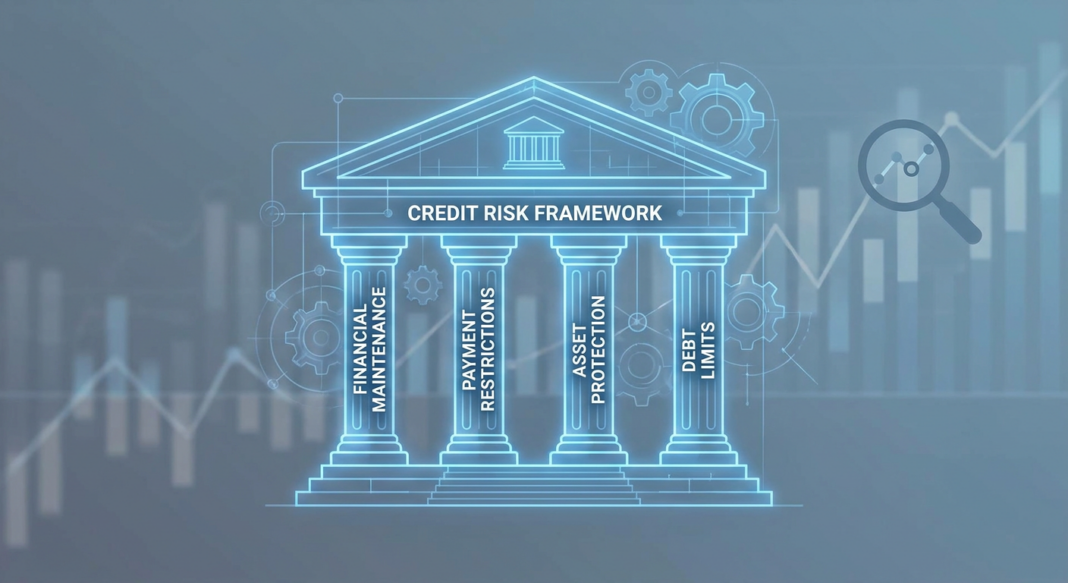
The Framework: Four Pillars of Covenant Architecture
Experienced direct lenders approach covenant design through four integrated pillars, each serving a distinct protective function:
1. Maintenance Financial Covenants
Maintenance covenants require the borrower to satisfy defined financial thresholds, tested quarterly, regardless of whether a specific action triggers them. They are the underwriter’s early warning system. The two most common are:
- Maximum Total Leverage Ratio (Total Debt ÷ EBITDA): Caps how indebted the business can become relative to earnings. A well-structured first-lien covenant might open at 6.0x and step down to 5.0x by year three, tracking the expected deleveraging path of the business.
- Minimum Interest Coverage Ratio (EBITDA ÷ Interest Expense): Ensures cash generation is sufficient to service debt. overbond.com notes that a company’s ability to meet interest expenses generally becomes questionable when EBITDA-to-Interest coverage migrates below 1.5x, a widely accepted floor among institutional lenders.
2. Restricted Payment Baskets
Restricted payment covenants limit dividends, equity distributions, management fees, and affiliate payments. Without tight baskets, a financially stressed borrower can legally extract cash from the enterprise before lenders can react. Best practice is to permit restricted payments only when leverage is below a defined threshold (say, 4.0x) and when no event of default exists.
3. Asset Transfer and Investment Covenants
These provisions prevent borrowers from transferring collateral, intellectual property, or operating subsidiaries outside the credit group. The J.Crew and Chewy maneuvers, now industry shorthand for aggressive collateral stripping, exploited gaps in early covenant packages. Modern agreements should explicitly define the perimeter of the “credit group” and restrict subsidiary reclassification without lender consent.
4. Debt Incurrence Limits
Incurrence covenants restrict the borrower from raising additional debt above defined leverage thresholds. They are a structural check on future capital structure deterioration. A Debt/EBITDA cap of 5.5x for incremental borrowings, for example, prevents the borrower from layering in pari passu debt that dilutes existing lenders’ recovery position.
The Analysis: Calibrating Covenants to Actual Borrower Risk
Consider a hypothetical $10M EBITDA industrial distribution company being underwritten at a 5.0x Total Leverage entry point, with $50M of total debt. The lender is structuring a $45M first-lien term loan at SOFR + 550 bps.
Step 1: Establish the EBITDA Definition
The single most consequential negotiation in any leveraged loan is what counts as EBITDA. Borrowers push to include: pro forma cost savings (add-backs for synergies), management projections, non-recurring charges, and equity compensation. Lenders must set firm limits. Best practice caps total add-backs at 20–25% of reported EBITDA and requires add-backs to be documented, time-limited (typically 18 months), and operationally achievable.
In the example above, the borrower reports $10M EBITDA but claims $2M in cost savings from a recently completed acquisition. An aggressive underwriter accepts $12M Adjusted EBITDA, yielding a 4.2x entry multiple that appears conservative. A disciplined underwriter haircuts unrealized synergies by 50%, accepting only $11M, and sets the covenant at 5.5x with a 10% cushion to the entry leverage of 4.5x ($50M ÷ $11M).
Step 2: Build in Headroom, Not Breathing Room
Covenants set too tight create constant technical defaults; covenants set too loose provide no early warning. The institutional standard is 20–30% headroom between the borrower’s projected performance and the covenant threshold at close. If the model projects 5.0x leverage, the maintenance covenant should be set at 6.0x–6.5x, tight enough to trigger dialogue on deterioration, but not so tight that a single bad quarter trips a technical default.
Step 3: Stress Test the Covenant Path
Underwriters should model a downside scenario, typically a 20–25% EBITDA haircut combined with a 10% revenue decline, and verify that the borrower would breach the maintenance covenant within 2–3 quarters. The breach itself is not a catastrophe; it is a structured opportunity to re-underwrite the credit, demand a cure, or accelerate. A covenant that is never triggered in a stress scenario provides no protection at all.
In the industrial distributor example: a 25% EBITDA decline drops earnings to $7.5M–$8.25M. With $50M in debt, leverage rises to 6.1x–6.7x, well inside the 6.5x covenant threshold. The lender is notified, discussions commence, and the equity sponsor is required to inject a cure amount or accept modified terms. This is how covenants are supposed to function.
Industry Standards: What Institutional Lenders Demand
The direct lending and institutional private credit markets have produced a body of empirical evidence on covenant performance that should anchor any underwriting framework:
- Borrower size matters materially. According to data cited by troweprice.com (OHA), borrowers with EBITDA of $100M or more experienced a 32% lower default rate than smaller borrowers from 1995 through 2025, underscoring the importance of scale as a credit quality indicator.
- Recovery rates are structural, not incidental. OHA’s illustrative analysis shows that two portfolios with identical spreads and identical default rates can produce a 44% difference in loss-adjusted spread based solely on recovery outcomes, driven directly by collateral quality and covenant structure at the time of origination.
- LME frequency is rising. As defaults increase, out-of-court restructurings have become the dominant resolution mechanism. Lenders without robust asset-transfer restrictions and debt-incurrence caps are systematically disadvantaged in these negotiations.
- Credit spread migration typically reduces expected return. As analyzed in the cfainstitute.org credit analysis framework, rating transitions and spread widening compound to erode realized yield, making covenant-triggered early action more valuable than spread at origination.
- BBB-rated concentration risk is elevated. The lowest investment-grade tier now represents over 40% of certain benchmark indices, per firstratefunding.net, creating a large pool of potential fallen angels where covenant protections are thinner and downgrade risk is asymmetric.
- Senior secured recovery (historical range): 40%–65% of face value in bankruptcy
- Subordinated debt recovery: below 25%, often zero in deep restructurings
- EBITDA-to-Interest threshold for concern: below 1.5x
- Institutional standard headroom on maintenance covenants: 20–30%
- Add-back cap on EBITDA adjustments (best practice): 20–25% of reported EBITDA
Sources: OHA / T. Rowe Price; Overbond Academy; First Rate Funding
Underwriting Checklist: Covenant Diligence at Origination
Before committing capital, a disciplined underwriting desk should work through the following covenant diligence checklist:
- EBITDA Definition Audit: Line-item review of every proposed add-back. Are they documented? Time-bounded? Operationally verifiable? Total add-backs should not exceed 20–25% of LTM reported EBITDA.
- Leverage Covenant Calibration: Model 3-year base and downside case. Confirm that the downside scenario trips the covenant within 2–3 quarters of deterioration onset.
- Restricted Subsidiary Review: Map every subsidiary in the organizational structure. Confirm that operating entities and IP-holding entities are included in the credit group and subject to covenant restrictions.
- Restricted Payment Basket Negotiation: Ensure distributions are gated behind a leverage test (e.g., ≤4.0x) and an absence-of-default condition.
- Incremental Debt Permissions: Confirm that any “accordion” or incremental facility is subject to a maximum leverage test on a pro forma basis.
- Asset Sale Proceeds Sweep: Verify that mandatory prepayment provisions capture net proceeds from asset dispositions above a defined threshold.
- Reporting Requirements: Quarterly financial statements, officer compliance certificates, and prompt notification of any material adverse change or covenant breach.
- Cure Rights: Confirm that any equity cure right is limited in frequency (e.g., no more than two cures in any four-quarter period) and amount.
Key Takeaways
- 🔐 The loan agreement is the product: Covenant architecture determines whether lenders can act before a borrower reaches terminal distress, spreads compensate for expected risk, but covenants protect against unexpected behavior.
- 📐 EBITDA definition discipline is non-negotiable: Uncapped add-backs inflate coverage ratios and leverage metrics at origination, obscuring true credit risk and undermining every downstream covenant test.
- ⚠️ Covenant headroom must be calibrated, not defaulted: A 20–30% buffer between projected performance and covenant thresholds balances early-warning functionality against unnecessary technical default triggers.
- 📉 Recovery rates are structural outcomes, not random events: Senior secured lenders recover 40–65% historically; subordinated holders often recover less than 25%, a direct function of collateral quality and covenant integrity negotiated at close.
- 🔍 Stress testing the covenant path is a diligence requirement: Every underwriting memo should demonstrate that a defined downside scenario, 20–25% EBITDA compression, produces a covenant breach within a predictable timeframe, validating the protective function of the structure.


