
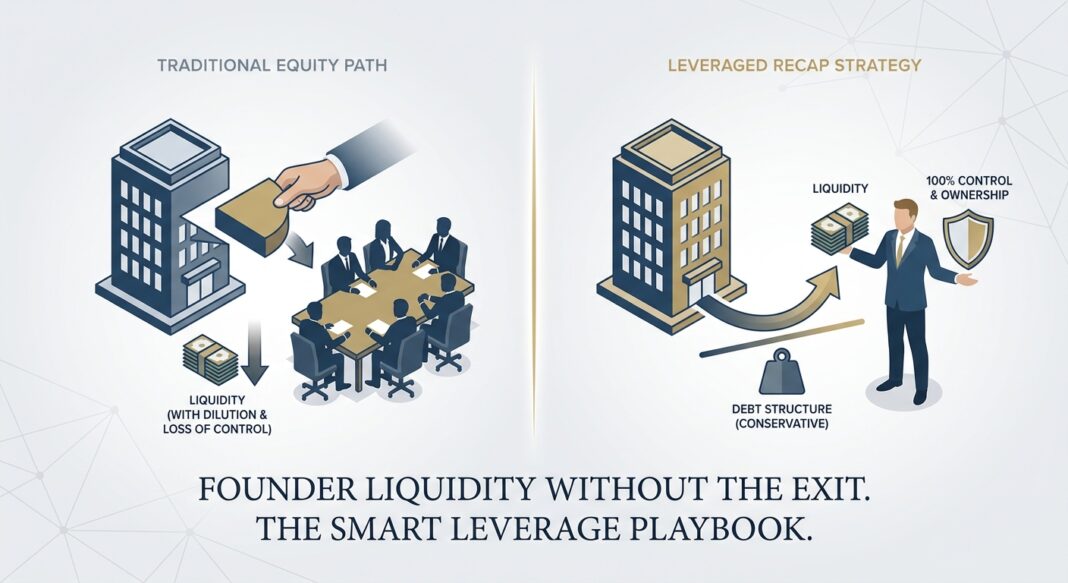
The Phone Call Every Founder Eventually Gets
Twelve years into building a specialty logistics software business, the founder had a problem most entrepreneurs would envy: the company was genuinely excellent. Recurring revenue of $6.2 million. EBITDA margins north of 65%. A loyal customer base across the transportation sector. Zero debt. And a founder who had never taken a dollar off the table.
Then came the call. Not from a PE firm, from his cardiologist. Nothing catastrophic, but a serious enough conversation about stress and lifestyle that the founder spent the next month doing the arithmetic on what would happen to his family if something happened to him. All his net worth, more than $20 million by any reasonable EBITDA multiple, was locked inside a private company he had no intention of selling.
He wasn’t ready to hand over the keys. He wasn’t interested in a PE partner sitting at his board table dictating exit timelines. But he also could no longer pretend that 100% illiquidity was a responsible financial position for a man with two kids in college and a mortgage on a second property.
What he needed didn’t exist in the VC playbook. It existed in a different one entirely.
The Decision: What Were the Options?
His M&A advisor laid out three paths. Each one came with a different price: measured not just in dollars, but in control, risk, and what the founder would wake up to on Monday morning.
Option A: Full Sale
At a market-rate multiple, the business was worth somewhere between $25M and $28M. After tax and fees, maybe $17M lands in the founder’s pocket. Clean. Final. And the thing he had built for twelve years would belong to someone else before Christmas.
Option B: Minority PE Recap (Equity-Based)
Sell 30–40% to a growth equity sponsor for $8–10M in personal liquidity. Keep operating. But now there’s a preferred shareholder at the table with a liquidation waterfall, a board seat, and a 5-to-7-year clock ticking toward a forced exit. The equity financing business model is predicated on liquidity, which means the sponsor’s incentives and the founder’s incentives are aligned only until they aren’t.
Option C: Leveraged Recapitalization
Borrow against the company’s own cash flows. Use those proceeds to pay a special dividend directly to the founder. Own 100% of the equity before and after. Pay down the debt with the business’s operating cash flow. No new shareholders. No preferred stack. No exit clock.
The structure of Option C looked like this:
| Capital Structure Component | Amount | Notes |
|---|---|---|
| Company TTM EBITDA | $4.0M | Normalized, recurring-revenue base |
| Senior Secured Term Loan | $6.0M | 1.5x EBITDA, conservative first-lien |
| Unitranche / Mezz Tranche | $2.0M | 0.5x EBITDA, subordinated, higher yield |
| Total Debt | $8.0M | 2.0x EBITDA total leverage |
| Special Dividend to Founder | $8.0M | Pre-tax; structure determines tax treatment |
| Annual Debt Service (est.) | ~$880K | ~11% blended all-in cost |
| Remaining Free Cash Flow | ~$1.8M | After debt service, business still healthy |
| Founder Equity Retained | 100% | No dilution, no new shareholders |
The leverage ratio matters here. According to the Pepperdine Private Capital Markets Report, lower middle market leveraged recapitalizations typically close at 3x to 5x EBITDA in total debt. This structure sat at a conservative 2x, well inside what lenders in this segment will support for a high-margin, recurring-revenue business. The founder had significant headroom. He chose not to use it.
The Outcome: Liquidity, Control, and the Monday Morning Test
The transaction closed in under ninety days. The founder wired $8 million into a personal account. He walked back into the office on a Monday morning still owning every share of the company he built.
Three years later, the debt was roughly 60% retired: paid down from operating cash flows without any constraint on the business’s ability to hire, invest, or take on new contracts. And the company itself had grown: the same recurring revenue base that supported the original recap was now generating $5.4M in EBITDA, making the remaining debt load even lighter in relative terms.
The Counterfactual: What Option B Would Have Cost
Had the founder taken the minority PE equity route, selling 35% for $9.1M, he would have received slightly more personal liquidity upfront. But let’s follow that thread:
- A PE sponsor now owns 35% of the equity and holds a preferred liquidation preference
- The board now includes at least one sponsor representative with real decision-making influence
- A forced exit is baked into the fund lifecycle, somewhere between year 5 and year 7
- If the company sells for $28M in year 6, the founder’s 65% stake yields roughly $13.3M (after preferences): versus keeping 100% in the recap scenario, where the same exit yields $28M minus remaining debt (perhaps $3M), or ~$25M
The delta between the two paths, at an identical exit price, is roughly $12 million in founder proceeds. The recap paid out $8M early. The equity path cost the founder $12M at the end. That is the arithmetic of dilution, and it deserves to be taken seriously.
The Market Behind the Story
This founder’s instinct was not unusual; it reflected something larger happening across the market. The leveraged recapitalization structure has surged in usage as both PE sponsors and independent owner-operators have discovered its power as a liquidity tool. According to PitchBook LCD data, PE-backed companies issued $72.2 billion in dividend recapitalizations during full-year 2025, the second-highest annual volume ever recorded. The reasons are structural: exit windows have been sluggish, and the recap has become the primary mechanism for extracting distributions without forcing a sale.
That said, the 2025 PE-sponsored recap boom came with a warning embedded in its own data. Analysis of those deals shows that sponsors were adding approximately one additional turn of leverage through the recapitalization process, with average pre-dividend leverage at 4.2x and post-dividend leverage approaching 5.2x to 5.5x in many cases. Adding a full turn of debt to satisfy LP distribution pressure is a fundamentally different decision than a founder taking a conservative 2x recap to address personal financial planning. The instrument is the same. The incentive driving it is not.
The Lessons: A Framework for Owner-Operators
1. Debt Is Not the Enemy of the Founder. The Waterfall Is.
The mistake most founders make is conflating “taking on debt” with “losing control.” Debt, structured correctly, does the opposite. It is equity that introduces the waterfall (preferred liquidation preferences, pro-rata rights, board governance, and exit timelines) that ultimately erodes founder ownership at the moment of exit. A leveraged recap adds a payment obligation; it does not add a new principal. The distinction is everything.
2. The Business Must Qualify, and That’s a Feature, Not a Bug
Recapitalizations are not available to every company. Lenders will scrutinize free cash flow stability, covenant headroom, and the owner’s tolerance for operating under debt. This discipline is actually protective: it means the instrument self-selects for companies that are genuinely strong enough to carry it. If your business cannot support a conservative recap, that is important information about the business, not an argument against the structure.
3. Sizing Conservatively Is the Sophisticated Move
The market currently supports lower middle market transactions at 3x to 5x EBITDA in total leverage. But the founder in our case study chose 2x. That conservatism is not timidity; it is the difference between a liquidity event and a leverage trap. The goal is to walk away with meaningful personal liquidity while leaving the business strong enough to grow, service the debt, and ultimately deliver a full exit at full value. Overlevering to maximize the dividend is how a good idea becomes a cautionary tale.
4. Know What Cycle You’re In
Recap market conditions change. After a historic $72.2 billion year in 2025, activity in the broad syndicated market has cooled in 2026, with volume down roughly 40% year-over-year. The private credit and lower middle market, however, remain more accessible. Unitranche all-in yields compressed meaningfully through 2025. The window is not closed, but it is more selective than it was eighteen months ago, and execution quality matters more in a tighter environment.
5. The “Chips Off the Table” Decision Is a Strategy, Not a Compromise
Too many founders treat personal liquidity as something to be postponed until a clean exit, or surrendered only through dilution. The leveraged recap reframes this entirely. Taking chips off the table through a structured recap while maintaining full ownership is not a hedge against ambition. It is what allows the founder to keep swinging for a full exit, from a position of financial security rather than desperation.
Key Insights
- Debt gives you liquidity; equity sells you control. A leveraged recap extracts personal cash flow from a company’s balance sheet without introducing a new equity principal, a preferred stack, or an exit timeline dictated by someone else’s fund structure.
- The dilution math is devastating at exit. In a comparable scenario, the equity path can cost a founder $10M–$15M in exit proceeds versus a conservative recap, even when both paths start with similar upfront liquidity. Preferences compound silently.
- 2025 was a record year for recaps, and the data explains why. PE-backed companies issued $72.2 billion in dividend recaps in 2025 (the second-highest annual total on record), driven by closed exit windows and LP distribution pressure. Independent founders can use the same playbook with less leverage and better alignment.
- Conservative leverage is the point. Lower middle market recaps typically clear at 3x–5x EBITDA; the most durable founder outcomes are built at the lower end of that range, where debt service leaves room for the business to grow and weather volatility.
- The instrument self-selects for strength. A lender’s willingness to structure a recap is itself a signal of business quality. Free cash flow stability, recurring revenue, and covenant headroom are what make the structure possible, which means the recap is available precisely when the company is in the best position to support it.


