
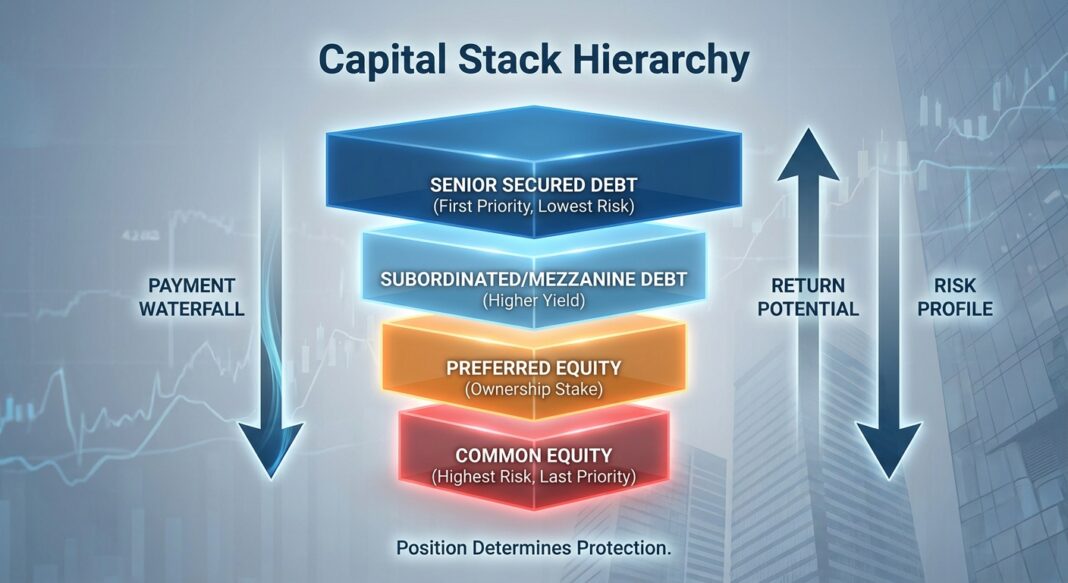
Where You Sit Determines What You Get
In private credit, one concept governs nearly every risk and return decision a lender or borrower makes: position in the capital stack. The capital stack is the structured hierarchy of financing sources used to fund a company: ranked from the safest, highest-priority claim at the top to the most speculative, lowest-priority claim at the bottom. In a default or liquidation scenario, the stack determines who gets paid first, who gets paid last, and who may get nothing at all.
Understanding this hierarchy is not optional knowledge for anyone entering private credit markets; it is the foundation. Whether you are an institutional investor evaluating a direct lending fund or a business owner considering your financing options, the capital stack dictates the terms of every negotiation.
The Four Rungs: How the Stack Is Structured
A typical leveraged buyout or private credit transaction will include some combination of the following layers, ordered from highest to lowest priority in repayment:
- Senior Secured Debt (First Lien): The top rung. Lenders here hold a first-priority claim (backed by collateral such as company assets or cash flows) and are repaid before all other creditors in any distress scenario. Because of this protection, senior secured lenders accept a lower interest rate. This is the primary zone where direct lending funds operate.
- Subordinated / Mezzanine Debt: The middle rung. Mezzanine, literally meaning “middle floor”, sits below senior debt and above equity. It is repaid only after senior creditors are made whole, so lenders charge a meaningfully higher rate to compensate. Mezzanine deals are frequently structured with warrants or equity conversion features to give lenders upside participation. As noted by Meketa Investment Group (April 2024), mezzanine debt is typically unsecured or lightly secured and carries higher interest rates than senior loans.
- Preferred Equity: Preferred equity holders have an ownership stake but receive priority distributions over common equity holders. They do not benefit from the hard contractual repayment protections that debt provides, but they do sit above common shareholders in liquidation priority.
- Common Equity: The bottom rung, and the most exposed. Common equity absorbs losses first and is paid last. In leveraged transactions, this is typically the private equity sponsor’s ownership stake. The potential upside is unlimited; so is the downside risk.
A Concrete Example: The $10M Company Acquisition
Suppose a private equity sponsor acquires a manufacturing company for $10 million. The deal is structured as follows:
- $5.5M, Senior Secured Term Loan (55% of capital stack) at SOFR + 500 bps
- $2M, Mezzanine Debt (20% of capital stack) at a fixed 13% interest rate with warrants
- $2.5M, Common Equity (25% of capital stack) contributed by the PE sponsor
Now suppose the company runs into difficulty and is liquidated for only $6 million: a 40% loss of enterprise value. Here is how the waterfall plays out:
- The senior lender recovers their full $5.5M: 100 cents on the dollar.
- The mezzanine lender recovers the remaining $0.5M: only 25 cents on the dollar.
- The equity sponsor recovers $0: a total loss.
This waterfall mechanics example illustrates why subordination is the single most important risk variable in private credit. The senior lender walked away whole because the equity cushion ($2.5M) and the mezzanine layer ($2M) absorbed the losses first. This is precisely why direct lenders price their risk differently from mezzanine funds, and why both price very differently from an equity investor.
Current Market Relevance: Where Capital Is Flowing in 2026
The capital stack is not an academic abstraction; it is actively shaping institutional capital allocation decisions right now. Several data points illustrate why stack position has become even more strategically important in today’s environment:
According to Long Angle’s Private Credit Investment Guide 2026, private credit assets under management surpassed $2 trillion in 2025 and are projected to reach $4.5 trillion by 2030, with direct lending, the most senior-positioned strategy, accounting for 38% of private credit capital raised in H1 2025. Investor preference for first-lien positions has been the dominant structural theme of this growth cycle.
As documented by Meketa Investment Group (April 2024), private credit financed approximately 85% of leveraged buyouts in 2023, up from 65% in 2021: meaning private lenders, not banks, now largely define stack construction in middle-market deals. Meanwhile, bank lending as a share of U.S. GDP has declined from approximately 59% in Q4 2008 to around 44% as of Q1 2025, according to Long Angle (2026). This structural retreat by banks has created the white space that private credit now fills, primarily at the senior secured level.
As described by Gridline (January 2024), in 2021 nearly half of all capital raised by private debt funds was directed to senior debt strategies, a direct reflection of institutional investors prioritizing capital preservation and structural seniority in an uncertain macro environment.
| Layer | Typical Rate / Return | Repayment Priority | Source |
|---|---|---|---|
| Senior Secured (First Lien) | SOFR + 450–600 bps | First | Long Angle, 2026 |
| Mezzanine / Subordinated | 11–15%+ (fixed or PIK) | Second | Meketa, April 2024 |
| Asset-Based Finance (ABF) | ~7–8% annualized | Varies by structure | Long Angle, 2026 |
| Common Equity | Target 20%+ IRR | Last | CFI, 2024 |
Decision Framework: Investors and Operators
For Investors Evaluating Private Credit
When reviewing any private credit opportunity, experienced allocators consider four stack-related questions:
- Where does this loan sit? First lien senior secured vs. second lien vs. mezzanine carries fundamentally different risk profiles, regardless of the borrower’s quality.
- How much equity cushion sits below this debt? A 30% equity cushion beneath a first-lien loan provides far more protection than a 10% cushion. The thicker the equity layer, the more enterprise value can erode before the lender is impaired.
- What covenants protect the position? Private credit typically includes maintenance covenants, such as minimum fixed charge coverage ratios, that give lenders early warning and intervention rights before losses materialize. As noted by Long Angle’s Terminology Guide, private credit typically has stronger covenants than public credit markets.
- Is the return commensurate with stack risk? Accepting mezzanine-level risk at senior-debt pricing is a mismatch. Investors evaluate whether spread and structure properly compensate for subordination.
For Business Owners Seeking Capital
Operators use the capital stack as a financing optimization tool. Key considerations include:
- Senior debt is cheaper but constrained. Lenders will only extend senior secured credit to a certain leverage threshold, typically 3x–5x EBITDA for middle-market companies. If you need more capital than senior debt provides, the next rung has a higher cost.
- Mezzanine fills the gap without diluting ownership. For a business owner who has maxed senior debt capacity but does not want to sell equity, mezzanine financing offers a bridge, at a higher interest cost, but without giving up ownership percentage.
- Every rung of debt you add reduces your equity cushion. This protects lenders but concentrates risk for the owner. Operators evaluate leverage decisions in terms of debt service capacity, specifically whether operating cash flow can comfortably cover all interest obligations across every layer of the stack.
Key Takeaways
- Position determines protection. In any distress scenario, the capital stack’s waterfall determines recovery, senior lenders are paid first, equity holders absorb losses first.
- Higher yield always signals lower stack position. When a private credit strategy offers meaningfully higher returns, it is because the lender is accepting subordination risk, not because the manager found a free lunch.
- Equity cushion is a lender’s first line of defense. Investors evaluate how much enterprise value can decline before their loan position is impaired, the thicker the equity cushion below the debt, the greater the margin of safety.
- Private credit dominates middle-market stack construction. With banks financing a declining share of leveraged buyouts, private credit lenders now largely define how capital stacks are built for companies with $25M–$100M in EBITDA.
- Operators can engineer their stack to balance cost and control. Layering senior debt, mezzanine, and equity thoughtfully allows business owners to access maximum capital at the lowest blended cost while preserving ownership.


