
Where You Sit Determines What You Get
When a company borrows money, not all lenders are created equal. Some stand at the front of the repayment line; others wait at the back. This ordering, known as the capital stack: is arguably the single most important structural concept in private credit. It governs who gets paid first in normal operations, who absorbs losses first in a downturn, and ultimately, what rate of return each layer must offer to attract investors willing to accept its specific position in the hierarchy.
Understanding capital stack position isn’t just academic. For investors evaluating a private credit fund, it determines the true risk profile of what they own. For business owners raising capital, it shapes the cost, flexibility, and dilution consequences of every financing decision they make.
The Capital Stack: Definition and Mechanism
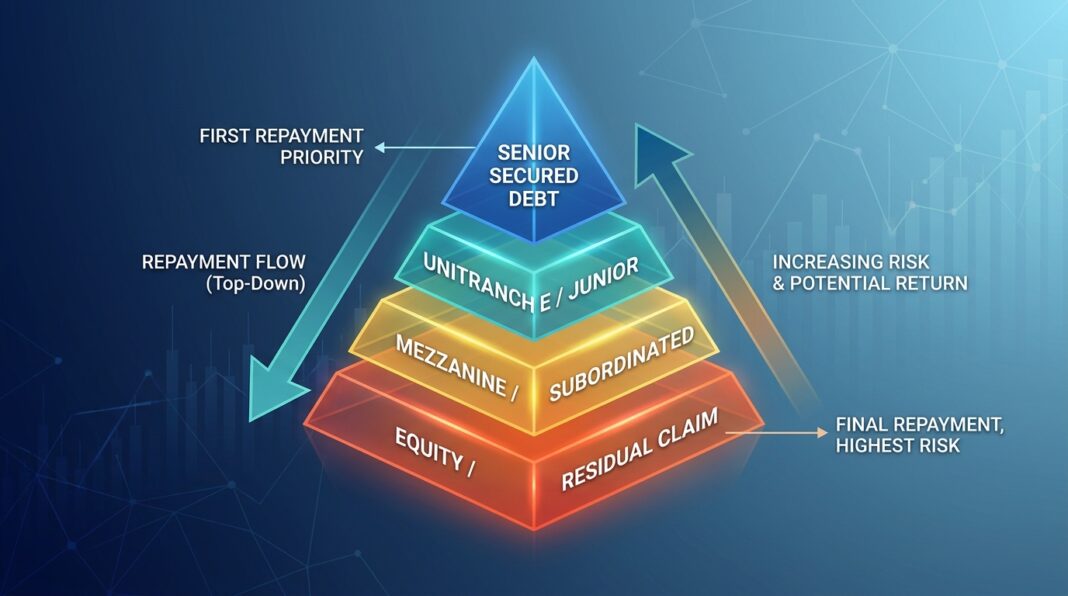
The capital stack is the structured hierarchy of all debt and equity claims on a company’s assets and cash flows. Arranged from lowest to highest risk, it typically comprises four main layers:
- Senior Secured Debt: First priority claim on collateral. Repaid before all other creditors. Lowest yield, lowest risk.
- Unitranche / Junior Secured Debt: A blended or secondary secured layer. Higher yield than senior debt, with a subordinated collateral claim.
- Subordinated / Mezzanine Debt: Unsecured or lightly secured. Higher yield, significant loss exposure in default scenarios. Often includes equity warrants.
- Equity (Preferred & Common): Residual claim after all debts are satisfied. Absorbs the first losses; highest potential return, highest risk.
The governing principle is subordination: each layer explicitly agrees, by contract, to be repaid only after all senior layers are made whole. As BIP Wealth explains, layers near the top, senior secured debt, are backed by tangible collateral such as cash, receivables, and equipment, while layers near the bottom absorb losses first and are repaid last. This is not a matter of negotiation at the moment of distress; it is locked in at origination.
How It Works: A Concrete Example
Consider a hypothetical middle-market manufacturer, Acme Industrial, with $100 million in total enterprise value. The company raises $60 million in external capital to fund a leveraged buyout, structured as follows:
- Senior Secured Term Loan: $35M at SOFR + 5.50% (≈10.8% all-in), secured by all assets
- Unitranche / Junior Tranche: $15M at SOFR + 8.00% (≈13.3% all-in), second-lien security
- Mezzanine Note: $10M at 14.00% fixed + equity warrants, unsecured
- Equity: $40M contributed by the private equity sponsor, the remaining cushion
Now stress-test this: if Acme’s enterprise value falls 35% to $65 million and the company must liquidate, recovery flows top-down. The senior secured lender recovers its full $35M first. The junior tranche receives $15M next, also made whole. The mezzanine lender receives the remaining $15M, recovering only $10M of its $10M note, plus $5M to spare. Equity receives nothing.
But push the scenario harder, a 50% value decline to $50M, and the mezzanine lender is wiped out entirely, recovering $0 on its $10M note. The senior and junior lenders are still whole. This is the mechanism of subordination in practice: equity cushion protects debt layers above it, and junior debt layers protect senior debt layers above them.
Current Market Relevance
Capital stack dynamics are particularly meaningful in today’s lending environment. Several structural trends have converged to make stack position more consequential than ever:
According to Long Angle’s Private Credit Investment Guide 2026, direct lending, which primarily occupies the senior secured layer, has seen default rates remain under 4% since 2021, as tracked by Proskauer’s Private Credit Default Index. This relatively low default rate reflects both the structural protection of senior position and the covenant packages that accompany it.
The private credit market’s growth has been concentrated in senior secured strategies. As documented by Gridline’s Alternative Investment research, nearly half of all capital raised by private debt funds in recent years has flowed to senior debt strategies, reflecting institutional demand for yield with structural downside protection rather than pure equity-like upside.
The broader private credit universe now encompasses over 26 distinct strategies, as catalogued in Briarcliffe’s Field Guide to Private Credit (January 2026), each occupying a different position on the risk-return spectrum defined by stack position. Senior secured direct lending strategies target unlevered net returns in a meaningfully different band than mezzanine or special situations strategies, a difference rooted entirely in subordination.
As Meketa Investment Group’s Private Credit Primer notes, the asset class has grown considerably since the Global Financial Crisis, with non-bank lenders filling the gap left by regulated banks. That structural shift means private credit managers, not banks, now set the terms, covenants, and stack positions for a growing share of middle-market lending activity, giving institutional lenders more direct influence over deal structure than the syndicated loan market traditionally permitted.
Decision Framework
For Investors Evaluating Private Credit Funds
- Ask first: where in the stack does this fund lend? Two funds both labeled “private credit” can have dramatically different risk profiles if one is senior secured and one is mezzanine.
- Evaluate the equity cushion beneath you. A senior secured loan at 50% loan-to-value has meaningful protection; the same loan at 80% LTV does not, regardless of its label.
- Understand collateral quality. Senior secured loans backed by hard assets (real estate, equipment) behave differently than those backed by enterprise cash flows. Recovery assumptions differ significantly.
- Match stack position to your return requirement. Accepting mezzanine risk to earn senior secured returns (or vice versa) reflects a misalignment that due diligence should surface.
For Business Owners and Operators Raising Capital
- Senior secured debt is the cheapest form of private credit, but it requires collateral and comes with the tightest covenants. Operators with strong asset bases and predictable cash flows typically qualify and should seek it first.
- Mezzanine and subordinated structures offer flexibility when senior capacity is exhausted, but at materially higher cost. Evaluate the total interest burden against projected cash flows, not just the headline rate.
- Equity warrants attached to mezzanine debt dilute ownership. Model the fully diluted cap table before accepting warrant-linked structures, the effective cost of capital is higher than the coupon alone implies.
Key Takeaways
- Position determines protection: Senior secured lenders hold a contractual priority claim on collateral, insulating them from losses that would wipe out junior creditors and equity holders first.
- “Private credit” is not one thing: Senior secured direct lending and mezzanine debt are both private credit, but they carry fundamentally different risk-return profiles defined by their stack position.
- The equity cushion is the senior lender’s first line of defense: The larger the sponsor equity contribution below the debt layers, the more enterprise value can erode before senior lenders face principal risk.
- Yield signals position: Higher coupons in private credit generally reflect lower stack position and greater loss exposure, not simply better value. Rate and risk move together by design.
- Institutional demand has concentrated at the top: The majority of private credit capital raised in recent cycles has targeted senior secured strategies, reflecting a broad preference for structural protection over maximum yield.


