
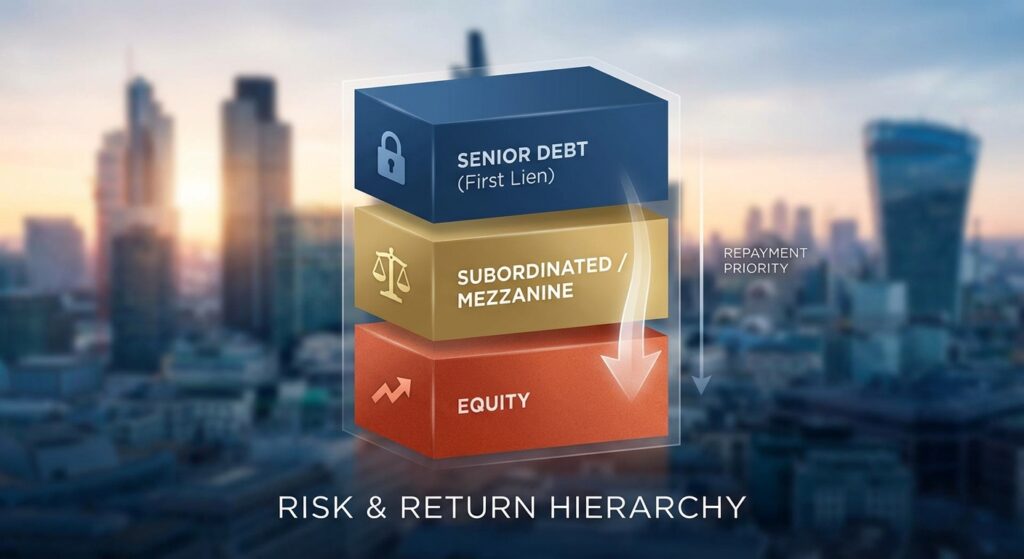
Why Your Position in the Stack Is Everything
When a company borrows money, not all lenders are created equal. Some will be repaid first no matter what. Others may wait years, or receive nothing at all. This hierarchy is called the capital stack, and understanding where a private credit instrument sits within it is arguably the single most important concept for anyone evaluating or structuring a private credit deal.
The capital stack is not an abstraction. It is a legally binding repayment priority that determines who gets paid first when cash flows are tight, when covenants are breached, or when a business is sold or liquidated. For investors, your position in the stack directly determines your downside protection. For business owners, it determines how much your capital costs and how much control you retain.
The Four Layers of the Capital Stack
A typical leveraged buyout or middle-market financing will include some combination of the following layers, stacked from safest to riskiest:
- Senior Secured Debt (First Lien): The top of the stack. These lenders have a first-priority lien on the company’s assets and cash flows. They are repaid first in any scenario, including bankruptcy or asset sale. Because the risk is lowest, the interest rate is lowest.
- Unitranche / Second Lien Debt: A blended or subordinated debt layer sitting just below first lien. Unitranche structures, increasingly common in direct lending, combine first and second lien into a single instrument with a single lender group, simplifying execution while offering lenders a modestly higher yield.
- Mezzanine / Subordinated Debt: Sits below senior debt. Mezzanine lenders accept higher risk in exchange for higher interest rates, often supplemented by equity warrants or payment-in-kind (PIK) features. In a default, they are repaid only after senior lenders are made whole.
- Equity: The bottom of the stack. Equity investors (typically the private equity sponsor or management team) absorb losses first and are paid last. Their upside is theoretically unlimited, but their downside is total loss.
As Corporate Finance Institute (Feb 2025) explains, each layer carries a different risk-return profile, and a well-structured capital stack optimizes that balance to allow sustainable growth while managing financial obligations.
A Concrete Example: The $10M Middle-Market Deal
Consider a manufacturing company being acquired for $10 million. Here is how the capital stack might be structured:
- Senior Secured Loan (First Lien): $5.5M-55% of the purchase price, priced at SOFR + 500 bps (~10.3% all-in as of early 2026)
- Mezzanine Debt: $2.0M-20% of the purchase price, priced at a fixed 14–16%
- Equity (Sponsor + Management): $2.5M-25% equity cushion at the bottom
Now imagine the company underperforms and is sold in a distressed scenario for only $7 million. Here is what happens:
- The senior lender receives their full $5.5M, fully repaid.
- The mezzanine lender receives the remaining $1.5M, taking a $500K loss on a $2M position.
- The equity investors receive nothing, a total wipe-out of their $2.5M.
This example illustrates subordination in action. The equity cushion, that $2.5M sitting below the debt, is what absorbed the first $3M of value decline before any debt investor was impaired. The larger the equity cushion below a debt position, the more protected that lender is. This is why loan-to-value (LTV) ratios and equity contribution percentages are so central to underwriting in private credit.
Current Market Relevance
The capital stack concept is not just textbook theory; it is actively shaping where private capital is flowing in 2026.
According to Long Angle’s Private Credit Investment Guide (March 2026), private credit assets under management surpassed $2 trillion in 2025 and are projected to reach $4.5 trillion by 2030, driven in large part by banks retreating from corporate lending. Bank lending as a share of U.S. GDP declined from 59% in Q4 2008 to 44% as of Q1 2025: a structural gap that private lenders are filling, predominantly at the senior secured level.
That senior-first bias is intentional. As noted by Gridline (Jan 2024), nearly half of all capital raised by private debt funds in the 2021 cycle went to senior debt strategies, a reflection of investor demand for first-lien protection in an uncertain macro environment. That preference has only deepened as rate volatility and tighter refinancing conditions have elevated default risk in more junior layers of the stack.
Meanwhile, CapitalXO (March 2026) highlights that for business owners, the practical implications of stack design are immediate: the composition of your capital stack determines your aggregate cost of capital, the degree of operational control you retain, and your flexibility to refinance or pivot as conditions change.
Private credit managers including Ares, Apollo, and Blackstone have all notably expanded their first-lien direct lending platforms, not by coincidence, but because senior secured positioning offers lenders the best risk-adjusted entry point in a market where equity cushions remain under pressure from elevated purchase price multiples.
Decision Framework
For Investors Evaluating Private Credit Funds
- Ask where in the stack the fund invests. A first-lien senior secured strategy carries materially different risk than a mezzanine or subordinated debt strategy, even if headline yields look similar.
- Evaluate the equity cushion below. Investors consider how much junior capital sits beneath a given position. A 30% equity cushion at entry provides significantly more loss absorption than a 15% cushion.
- Understand average LTV at origination. Cliffwater’s research on direct lending performance has consistently shown that lower attachment points (i.e., smaller loans relative to enterprise value) correlate with better recovery outcomes in stressed scenarios.
- Review historical loss rates by stack position. Senior secured instruments have historically demonstrated significantly lower loss rates than subordinated or equity co-investment positions across private credit vintages.
For Business Owners Structuring Capital
- Senior debt is your cheapest source of capital: use it first, up to a sustainable leverage multiple.
- Mezzanine debt fills the gap between what banks or senior lenders will provide and what equity would otherwise need to cover, but it comes at a cost. Operators evaluate whether the mezzanine interest burden is serviceable at base-case cash flows, not just upside projections.
- Every dollar of equity you preserve by layering in mezzanine has a cost: higher fixed interest charges that reduce cash flow flexibility. The trade-off between dilution avoidance and debt service capacity is a core structuring decision.
- Stack complexity adds execution risk. Multiple lender groups with conflicting intercreditor agreements can slow refinancing or complicate distressed resolutions. Unitranche structures, as noted by Mayer Brown (March 2025), have gained traction precisely because they consolidate lender relationships and streamline the capital stack for mid-market borrowers.
Key Takeaways
- Position is protection. In private credit, where you sit in the capital stack determines your downside exposure far more than the borrower’s headline credit quality alone.
- The equity cushion is your margin of safety. Senior lenders are insulated from loss as long as the enterprise value stays above the debt balance. The larger the equity layer below, the wider that safety margin.
- Subordination is not a flaw; it is a pricing signal. Mezzanine and subordinated debt carry higher yields precisely because they absorb losses before senior lenders. Investors must ensure they are being adequately compensated for that junior exposure.
- The $2T private credit market is senior-first by design. The structural retreat of bank lending has created a senior secured opportunity set that private lenders are capturing at scale, with first-lien protections that institutional investors consider highly favorable on a risk-adjusted basis.
- For operators, the stack is a cost-of-capital optimization problem. Thoughtful layering of senior debt, mezzanine, and equity can minimize dilution and reduce the blended cost of capital, but only if each layer’s terms are stress-tested against realistic downside scenarios.


