
Where You Sit in the Stack Determines Everything
In private credit, not all lenders are created equal. Two investors can lend money to the exact same company, at the exact same time, and face dramatically different outcomes if that company runs into trouble. The variable that separates them is not luck; it is capital stack position. Understanding where a loan sits in the hierarchy of a company’s obligations is one of the most foundational concepts in private credit investing and one of the most important decisions a business owner makes when structuring a deal.
The capital stack is the ordered framework of all the financial claims against a company’s assets and cash flows. In a default or liquidation, that order determines who gets paid first, who gets paid last, and who gets nothing. For investors evaluating private credit opportunities, and for operators considering how to finance growth, understanding this hierarchy is not optional; it is essential.
How the Capital Stack Works
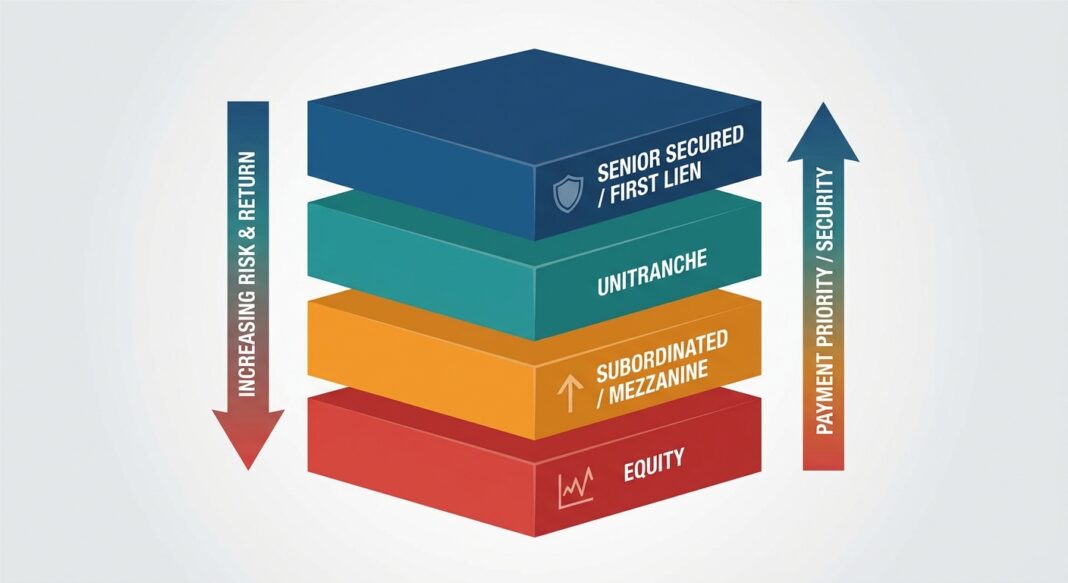
The stack is typically organized into four broad layers, each carrying a distinct risk-and-return profile:
- Senior Secured Debt (First Lien): The highest-priority claim. Lenders at this level hold a first lien, a legal claim, on the company’s assets. In a default, they are repaid before anyone else. Because of this protection, senior secured lenders accept lower interest rates. This is where the majority of direct lending activity in private credit takes place.
- Unitranche Debt: A hybrid structure that blends senior and subordinated debt into a single loan from one lender. It simplifies the borrower’s capital structure while offering the lender a blended rate between senior and mezzanine pricing. Unitranche has become a dominant format in middle-market private credit transactions.
- Subordinated or Mezzanine Debt: These lenders sit behind senior creditors. Sometimes called “junior debt,” mezzanine financing is repaid only after senior obligations are satisfied. To compensate for this increased risk, mezzanine lenders demand higher interest rates, and sometimes include equity warrants that allow participation in the company’s upside.
- Equity: At the bottom of the stack, equity holders bear the most risk. They are last to be repaid in any liquidation scenario, and they may receive nothing if the company’s assets are insufficient to cover debt obligations. In exchange for this risk, equity investors expect the highest potential returns through ownership appreciation.
The principle at work is called subordination: each layer is subordinate to the one above it, meaning it has a lower-priority claim on the company’s value. As you move down the stack, risk increases, expected return increases, and protection decreases.
A Concrete Example: The Numbers Behind the Stack
Consider a hypothetical middle-market company being acquired in a leveraged buyout for $100 million. The deal is structured with the following capital stack:
- Senior Secured Debt (First Lien): $50 million at SOFR + 5.00% (approximately 9.5% all-in as of early 2026)
- Mezzanine Debt: $20 million at a fixed 13.0%
- Equity: $30 million contributed by the private equity sponsor
Now imagine the company underperforms and is sold two years later for only $60 million: a 40% decline from the original purchase price.
Here is how recoveries flow down the stack:
- The senior secured lender has a first lien claim. They recover their full $50 million. Principal is preserved. Outcome: full recovery.
- The remaining $10 million goes to the mezzanine lender, who is owed $20 million. They recover 50 cents on the dollar. Outcome: significant loss.
- The equity sponsor, who put in $30 million, receives nothing. Outcome: total loss.
This example illustrates the core logic of subordination: the equity cushion below the senior loan absorbed the first loss, protecting the senior lender’s capital. That $30 million in equity, representing a 30% cushion, is precisely why senior secured private credit investors accept lower interest rates. The cushion must be eroded entirely before senior lenders face impairment.
Current Market Relevance
The capital stack concept is not merely theoretical; it is actively shaping how institutional capital is being deployed in today’s private credit market.
According to Long Angle’s Private Credit Investment Guide (March 2026), direct lending, which predominantly occupies the senior secured position, accounted for 38% of all private credit capital raised in H1 2025, making it the largest private credit sub-strategy by assets under management. Investors are concentrating capital at the top of the stack, where structural protection is strongest.
The scale of this market is significant. According to the Coller Capital Secondaries Institute (June 2025), global private credit AUM reached approximately $1.7 trillion at the end of 2024, with forecasts projecting growth to over $2.6 trillion by 2029: driven by continued bank disintermediation and institutional demand for yield with structural downside protection.
The bank pullback that created this opportunity is measurable. As noted by Long Angle (March 2026), bank lending as a share of U.S. GDP has declined from 59% in Q4 2008 to 44% as of Q1 2025: a structural shift that has permanently expanded the addressable market for private lenders, particularly at the senior secured level of the capital stack.
Default rates have remained contained at the senior level. According to Long Angle citing Proskauer’s Private Credit Default Index, direct lending default rates have remained under 4% since 2021: a figure that reflects both the protective effect of senior positioning and the covenant structures that allow lenders to intervene early when a borrower’s performance deteriorates.
Private credit has also accelerated its role in financing leveraged buyouts. According to Meketa Investment Group’s Private Credit Primer (April 2024), private credit financed 85% of leveraged buyouts in 2023: up from 65% in 2021, displacing broadly syndicated bank loans as the dominant source of LBO capital.
Decision Framework
For Investors Evaluating Private Credit Opportunities
When evaluating any private credit opportunity, investors consider the following questions rooted in capital stack analysis:
- What is my lien position? First lien senior secured offers the highest structural protection. Second lien and mezzanine positions carry subordination risk that should be compensated with meaningfully higher spreads.
- How large is the equity cushion below me? A 30–40% equity cushion is generally considered a meaningful buffer at the senior level. Thinner cushions require higher spreads or tighter covenants to compensate.
- What covenants govern the loan? Covenants (financial maintenance tests and behavioral restrictions) act as an early warning system. They give senior lenders the right to act before a company’s situation becomes irreversible.
- Does the expected return match the stack position? Senior secured positions typically target current all-in yields in the high single digits. Mezzanine positions targeting 12–16% should reflect the subordination risk being accepted.
For Operators Structuring a Capital Raise
Business owners and CFOs evaluating financing options consider capital stack position from the cost and control perspective:
- Senior secured debt is the cheapest non-dilutive capital available. Borrowers who can offer quality collateral and strong cash flow coverage access capital without giving up equity ownership.
- Mezzanine is a bridge, not a first choice. Operators turn to mezzanine when senior capacity is exhausted, accepting higher rates in exchange for avoiding equity dilution at what they believe is a low valuation.
- Every dollar of equity injected into a deal creates protection for lenders above it. A well-capitalized equity sponsor signals alignment and reduces the cost of debt across the entire stack.
Key Takeaways
- Position determines protection. Senior secured lenders hold first lien claims and are repaid before all other creditors. Subordination risk increases materially as you move down the stack.
- The equity cushion is a senior lender’s first line of defense. In the example above, $30 million in equity had to be fully wiped out before the senior lender faced any loss.
- Return should match risk by layer. Senior secured lenders accept lower yields because their structural position justifies it. Mezzanine and equity demand premium returns to compensate for subordination and loss exposure.
- Direct lending at the senior level is the market’s fastest-growing segment: accounting for 38% of private credit capital raised in H1 2025, precisely because institutional investors prioritize structural protection in uncertain economic environments.
- For operators, understanding the stack means understanding the cost of capital. Choosing the right layer of financing (senior, mezzanine, or equity) directly determines how much ownership is preserved and how much the capital costs on an annualized basis.


