
The Most Important Question in Private Credit
When someone says they “invest in private credit,” that phrase alone tells you very little. A mezzanine debt fund and a senior secured direct lending fund are both technically private credit, but they occupy fundamentally different positions in the hierarchy of claims on a borrower’s assets. That hierarchy has a name: the capital stack. Understanding where a loan sits within it is arguably the single most important factor in evaluating any private credit opportunity, for both investors assessing risk and operators seeking capital.
What Is the Capital Stack?
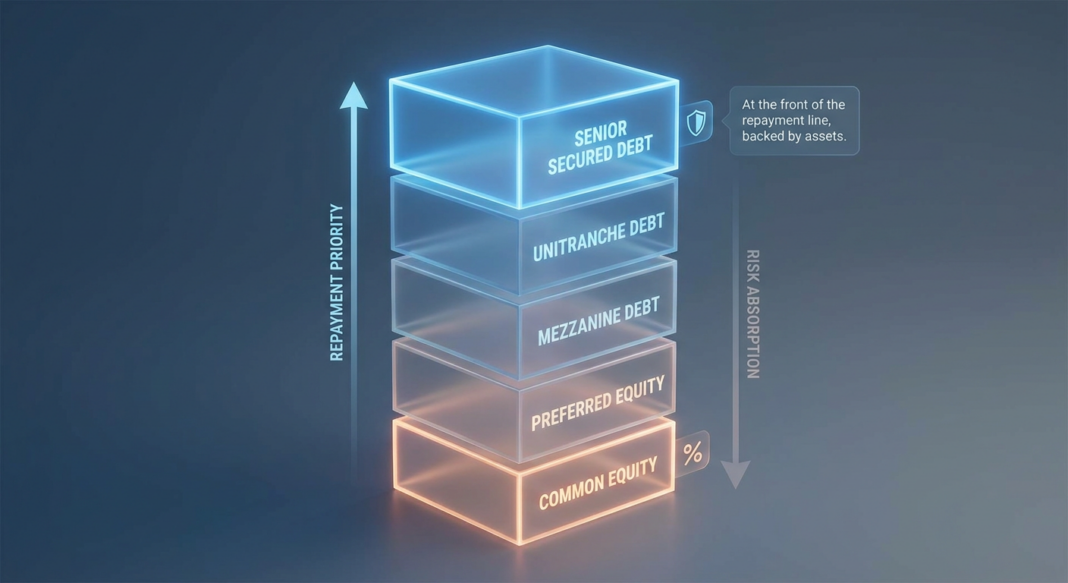
The capital stack is the ordered hierarchy of financial claims on a company’s assets and cash flows. It determines who gets paid first (and who absorbs losses first) when a borrower encounters financial stress. Think of it like a building: the higher floors are safer but offer lower returns; the ground floor carries more risk but more potential upside.
From safest to most exposed, the typical capital stack layers are:
- Working Capital & Senior Secured Debt: First in line. Backed by tangible collateral: receivables, equipment, real property. Repaid before all other long-term creditors in a liquidation.
- Unitranche Debt: A blended single-loan structure combining first-lien and second-lien characteristics, originated by one lender or a small club. Increasingly common in middle-market transactions.
- Subordinated / Mezzanine Debt: Junior to senior secured. Higher coupon to compensate for standing further back in the repayment line. Sometimes includes equity warrants for additional upside.
- Preferred Equity: Not debt, but carries preferential distribution rights over common shareholders. Absorbs losses before debt holders only in a solvent scenario; in distress, ranks behind all creditors.
- Common Equity: Last in line. First to absorb losses, last to receive any recovery. Highest risk, highest potential return.
As BIP Wealth explains, layers near the top of the capital stack are backed by tangible assets and get repaid before anyone else, while layers near the bottom absorb losses first and are repaid last.
How It Works: A Concrete Example With Numbers
Consider a private equity-backed manufacturing company valued at $100 million. The deal is financed as follows:
- Senior Secured Loan: $50 million (50% of enterprise value)
- Mezzanine Debt: $15 million
- Equity (PE Sponsor): $35 million
Now suppose the business deteriorates and is sold in a distressed scenario for only $55 million.
- The senior secured lender recovers their full $50 million: 100 cents on the dollar.
- The mezzanine lender receives the remaining $5 million: a recovery of roughly 33 cents on the dollar.
- The equity sponsor receives nothing.
This is the equity cushion at work: the $35 million in sponsor equity sits below the senior loan and absorbs losses first. The senior secured lender’s position only begins to erode if asset values fall by more than 50%, in this case, below $50 million. That buffer is why senior secured private credit has historically maintained lower loss rates than subordinated strategies.
According to Long Angle’s Private Credit Investment Guide 2026, default rates for direct lending, the dominant form of senior secured private credit, have remained under 4% since 2021, reflecting the structural protection that priority position provides.
Current Market Relevance
The capital stack concept has never been more practically relevant than in today’s private credit landscape. Global private credit assets under management now exceed $1.7 trillion as of Q1 2026, with the asset class having grown from roughly 5% of the U.S. below-investment-grade credit market in the mid-2000s to more than 25% today, according to Blackstone’s Essentials of Private Credit.
This growth is structural, not cyclical. As PitchGrade’s 2026 Private Credit Primer notes, Basel III capital requirements effectively require banks to hold $8–12 million in Tier 1 capital for every $100 million in leveraged loans extended, a constraint that makes leveraged lending economically unattractive for banks but creates a structural opening for non-bank private credit funds operating without those capital adequacy requirements.
The practical consequence: more than 75% of leveraged buyout financing in transactions below $500 million in EBITDA is now provided by private credit funds rather than banks, per PitchGrade. Middle-market direct lending typically prices at SOFR + 500–650 basis points, while large-cap transactions price at SOFR + 425–500 basis points: a spread premium that reflects both the illiquidity and the structural protections embedded in senior secured positions.
| Metric | Figure | Source |
|---|---|---|
| Global Private Credit AUM | $1.7T+ | PitchGrade, Q1 2026 |
| Private Credit Share of U.S. Below-IG Market | >25% | Blackstone, 2026 |
| Direct Lending Default Rate (since 2021) | <4% | Long Angle / Proskauer, 2026 |
| Middle Market Direct Lending Spread | SOFR + 500–650 bps | PitchGrade, 2026 |
| LBO Financing Below $500M EBITDA via Private Credit | >75% | PitchGrade, 2026 |
Decision Framework: Investors and Operators
For Investors Evaluating Private Credit Funds: Capital stack position should be the first filter: before yield, before manager brand, before fees. Investors consider the following when evaluating stack position:
- Lien priority: Is this first-lien senior secured, or is there senior debt sitting above this investment?
- Loan-to-value (LTV): How much equity cushion sits below before the lender takes a loss? Lower LTV generally means more protection.
- Collateral quality: What assets back the loan: hard assets, receivables, or intangible cash flows? Hard collateral recovers more predictably in distress.
- Covenant strength: Does the loan include maintenance covenants that trigger before a default, giving lenders early warning and renegotiation leverage?
A higher coupon from a mezzanine or subordinated position reflects a real and quantifiable increase in risk, not simply better value. Investors evaluate whether that incremental yield is sufficient compensation for the step down in repayment priority.
For Operators Seeking Capital: Your position in the capital stack is a negotiation, not a given. Senior secured debt is typically the cheapest form of non-equity capital, but it comes with collateral requirements and covenant restrictions. Operators evaluate trade-offs carefully:
- Senior secured: Lower cost, but collateral pledge and tighter covenants.
- Mezzanine: Higher cost, but fewer collateral constraints and sometimes deferred cash interest.
- Unitranche: Single-lender simplicity with blended pricing between first- and second-lien rates, increasingly the structure of choice in middle-market buyouts.
According to Blackstone, borrowers increasingly select private lenders over bank syndications for speed, execution certainty, and structural flexibility, even when all-in pricing is slightly higher than a syndicated alternative.
Key Takeaways
- Position determines protection: Senior secured lenders have priority over all other long-term creditors. In the example above, a 45% decline in asset value leaves the senior lender whole. Stack position is not a detail; it is the core risk variable.
- Higher yield means lower stack position: When a fund advertises significantly higher returns than senior secured peers, investors ask what position in the repayment hierarchy they are accepting to earn that premium.
- Equity cushion is the first line of defense: In a PE-sponsored deal, the sponsor’s equity sits below all debt tranches and absorbs losses first. The size of that cushion (often evaluated via LTV or loan-to-EBITDA multiples) is a primary underwriting metric.
- Bank retreat has structurally re-priced middle-market debt: Regulatory capital constraints have permanently reduced bank appetite for leveraged lending, creating durable origination opportunities for private credit funds, particularly in the senior secured, sub-$500M EBITDA segment.
- “Private credit” is not monolithic: Senior secured direct lending, mezzanine, and distressed debt are all private credit, but they carry materially different risk profiles. Investors and operators evaluate each on its own capital stack merits before making any allocation or financing decision.


