
The Most Important Question in Private Credit
When someone tells you they “invest in private credit,” that phrase alone tells you almost nothing useful. A senior secured direct lending fund and a mezzanine debt fund are both technically private credit, but they occupy entirely different positions in the repayment hierarchy, carry fundamentally different risk profiles, and demand very different return expectations. The variable that separates them is capital stack position: where in the line you stand when a borrower runs into trouble.
Understanding the capital stack is arguably the single most foundational concept in private credit. It determines priority of repayment, exposure to loss, appropriate yield expectations, and, for business owners seeking capital, how much control and flexibility you surrender in exchange for financing. Whether you are evaluating a private credit fund or negotiating a financing package for your company, this framework belongs at the center of the conversation.
What the Capital Stack Actually Is
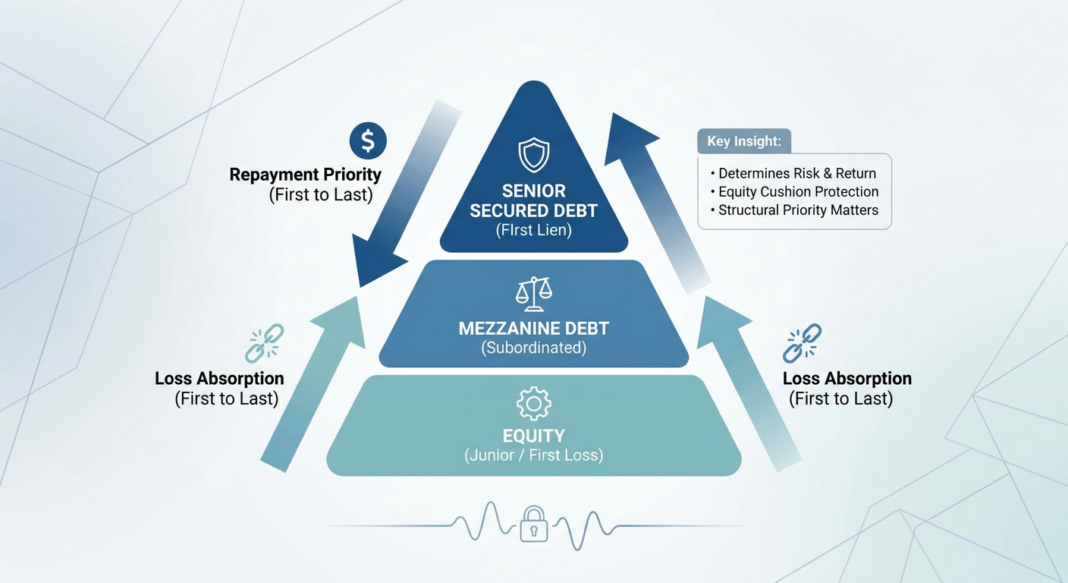
The capital stack is the structured hierarchy of all financial claims on a company’s assets and cash flows. Every dollar that funds a business (whether from a bank, a private credit fund, or an equity investor) sits somewhere in that hierarchy. The position determines two things: who gets paid first when the company generates cash, and who absorbs losses first when the company encounters financial stress.
A simplified capital stack, from most senior to most junior, looks like this:
- Working Capital & Revolving Credit Facilities: Short-term, highest priority, typically provided by banks
- Senior Secured Debt (First Lien): Backed by collateral, first in line among long-term creditors; the primary domain of direct lending funds
- Second Lien Debt: Also secured, but subordinate to first lien; higher yield, higher risk
- Mezzanine / Subordinated Debt: Unsecured or lightly secured; often includes equity warrants to compensate for junior position
- Preferred Equity: Has priority over common equity but is last among capital providers to receive repayment
- Common Equity: Owns the residual value; absorbs the first dollar of loss
As BIP Wealth explains it: layers near the top of the stack are repaid before anyone else and are typically backed by tangible assets, while layers near the bottom absorb losses first and are repaid last. The stack is not just an academic organogram; it is a legally enforceable priority waterfall that governs every dollar in and out of the business.
How Capital Stack Position Works: A Concrete Example
Consider a private equity-backed manufacturing business with an enterprise value of $100 million and the following capital structure used to finance its acquisition:
- Senior Secured Loan (First Lien): $50 million, priced at SOFR + 550 bps, backed by all company assets
- Mezzanine Debt: $15 million, priced at 13–15% (cash + PIK), subordinated to senior
- Equity: $35 million, contributed by the private equity sponsor
Now suppose the business underperforms and is sold in a distressed scenario for $60 million: a 40% decline from the original enterprise value. Here is how the proceeds flow down the stack:
- Senior secured lenders receive their full $50 million, 100 cents on the dollar
- Mezzanine lenders receive the remaining $10 million, recovering approximately 67 cents on the dollar
- Equity holders receive nothing: their $35 million is entirely wiped out
This numerical example makes the protection logic visceral. The senior secured lender absorbed a 40% drop in enterprise value and still recovered in full, because they had a $35 million equity cushion and $15 million of junior debt absorbing losses before their position was touched. That buffer, equity plus subordinated debt sitting below you in the stack, is the structural protection that defines senior secured private credit.
Where the Market Stands Today
The capital stack framework has never been more relevant to institutional investors and business owners than it is right now, given how dramatically the private credit market has grown and evolved.
According to PitchGrade’s 2026 Private Credit Primer, global private credit AUM has exceeded $1.7 trillion as of Q1 2026, with the five largest managers (Ares, Apollo, Blackstone, Blue Owl, and HPS) collectively overseeing more than $800 billion of the asset class. This scale reflects a structural, not cyclical, shift: regulatory constraints introduced after the Global Financial Crisis permanently reduced bank appetite for leveraged lending, and private credit funds have filled that void at every layer of the capital stack.
Senior secured direct lending for middle market borrowers currently prices at approximately SOFR + 500–650 basis points, while large-cap borrowers access senior debt at SOFR + 425–500 bps, per the same PitchGrade analysis. These spreads reflect both the illiquidity premium and the structural protection that first-lien position provides. Per Long Angle’s Private Credit Investment Guide 2026, direct lending default rates have remained under 4% since 2021 according to Proskauer’s Private Credit Default Index, a figure that reflects both disciplined underwriting and the loss-absorption benefit of equity cushions sitting below senior lenders.
As Blackstone’s Essentials of Private Credit notes, private credit has historically delivered income premiums of 200–400 basis points above comparable broadly syndicated loans, while maintaining the defensive characteristics of senior secured collateral. Critically, over 75% of leveraged buyout financing in transactions below $500 million in EBITDA is now provided by private credit funds rather than bank lenders, per PitchGrade, meaning the capital stack is increasingly being constructed entirely outside the banking system.
Decision Framework: Investors and Operators
For Investors Evaluating Private Credit Funds
- Ask first: where in the stack does this fund lend? “Private credit” spans from senior secured (conservative) to mezzanine (higher risk/return) to distressed (opportunistic). The label alone is insufficient.
- Evaluate the equity cushion. In a typical sponsor-backed deal, equity contributes 35–50% of the capital structure. That buffer must be exhausted before a senior secured lender absorbs losses. Assess whether that cushion is sufficient for the sector and vintage.
- Assess covenant protections. As explained by DeMarche’s 2026 Private Credit Overview, covenants (affirmative, negative, and financial) act as structural safeguards. Financial maintenance covenants (minimum DSCR, maximum leverage) provide early warning signals and negotiating leverage before a default occurs. Covenant-lite structures remove this early warning mechanism.
- Match position to your return requirement. Senior secured positions offer lower yield with higher structural protection. Mezzanine positions offer higher yield in exchange for accepting junior status and greater loss exposure. Investors consider whether the additional spread on junior debt adequately compensates for the subordination risk.
For Business Owners Seeking Capital
- Understand what you are giving away at each layer. Senior secured debt costs less but is collateral-backed and typically carries maintenance covenants. Mezzanine debt costs more but may carry fewer operational restrictions. Equity is the most expensive capital because investors require the highest return, and it permanently dilutes ownership.
- Stack position affects operational flexibility. Negative covenants at the senior secured layer may restrict additional debt, asset sales, or dividend payments. Operators evaluate these constraints against their strategic plans before signing.
- Private credit offers structural flexibility banks cannot. As Blackstone highlights, the direct lending model, no bank intermediary, allows for customized terms, greater speed of execution, and confidentiality that syndicated bank debt cannot provide.
Key Takeaways
- Capital stack position, not the “private credit” label, determines your actual risk exposure. Senior secured and mezzanine are both private credit, but they are not the same investment.
- The equity cushion is a senior lender’s first line of defense. In a typical leveraged buyout, 35–50% equity means enterprise value must fall substantially before a first-lien lender absorbs losses.
- Subordination commands a yield premium. Moving down the stack, from senior to mezzanine to equity, requires progressively higher return expectations to compensate for the increased loss-absorption risk.
- Covenants reinforce stack protection. Financial maintenance covenants at the senior level provide structural early warning mechanisms that help lenders act before a distressed situation becomes a default.
- For operators, every layer of the stack has a cost beyond the coupon. Business owners evaluate not just the interest rate, but the collateral pledged, the covenants accepted, and the equity dilution avoided when choosing where in the capital stack to access financing.


