
Where You Stand in Line Changes Everything
Imagine a company runs into serious financial trouble. Assets are being liquidated. Cash is being distributed. Who gets paid first (and who gets paid at all) is not a matter of negotiation in that moment. It was determined long before the crisis hit, the day the capital structure was assembled. That hierarchy is called the capital stack, and understanding your position within it is arguably the single most important concept in private credit investing.
When someone says they “invest in private credit,” that phrase tells you almost nothing about their actual risk exposure. According to BIP Wealth, a subordinated debt fund and a senior secured direct lending fund are both technically private credit, but they occupy fundamentally different positions in the repayment line, with dramatically different risk and return profiles to match.
The Capital Stack: A Defined Mechanism
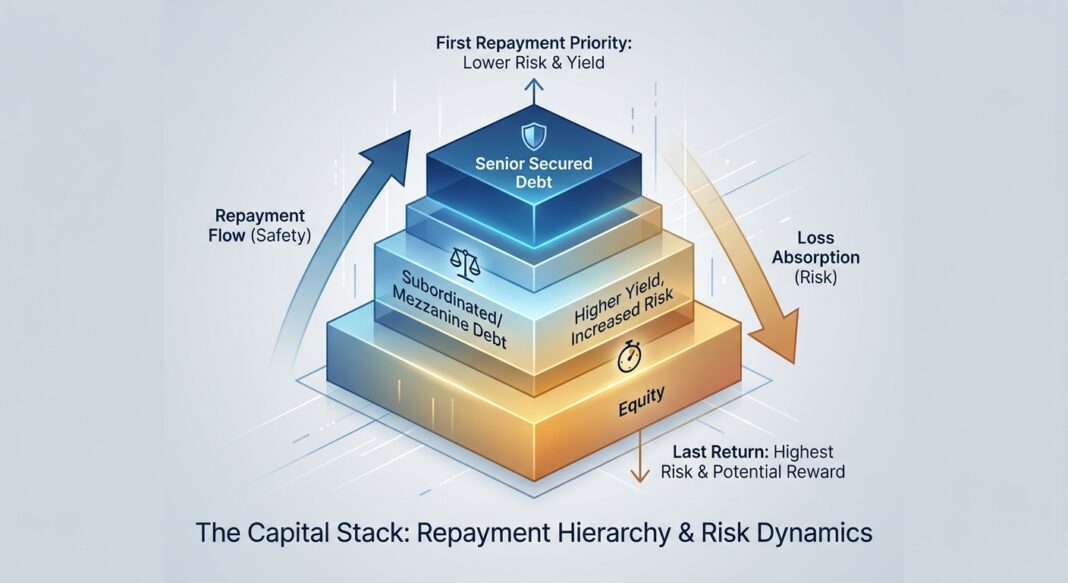
The capital stack is the ordered hierarchy of financial claims on a company’s assets and cash flows. Each layer, or tranche: has a defined priority: higher layers get paid first in both ongoing operations and in a default or liquidation scenario. Lower layers absorb losses first.
From top to bottom, a typical leveraged buyout capital structure looks like this:
- Working Capital & Senior Secured Debt: First priority claim, backed by tangible collateral (receivables, equipment, real property). Lowest risk, lowest return.
- Unitranche / First-Lien Term Loan: A blended senior loan, often the dominant instrument in middle-market private credit deals. Combines first-lien security with a single blended rate.
- Second-Lien / Subordinated Debt: Junior to senior secured claims. Higher yield, but further back in the repayment line.
- Mezzanine Debt: Sits between senior debt and equity. Often carries equity warrants to compensate for elevated risk.
- Preferred Equity: Ahead of common equity holders, but behind all debt tranches.
- Common Equity: Last in line. First to absorb losses, last to receive proceeds, and highest return potential if the company succeeds.
How It Works: A Concrete Example with Numbers
Consider a private equity sponsor acquiring a middle-market manufacturing business for $100 million. The deal is financed as follows:
- Senior Secured Term Loan: $55 million (SOFR + 575 bps, first-lien)
- Mezzanine Debt: $15 million (15% coupon + equity warrants)
- Sponsor Equity: $30 million
Now assume the company underperforms significantly. In a distressed liquidation, the business is sold for only $60 million.
Here is how proceeds are distributed:
- Senior Secured Lender receives: $55 million: fully recovered.
- Mezzanine Lender receives: $5 million of their $15 million, a 67% loss.
- Equity Sponsor receives: $0: a total wipeout.
The senior secured lender walked away whole. The mezzanine lender took a significant haircut. The equity sponsor lost everything. Same company, same distress event, entirely different outcomes depending solely on where each party stood in line.
This is why, as Blackstone notes in its private credit overview, senior secured private loans are structured with meaningful junior capital cushion below them; that subordinated capital absorbs losses before the senior lender is ever touched.
Current Market Relevance
The capital stack framework is not just theoretical; it directly shapes where the $1.7 trillion private credit market is concentrating today.
According to PitchGrade (2026), global private credit AUM has exceeded $1.7 trillion as of Q1 2026, with direct lending, the predominantly senior secured strategy, representing the largest share of that capital. The five largest managers (Ares, Apollo, Blackstone, Blue Owl, and HPS Investment Partners) collectively manage over $800 billion of the asset class.
Spreads for senior secured middle-market direct lending are currently running at approximately SOFR + 500–650 bps, while large-cap transactions price tighter at SOFR + 425–500 bps, per PitchGrade. The spread differential between senior secured and subordinated capital reflects exactly the stack premium, investors in lower tranches demand more yield to compensate for their position further back in line.
According to Long Angle’s Private Credit Investment Guide 2026, default rates for direct lending have remained under 4% since 2021, citing Proskauer’s Private Credit Default Index, a figure that reflects the structural protection senior position provides even in a period of elevated rates and economic stress.
Bank retreat has reinforced the stack’s importance. Per PitchGrade, regulatory guidance effectively limits bank underwriting of loans above 6.0x Debt/EBITDA, pushing higher-leverage (and therefore more subordinated) deal structures directly into private credit markets. Over 75% of leveraged buyout financing in deals below $500 million EBITDA now comes from private credit funds rather than banks.
| Metric | Figure | Source |
|---|---|---|
| Global Private Credit AUM | $1.7T+ | PitchGrade, Q1 2026 |
| Senior Secured MM Spread | SOFR + 500–650 bps | PitchGrade, 2026 |
| Direct Lending Default Rate (since 2021) | <4% | Long Angle / Proskauer, 2026 |
| LBO Financing from Private Credit (<$500M EBITDA) | 75%+ | PitchGrade, 2026 |
| Private Credit Share of US Below-IG Credit | >25% | Blackstone, 2026 |
Decision Framework: Investors and Operators
For Investors Evaluating Private Credit Funds: Stack position is the first filter, not an afterthought. Before evaluating yield, management fees, or vintage year, investors consider: What tranche does this fund primarily occupy? A fund advertising 14% net returns warrants scrutiny, high yield almost always signals a lower stack position, which means more credit risk. Investors compare the yield pickup against the additional loss exposure they are accepting by moving down the hierarchy. Senior secured strategies with sub-4% historical default rates may offer a more compelling risk-adjusted profile than chasing headline returns in mezzanine or subordinated funds. Investors also examine the equity cushion below the debt, the larger the sponsor’s equity contribution, the more losses can be absorbed before senior lenders are impaired.
For Business Owners and Operators Seeking Capital: Understanding the stack helps operators structure their financing strategically. Senior secured debt is the least expensive form of external debt capital, but it comes with collateral requirements, tighter covenants, and typically lower leverage limits. Operators with strong, predictable cash flows and tangible assets will qualify for senior pricing. Those needing flexibility, higher leverage, or less collateral may consider unitranche structures, a single blended instrument that simplifies the capital stack, or mezzanine, accepting a higher coupon in exchange for looser terms. The key question for any operator: How much of your ownership and cash flow are you willing to commit, and at what cost?
Key Takeaways
- Stack position is the primary driver of risk and return in private credit, higher in the stack means first repayment priority and lower loss exposure, while lower positions demand higher yields to compensate for absorbing losses first.
- Senior secured direct lending has maintained sub-4% default rates since 2021, reflecting the structural protection that collateral and repayment priority provide even in stressed conditions.
- The equity cushion below senior debt matters enormously: sponsor equity and subordinated tranches must be wiped out before senior lenders face impairment, making that buffer a critical underwriting metric.
- Investors evaluate stack position before yield: a higher advertised return almost always indicates a lower position in the hierarchy and greater credit risk that must be explicitly understood and priced.
- Operators select their tranche based on cost, flexibility, and asset profile: senior secured is cheapest but most restrictive; mezzanine offers flexibility at a higher cost; unitranche structures can simplify multi-tranche complexity for middle-market deals.


