
Where You Sit Determines What You Get
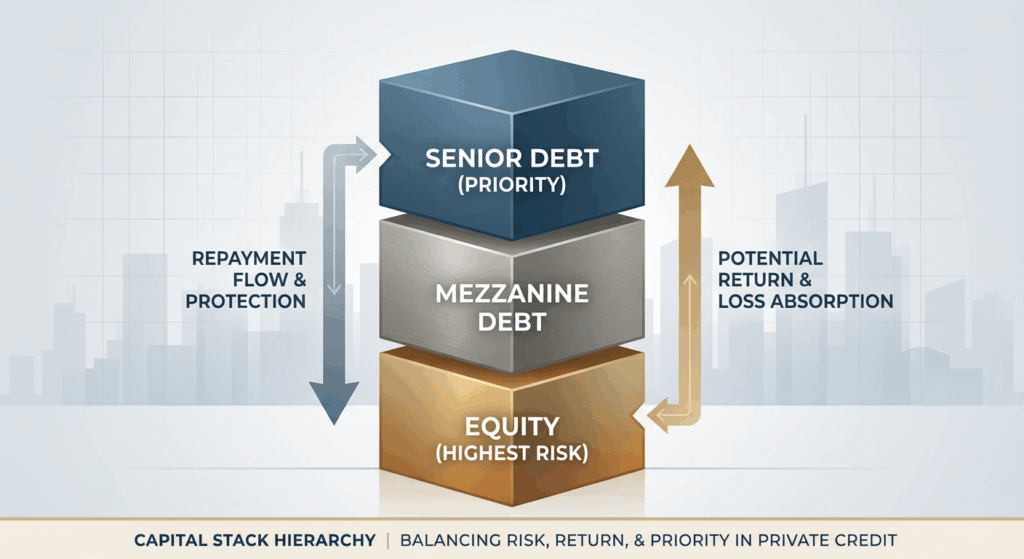
In private credit, the single most important structural question is not the interest rate; it is where in the capital stack your claim sits. Every dollar deployed into a company operates inside a hierarchy. That hierarchy, the capital stack: dictates who gets paid first when things go right, and who absorbs losses first when they go wrong. Understanding this structure is foundational for investors evaluating private credit funds and for operators deciding how to finance their businesses.
The capital stack is not abstract. It is the legal and contractual ordering of every financing source a company uses. Senior lenders sit at the top and get paid before anyone else. Equity holders sit at the bottom and absorb the first losses, but also capture the upside if the business grows. Everything in between is a negotiated trade-off between risk, return, and control.
The Three Core Layers
According to Corporate Finance Institute, the capital stack is typically divided into three primary layers, each carrying a distinct risk-return profile:
- Senior Debt: First-lien secured loans that are backed by specific company assets (equipment, receivables, real property, intellectual property). In a liquidation or bankruptcy, senior lenders are repaid before any other creditor or owner. Because the risk is lowest, the interest rate is the lowest among financing sources.
- Subordinated Debt (Mezzanine): Debt that ranks below senior debt in repayment priority. If the business is liquidated, subordinated lenders are repaid only after senior claims are satisfied. To compensate for this elevated risk, mezzanine debt carries higher interest rates, and often includes equity warrants or conversion features that give lenders a share of upside.
- Equity: Ownership stakes that carry the highest risk and the last claim on assets. Equity investors absorb losses first, but they also benefit most from enterprise value creation. Private equity sponsors typically sit at this layer in leveraged buyout structures.
A Concrete Example: A $10 Million Middle-Market Acquisition
Consider a private equity firm acquiring a manufacturing company for $10 million. The firm structures the deal using three financing layers:
- Senior Secured Loan, $5.5M (55% of capital stack): Provided by a private credit fund at a floating rate of SOFR + 550 bps. Currently approximately 10.8% all-in with SOFR near 4.3%. This lender has a first lien on all assets. If the business is sold or liquidated for any value above zero, this lender gets repaid first.
- Mezzanine Debt, $2M (20% of capital stack): Provided by a subordinated lender at a fixed rate of 14%, plus a small equity warrant. This lender is only repaid after the $5.5M senior loan is retired.
- Equity, $2.5M (25% of capital stack): The private equity sponsor’s own capital. This is the last to be repaid and the first to be wiped out if the business underperforms.
Now suppose the business declines in value and is sold for only $6 million. The senior lender recovers its full $5.5M. The mezzanine lender recovers $500K of its $2M, a partial loss. The equity sponsor recovers nothing. The senior lender’s position in the stack was its protection. That structural seniority is the fundamental mechanism private credit investors rely on: not just the interest rate, not just the business quality, but where in the waterfall their claim lives.
Why Capital Stack Position Matters More Than Ever in 2026
Private credit has grown from roughly $557 billion in assets under management in 2014 to more than $2 trillion globally as of 2023, according to PitchBook. The global market is projected to reach approximately $3 trillion by 2028, per Mayer Brown’s 2025 analysis of private credit fund structures. As more capital pours into the asset class, stack discipline (specifically, the protection offered by senior secured positioning) has become a front-and-center conversation among institutional allocators.
The market stress of early 2026 has underscored this point sharply. According to Atlas Peak Research (March 2026), the current environment is best characterized as a liquidity, valuation-credibility, and underwriting-discipline repricing, not a generalized solvency crisis. The funds most exposed to redemption pressure are those that packaged illiquid middle-market loans inside semi-liquid structures, not classic closed-end direct lending funds with capital lockups that match loan maturities. Structural design (at both the fund level and the individual loan level) is where the stress is being felt.
Separately, data from Capital Founders OS (March 2026) citing Cambridge Associates indicates that private credit default rates have run at approximately 1.45%, compared to 3.37% for broadly syndicated loans: a differential that many analysts attribute, at least in part, to the structural protections embedded in senior secured direct lending positions, including covenants and lien priority.
Decision Framework: Investors and Operators
For Investors Evaluating Private Credit: Stack position is a primary due diligence filter before evaluating yield, manager, or sector. Senior secured first-lien positions offer the most structural downside protection. Investors should ask: What percentage of the fund’s portfolio is in first-lien senior secured loans? Does the loan documentation include maintenance covenants that create early warning triggers? What is the weighted average loan-to-value (LTV) of the portfolio? A lower LTV, meaning the loan represents a smaller fraction of the company’s total enterprise value, means a larger equity cushion beneath the debt, providing additional protection. Investors also consider whether the vehicle structure itself (closed-end fund, BDC, interval fund) matches the underlying asset liquidity profile.
For Operators Seeking Capital: The capital stack is a cost-of-capital tool. Senior debt is always the cheapest source of outside capital because lenders accept lower returns in exchange for priority and security. Operators evaluate the cost and covenant burden of each layer. Taking on mezzanine or subordinated debt costs more but avoids equity dilution, preserving ownership upside. The decision framework centers on one question: what is the projected enterprise value at exit, and which stack structure preserves the most value for the founding team or sponsor at that point?
Key Takeaways
- Position is protection: In private credit, where you sit in the capital stack determines your risk exposure and recovery rate in a downside scenario, often more than the creditworthiness of the borrower alone.
- Senior secured first-lien loans anchor most direct lending portfolios because they offer the highest structural protection combined with yields currently in the 10–12% range in the middle market.
- The equity cushion beneath senior debt is the first line of defense: Operators and sponsors absorb losses before any private credit lender sees impairment; that buffer is what investors are underwriting when they evaluate LTV.
- Stack discipline matters at the fund level too: The 2026 market repricing has shown that structuring mismatches, illiquid loans inside liquid-redemption vehicles, create stress independent of whether the underlying loans are performing.
- For operators, mezzanine debt is a dilution-avoidance tool: Paying a higher rate on subordinated debt can be less expensive in the long run than selling equity at a low valuation, particularly when exit multiples are expected to expand.


