
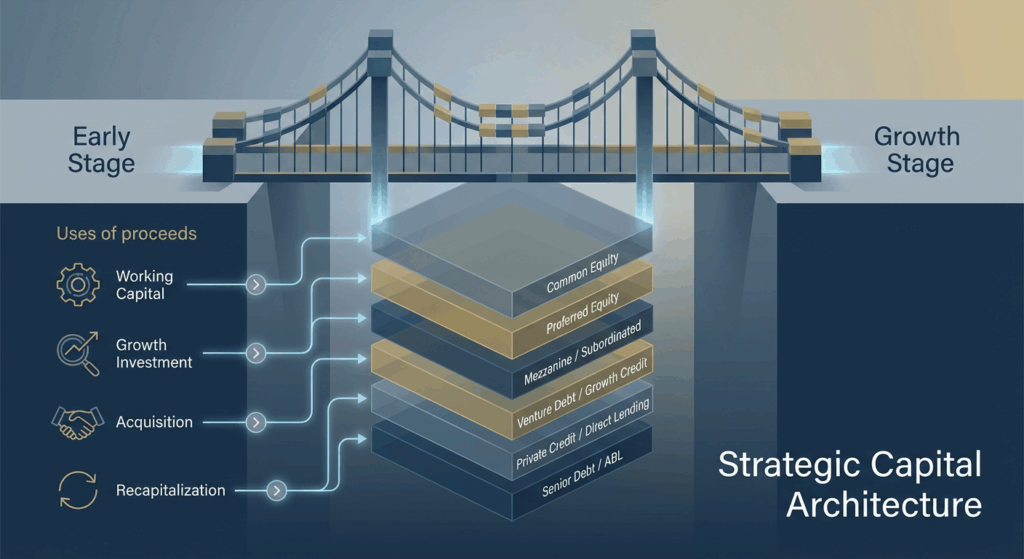
The Growth-Stage Inflection Point
A company generating $8M in annual recurring revenue with a clear path to $20M faces a problem that is counterintuitively harder than it sounds: it has outgrown the patience of seed-stage investors, but it hasn’t yet produced the audited track record, EBITDA margin, or institutional brand recognition that traditional senior lenders require. This is the growth-stage capital gap, and it is one of the most structurally misunderstood moments in a company’s financing lifecycle.
The mistake most operators make at this stage is treating capital as a commodity. They approach the market with a number (say, $5M) without a rigorous use-of-proceeds map or a clear articulation of which layer of the capital stack that need should come from. The result is either an over-priced equity raise that permanently dilutes the cap table, or an under-structured debt facility that matures before the strategy it was meant to fund is complete. Getting this right is not a fundraising exercise. It is a capital architecture decision.
Mapping the Use-of-Proceeds: Why It Dictates the Structure
Before touching the capital stack, an operator must disaggregate the financing need into its constituent parts. Capital deployed for different purposes carries fundamentally different risk profiles, and therefore belongs at different cost points on the spectrum. The four primary use-of-proceeds categories at the growth stage are:
- Working Capital: Funding the cash conversion cycle: receivables, inventory, payroll bridge. This is short-duration, self-liquidating, and should be financed as cheaply as possible, typically via a revolving credit facility or asset-based lending (ABL) line tied to eligible receivables.
- Growth Investment: Sales and marketing headcount, product development, geographic expansion. This capital destroys near-term EBITDA before it creates it. It is not suitable for senior debt. It belongs in the subordinated or equity layer: growth credit, venture debt with warrants, or preferred equity.
- Acquisition Financing: Buying a competitor, a book of customers, or a complementary technology. This is a discrete event with a definable asset base and projected synergy EBITDA. It can support a blended structure: senior secured term loan on the acquired asset base, with a mezzanine or seller note filling the valuation gap.
- Recapitalization: Returning capital to founders, restructuring the equity waterfall, or extending runway without dilution. This is typically financed via a combination of cash flow-based term debt and, where applicable, a preferred equity strip that sits above common but below senior debt.
The critical discipline is to resist blending these needs into a single ask. Each bucket has its own optimal source, its own covenant logic, and its own repayment horizon.
The Cost of Capital Spectrum at the Growth Stage
From cheapest to most expensive, the growth-stage capital stack typically layers as follows:
- Senior Bank Debt / ABL: SOFR + 200–350 bps for well-collateralized borrowers with demonstrable cash flow. Requires maintenance covenants, clean audit, and typically 3x leverage or below. Many growth-stage companies are not yet bankable on a cash flow basis, but may qualify for an ABL facility if receivables are strong.
- Private Credit / Direct Lending: SOFR + 500–700 bps for cash flow-based senior secured loans from non-bank lenders. Unitranche structures (where a single lender holds both the senior and subordinated economic exposure) have become a dominant format in the sub-$100M enterprise value market, offering speed and structural simplicity at a modest cost premium over bifurcated bank/mezz structures. As noted in frameworks tracked by fastercapital.com, later-stage financing increasingly involves established business models seeking expansion capital, the exact profile that direct lenders target.
- Venture Debt / Growth Credit: Typically structured as a term loan with 12–18 months of interest-only, priced at 9–13% cash pay, plus warrant coverage of 1–3% of the fully diluted cap table. Appropriate for venture-backed SaaS and tech companies that lack EBITDA but have strong ARR and low churn. The warrant is the lender’s equity kicker, the price of non-dilutive capital for a company that cannot yet support traditional leverage metrics.
- Mezzanine / Subordinated Debt: All-in yields of 13–18%, often blended between cash pay (10–12%) and PIK (payment-in-kind) toggle, plus an equity co-invest or warrant. PIK allows the company to conserve cash by accruing interest to principal during high-investment periods, structurally valuable when growth investment is suppressing near-term cash flow.
- Preferred Equity: Priced as a fixed or participating dividend (8–12%), with a liquidation preference and, in many structures, a conversion option into common. As outlined in growth capital frameworks covered by angelinvestorsnetwork.com, non-dilutive or minimally dilutive structures that avoid equity valuation negotiations are increasingly attractive to founders who have hit product-market fit but do not want to give up 25%+ in a premature Series A.
- Common Equity (Venture / Growth Equity): The most expensive capital in cost-of-equity terms, appropriate when the growth investment thesis requires permanent capital, when leverage would impair strategic flexibility, or when a strategic partner relationship adds non-financial value.
The Gap Capital Playbook: Four Steps
Step 1, Quantify the Gap with Precision. Build a 24-month operating model with three scenarios (base, upside, stress). Identify the peak cash deficit in each scenario. The gap is not the average deficit; it is the worst-case trough in the base case, plus a 15–20% buffer. This number is your minimum facility size. Attempting to raise less to minimize dilution and then returning to market six months later is one of the most value-destructive patterns in growth-stage finance.
Step 2, Prepare the Lender/Investor Package. A credible growth-stage credit package includes: (a) a CIM or investor memo with a clear use-of-proceeds waterfall, (b) three years of historical financials or the full operating history if shorter, (c) a monthly model with clear covenant headroom analysis, (d) a KPI dashboard (ARR, NRR, CAC, LTV, churn) for recurring revenue businesses, and (e) a management presentation that maps capital deployment to specific, measurable milestones. As noted in wearepresta.com‘s 2026 funding guide, the post-correction capital environment rewards founders who treat fundraising as a structured sales process grounded in unit economics, not a narrative exercise.
Step 3, Run a Parallel Process. Approach at least two layers of the capital stack simultaneously, for example, a senior ABL lender and a growth credit provider. This creates competitive tension, produces real market feedback on structure and pricing, and ensures you have a fallback if one layer fails to close. Single-source processes consistently produce inferior terms.
Step 4, Negotiate the Structure, Not Just the Rate. The most consequential terms are rarely the headline interest rate. Operators should focus negotiation energy on: (a) covenant design: maintenance covenants (tested quarterly against a financial metric) are far more restrictive than incurrence covenants (triggered only by a specific corporate action); push for incurrence-based packages wherever leverage supports it; (b) PIK toggle flexibility: the right to elect PIK during designated periods preserves cash during investment cycles; (c) call protection: standard market terms include 103/102/101 non-call schedules; negotiate the shortest possible non-call window given your expected refinancing horizon; and (d) accordion / incremental facility capacity: the right to upsize the facility without a full re-documentation process is structurally valuable as the business scales.
Key Takeaways
- Disaggregate before you capitalize. Working capital, growth investment, and acquisitions belong at different points on the cost of capital spectrum, structuring them together produces an inefficient blended cost.
- Unitranche and growth credit have filled the bank lending gap for sub-$100M EV companies that lack the leverage metrics for traditional senior debt but don’t need to raise full equity rounds.
- PIK and warrant coverage are tools, not penalties. PIK preserves near-term cash flow; warrant coverage is the price of accessing non-dilutive capital at a pre-EBITDA stage. Model both explicitly before accepting or rejecting.
- Covenant design is a strategic asset. Maintenance versus incurrence covenants define how much operating flexibility you retain through the investment cycle, negotiate this before rate.
- The gap capital playbook works in sequence: quantify precisely, prepare rigorously, run a parallel process, and negotiate structure over pricing. Operators who compress or skip steps consistently leave value on the table.


