
The Growth Stage Financing Problem No One Prepares You For
A company generating $4M in ARR with 85% gross margins and 110% net revenue retention sits in one of the most structurally awkward positions in corporate finance. It has outgrown the seed-stage narrative, it is not yet large enough to absorb a $20M institutional Series A without severe dilution, and its bank, if it has one, will lend against historical cash flow, not forward-looking growth trajectories.
This is the growth-stage capital gap: the distance between what a company needs to deploy and what conventional financing instruments are structured to provide. Closing that gap is not a fundraising exercise. It is a capital structuring problem. The solution requires a precise mapping of use-of-proceeds to the appropriate layer of the capital stack, an honest assessment of cost-of-capital trade-offs, and a disciplined process for running a structured financing. The wrong instrument, even at an attractive headline rate, can misalign incentives, burden the balance sheet, or dilute equity prematurely. Getting it right starts with a clear understanding of what the capital is actually for.
The Cost-of-Capital Spectrum: From Banks to Equity
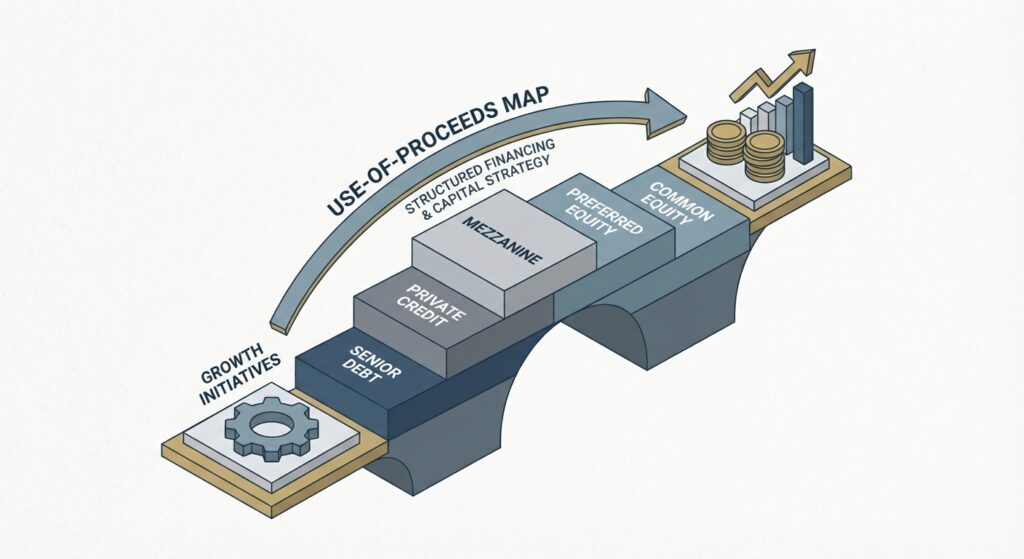
Every financing decision involves navigating a spectrum of capital sources, each priced for its position in the repayment hierarchy and calibrated to the risk profile of the borrower. Understanding the spectrum is the first step in structuring a gap-capital solution.
- Senior bank debt (lowest cost, highest constraint): Traditional revolving credit and term loans from commercial banks typically price at SOFR plus 150–300 basis points for investment-grade or near-investment-grade borrowers. Availability is tightly governed by historical EBITDA or borrowing-base asset values. For growth-stage companies with limited trailing cash flow, bank capacity is structurally constrained, a lender will not advance 4x leverage against a business with $500K of LTM EBITDA regardless of forward projections.
- Asset-based lending (ABL): Where tangible assets exist (receivables, inventory, equipment) ABL structures unlock liquidity against the collateral pool rather than enterprise cash flow. For B2B SaaS or services businesses with strong receivables quality, an ABL revolver can provide working capital at rates competitive with term debt, preserving more expensive capital for growth initiatives. As corporatefinanceinstitute.com outlines, senior secured debt occupies the lowest-risk position in the capital stack and is repaid first in liquidation, a structural advantage that commands the lowest pricing.
- Private credit / unitranche (mid-spectrum): Non-bank direct lenders (business development companies, credit funds, and specialty finance platforms) underwrite to forward cash flows and sponsor relationships rather than historical earnings. A unitranche facility blends first-lien and second-lien economics into a single instrument, typically pricing in the SOFR plus 500–700 bps range for growth-stage credits, with leverage tolerances of 3.5x–5.5x depending on sector and retention metrics. This is the workhorse instrument for the $5M–$50M gap.
- Mezzanine / subordinated debt with equity features: Sitting below senior debt but above equity in the repayment waterfall, mezzanine capital accepts higher risk in exchange for blended returns, typically 14%–18% all-in, delivered through a combination of cash coupon, PIK interest, and an equity kicker (warrant coverage or a co-investment right). This instrument is well-suited for acquisition financing and recapitalisations where senior debt capacity has been exhausted.
- Preferred equity (higher cost, limited dilution): Structured preferred shares (with liquidation preferences, participating or non-participating features, and optional redemption rights) sit above common equity but below all debt in repayment priority. Preferred is the appropriate instrument when cash flow cannot service debt but the business does not warrant full common equity dilution at a depressed valuation. For growth-stage founders, the key negotiation is the preference multiple and whether participation rights are capped.
- Common equity (highest cost, permanent dilution): Venture capital and growth equity optimise for outlier outcomes at the cost of meaningful dilution, typically 20–30% per institutional round, plus governance changes including board representation. As noted by angelinvestorsnetwork.com, a founder raising $5M at a $15M pre-money valuation surrenders 25% of enterprise value at the point of the transaction, with compounding dilution across subsequent rounds.
Matching Use-of-Proceeds to the Right Instrument
The cardinal rule of capital structuring is that the instrument must match the use. Permanent capital requirements demand permanent capital. Short-cycle working capital demands revolving liquidity. Mismatches (funding long-duration growth initiatives with a 12-month revolver, or drawing on equity for working capital) destroy value structurally before the capital is even deployed.
| Use of Proceeds | Recommended Instrument | Why It Fits |
|---|---|---|
| Seasonal or contract working capital | ABL revolver or factoring facility | Self-liquidating; matched to the receivable cycle |
| Sales team buildout and GTM expansion | Revenue-based or growth term loan (private credit) | Repayment tied to incremental revenue; preserves equity |
| Bolt-on acquisition | Unitranche or senior + mezzanine | Leveraged against combined EBITDA; fixed amortisation schedule |
| Founder or investor liquidity (recap) | Preferred equity or dividend recap | Monetises value without full exit; preserves operating control |
| Capex / infrastructure build | Equipment finance or senior term | Asset-secured; amortises in line with asset useful life |
The Gap Capital Playbook: Four Steps to a Closed Deal
Step 1: Quantify the Gap with Precision
Before approaching any capital provider, the company must produce a bottoms-up capital model that isolates the specific funding requirement. This means calculating the delta between current liquidity runway and the cash deployment required to hit the next inflection point: whether that is a revenue threshold, an EBITDA milestone, or a transaction close. Lenders and investors do not fund ambiguity. A well-constructed model that separates working capital needs from growth investment from contingency reserves signals sophistication and reduces perceived risk.
For a growth-stage B2B SaaS company targeting a $10M ARR milestone from a current $4M base, the capital requirement might decompose as: $1.8M in incremental sales and marketing headcount over 18 months, $600K in customer success and implementation capacity, $400K in product development acceleration, and a $300K liquidity buffer. The total, $3.1M, defines the instrument size and the repayment horizon.
Step 2: Prepare the Information Package
The information memorandum (IM) for a private credit or mezzanine process differs materially from a venture pitch deck. Capital providers at this level underwrite repayment capacity, not exit optionality. The IM must lead with cohort-level unit economics (CAC payback, LTV/CAC ratio, net revenue retention) followed by a detailed cash flow model with base, upside, and downside scenarios. Covenant headroom analysis, showing that the business can service debt even in the downside case, is not optional. It is the central underwriting question.
Step 3: Run a Competitive Process
The private credit market in 2026 has significant capital availability chasing quality credits at the growth stage. A competitive process, even among three to five targeted lenders, materially improves pricing, covenant flexibility, and structural terms. The key segmentation is between lenders who require maintenance covenants (tested quarterly against a leverage or coverage ratio) and those who accept incurrence-only covenants (triggered solely by a specific action such as additional debt issuance or a dividend). For growth-stage companies with volatile near-term EBITDA, the incurrence-only package is structurally superior and worth accepting a modest pricing premium to secure.
Step 4: Negotiate the Structure, Not Just the Rate
The headline interest rate is the least important number on the term sheet. The terms that determine long-run value are: the covenant package, the prepayment flexibility (and any make-whole provisions), PIK toggle rights that allow the borrower to defer cash interest in periods of constrained liquidity, and, critically, any equity participation features. Warrant coverage that delivers 1%–3% diluted ownership to a lender on a $5M growth loan is a very different economic outcome from a clean debt instrument at 50 basis points more in coupon. Founders and CFOs must model the total cost of capital across the full holding period before accepting equity-linked features, as fastercapital.com notes in its treatment of valuation and deal structuring: future potential, not just current economics, drives the real cost of every financing decision.
Key Takeaways
- Use-of-proceeds determines instrument: Working capital, growth investment, acquisitions, and recaps each have a structurally optimal funding source. Mismatching instrument to use destroys value before deployment begins.
- The growth stage gap is a structuring problem, not a fundraising problem: The right framing shifts the conversation from valuation to repayment capacity, covenant design, and capital efficiency.
- Covenant architecture is a core deal point: Incurrence-only covenants provide critical operating flexibility for businesses with volatile near-term EBITDA. The pricing premium to achieve this is almost always worth paying.
- Equity-linked features carry a real cost: Warrant coverage and co-investment rights embedded in debt instruments must be modelled against the full holding period, not just the coupon, to understand true dilution impact.
- A competitive process is non-negotiable: Even a three-lender process in the private credit market meaningfully improves structural terms. Sole-sourced deals systematically underperform on covenant flexibility and prepayment optionality.


