
The Inflection Point Nobody Plans For
Most operators know what their capital needs look like at the extremes. At the seed stage, the answer is equity: angels, SAFEs, and convertibles. At the mature stage, the answer is term debt from a bank. But the growth stage (roughly the moment a company crosses $3M ARR or $2M EBITDA and begins pursuing meaningful expansion, platform acquisitions, or operational scale-up) is where the capital stack gets genuinely complex. This is the inflection point where the wrong instrument can cost a founder 20 percentage points of ownership, or cost a CFO a covenant trip-wire that didn’t need to exist.
The challenge is structural: growth-stage companies generate real revenue but rarely generate the free cash flow that traditional senior lenders require for clean underwriting. They have enterprise value that is accumulating rapidly, but that value is often intangible (software contracts, customer retention, brand equity) which limits asset-based lending. They are too large for venture debt to fully fund and too early for broadly syndicated leverage. The result is a financing gap that sits awkwardly between the bank market and the equity market, and navigating it requires a deliberate, sequenced capital strategy rather than a reactive fundraise.
This piece maps the capital options available at this stage, prices each instrument against current market terms, and walks through a practitioner’s playbook for quantifying the need, preparing materials, running a competitive process, and negotiating a structure that does not over-lever the balance sheet or over-dilute the cap table.
The Growth-Stage Capital Stack: Components, Mechanics, and Current Pricing
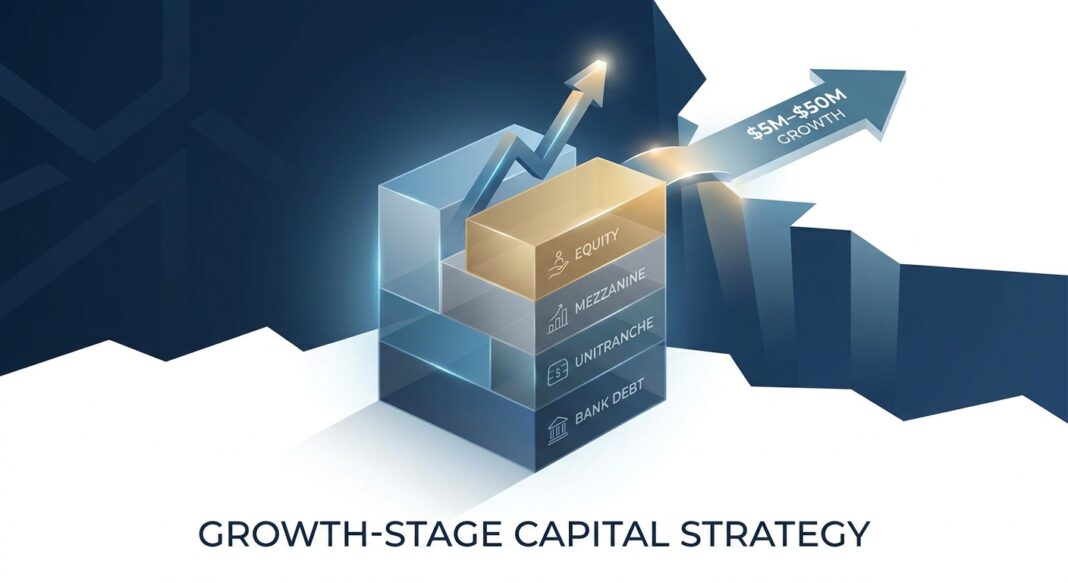
The capital stack for a growth-stage company is best understood as a cost-of-capital spectrum. Moving from left to right, from senior bank debt to common equity, the cost of each instrument rises as its subordination increases and its claim on cash flow weakens. The practical art of structuring lies in using the cheapest instrument that the company’s profile can actually support, and filling the residual gap with progressively more expensive capital only where necessary.
Here is the spectrum as it stands in mid-2026, structured around a representative company: a B2B software business with $8M ARR, 85% gross retention, and $2.5M of EBITDA, pursuing a $15M growth initiative (combination of product development, geographic expansion, and one bolt-on acquisition at 4x EBITDA):
Tier 1: Senior Bank Debt or Revolving Credit Facility (RCF)
Cost: Prime + 100–200 bps (approximately 8.5–9.5% all-in at current prime). Leverage: 1.5x–2.5x EBITDA. Covenant package: maintenance-heavy (quarterly leverage and coverage tests). Suitable for: working capital cycles, equipment, and established cash-flow businesses. Limitation at this stage: most banks will not exceed 2.5x EBITDA on a software company without hard assets, and covenant packages are tight enough to constrain operational flexibility. For our $2.5M EBITDA company, senior bank capacity is approximately $5M–$6M, meaningful, but insufficient to fund the full $15M programme.
Tier 2: Unitranche Direct Lending
Unitranche debt combines what would otherwise be senior debt and mezzanine or subordinated debt into one instrument with one lender and one credit agreement. This is the structural workhorse of growth-stage and lower middle market financing in 2026. Total leverage typically runs 4–6x EBITDA, with blended interest rates of 8–11% (SOFR + 500–700 bps in 2026), a single covenant package, and a single intercreditor relationship.
Unitranche facilities typically price at SOFR + 425–475 bps for sponsored upper middle market transactions, with core middle market credits commanding 50–100 bps higher, according to Capstone Partners’ Winter 2025 Leveraged Finance Report. For our representative company, a core middle market credit, the realistic pricing band is SOFR + 500–650 bps, per Lincoln International’s Q1 2026 Senior Debt Facility data. At current SOFR levels, that produces an all-in rate of approximately 9.5–11%. Unitranche pricing in 2026 also typically includes a 2–3% original issue discount (OID) and a 2–3% prepayment fee declining over the first 24 months.
For the representative company at 4x leverage, a unitranche facility of approximately $10M is achievable: covering the majority of the growth initiative with a single lender, a single documentation package, and no intercreditor complexity. The simplification matters: one negotiation, one closing, one lender to manage post-close, no agreement-among-lenders to contend with.
Tier 3: Mezzanine / Junior Capital
Mezzanine debt sits junior to senior debt but senior to common equity in a company’s capital stack, creating a unique risk-return profile that appeals to both growth-oriented companies and yield-seeking investors. The instrument typically combines a cash interest component (8–12%), a PIK toggle that allows optional interest accrual to preserve cash flow, an equity kicker in the form of warrants or conversion rights (typically 3–8% of loan amount), a covenant-lite structure relative to senior debt, and a longer tenor of 5–7 years versus 3–5 for senior debt.
Unlike conventional loans that prioritize security over returns, mezzanine debt operates in a nuanced middle ground, offering lenders substantial yields (typically 12–20%) while providing borrowers with flexible, non-dilutive growth capital. The equity kicker is the cost of that flexibility: warrants priced at the current equity valuation that give the mezzanine lender upside participation without requiring a full equity raise. For a company not wanting to run a priced equity round at a potentially compressed valuation, mezzanine with a small warrant coverage can be preferable to a dilutive Series B.
Tier 4: Preferred Equity / Growth Equity
At the top of the cost spectrum sits institutional equity. According to Carta’s State of Private Markets data, median dilution in 2025 sits at approximately 19.5% for seed rounds and 18% for Series A rounds. These figures are higher than the peak of 2021, reflecting a market where capital has become more expensive and investors are demanding more ownership for the same capital. Equity is essential when the business requires patient capital, when leverage would impair operations, or when the investor network and operational support justify the dilution. But it should be the last instrument placed, not the first.
Illustrative Capital Stack for the $15M Growth Programme
| Instrument | Amount | All-In Cost (Est.) | Key Feature |
|---|---|---|---|
| Senior RCF (Bank) | $3M | 8.5–9.5% | Working capital buffer; maintenance covenants |
| Unitranche (Direct Lender) | $10M | 9.5–11% | 4x EBITDA; single lender; 1 maintenance covenant |
| Mezzanine / Warrant Note | $2M | 13–16% (cash + PIK) | PIK toggle; 3–5% warrant coverage on equity |
| Total Debt Capital | $15M | ~10.5% blended | Zero equity dilution to common holders |
Illustrative example for a $8M ARR / $2.5M EBITDA B2B software company. Pricing based on published market benchmarks as of Q2 2026. Not a recommendation or commitment.
This Stack vs. Alternatives: Trade-Offs and Decision Points
The pure equity alternative to the structure above would require raising approximately $15M–$18M in growth equity to account for the dilution premium investors demand at this stage. At a $30M pre-money valuation (a reasonable multiple for an $8M ARR business at current market comps), that represents 33–38% dilution to existing shareholders, versus the warrant coverage of 3–5% on a $2M mezzanine tranche in the mixed-stack approach. The maths strongly favour debt where the business can service it.
The pure unitranche alternative, stretching the direct lending facility to $15M at 6x leverage, is theoretically available but carries structural risk. The IMF’s 2025 Financial Stability Report found that around 40% of private credit borrowers have negative free cash flow, up from 25% in 2021. Overleveraging at the growth stage is the most common structural error made by operators who optimise for minimising dilution without stress-testing cash flow at downside scenarios. A 6x leveraged company with rising rates and slowing growth can tip into covenant distress quickly.
The SBA 7(a) alternative is worth noting for businesses below the $3M EBITDA threshold. For lower middle market buyers under $2M EBITDA, SBA 7(a) often produces the best economics, especially for acquisition financing where the guaranteed portion reduces lender risk and allows lower spreads. The trade-off is execution time and programme restrictions.
For companies with $15M+ ARR and clean unit economics, unitranche facilities, historically reserved for sponsor-backed buyouts, are now available to growth-stage companies. Companies that arrive with a pre-modelled mixed stack close their equity component 4–6 weeks faster than companies pitching equity-only, a meaningful process efficiency that has its own strategic value when timing an acquisition or competitive financing.
Current Market Terms: What Is Standard in Mid-2026
The direct lending market has shifted meaningfully over the past six to nine months. Spreads have widened by roughly 50–100 basis points since late 2025, while defensive terms have also improved, according to PitchBook. More importantly, new loans are increasingly coming with better credit structures: less leverage, more covenants, fewer PIK requests, and tighter documentation. Borrowers entering the market now face a lender-friendly reset after a prolonged period where competition for deal flow compressed terms in their favour.
Key market data points for the growth-stage borrower as of Q2 2026:
- Unitranche Pricing (Core Middle Market, ~$10M EBITDA): SOFR + 500–650 bps is the working 2026 pricing band for unitranche on a $10M EBITDA target, per Lincoln International’s Q1 2026 Senior Debt Facility data.
- OID and Fees: OID and upfront fees are paid at closing and amortised for accounting. In the first half of 2024, average OID on private credit deals ran around 2–3% of funded principal. This baseline has held into 2026 for core middle market credits.
- Leverage Ceiling: Total leverage for unitranche structures typically runs 4–6x EBITDA, with the upper end reserved for high-quality software credits with strong retention and visible ARR.
- Covenant Structure: Unlike the BSL market where over 90% of senior syndicated loans carry no meaningful maintenance covenants, most middle market unitranche facilities retain at least one financial maintenance covenant. A typical leverage covenant in a direct lending transaction may be set with a 25–35% cushion to the EBITDA projected in the sponsor or borrower model.
- PIK Trends: PIK is increasingly appearing in senior secured loan documentation. While many managers argue for a distinction between “good” and “bad” PIK, this broad-based increase suggests that borrowers are increasingly struggling under higher interest burdens. Borrowers should use PIK toggles selectively and understand that lenders are scrutinising PIK usage far more carefully in 2026 than in prior cycles.
- Market Scale: Global private credit assets under management reached about $2.1 trillion in 2025, up from $1.5 trillion a year earlier. The depth of this market means competitive tension is achievable even for sub-$20M facilities, but only with a well-prepared process.
The Gap Capital Playbook: Quantify, Prepare, Run the Process
The most common mistake at the growth stage is running a capital raise reactively: when the company is under time pressure, when the acquisition has already been signed, or when the runway is visibly narrowing. The gap capital playbook requires a minimum 90-day lead time and five discrete steps.
Step 1: Quantify the Gap with Precision
Before approaching any lender or investor, build a bottoms-up model that answers three questions: (a) What is the maximum debt service coverage at a stress-case EBITDA scenario (typically 20–30% below base)? (b) What leverage multiple does that imply? (c) What is the residual funding gap after applying that leverage ceiling? Only after answering these questions can a CFO determine whether the gap is best filled with mezzanine, preferred equity, a seller note, or a priced equity round. The difference between a reactive and a structured raise is whether you arrive at the lender table knowing your leverage ceiling before they tell you.
Step 2: Prepare the Package
Business owners need clean financials, realistic forecasts, a clear use of funds, and a strong understanding of which funding options align with their business model, growth stage, and long-term goals. For a direct lender process, this means: trailing 12-month and LTM EBITDA bridge (with add-back schedule); ARR waterfall if software; customer concentration analysis; and a clear use-of-proceeds mapping that ties each dollar of capital to a specific initiative. Direct lenders in 2026 underwrite off logo concentration, contract length, and gross retention, not just EBITDA. Build the package around those metrics.
Step 3: Run a Competitive Process
Contact 6–10 lenders across tiers: 2–3 bank relationship lenders, 3–4 core middle market direct lenders, and 1–2 mezzanine or hybrid capital providers. Provide a non-binding indicative term sheet deadline within 3 weeks. The goal is not necessarily to maximise proceeds but to create enough competitive tension to test pricing, covenant terms, and structural flexibility simultaneously. The speed premium is real. If unitranche financing can close 30–45 days faster than a syndicated alternative, sponsors often justify 50–100 bps of extra spread by avoiding financing gaps, broken syndications, or delayed closings that jeopardise purchase agreements.
Step 4: Negotiate the Structure
The four negotiation levers that matter most for growth-stage borrowers are: (1) Covenant headroom: push for a 30–35% cushion on the leverage maintenance test rather than the lender’s default of 15–20%; (2) Incremental accordion: negotiate the right to raise additional debt (typically $5M or 0.5x EBITDA) without full syndication or lender consent, preserving flexibility for add-on acquisitions; (3) Prepayment economics: a declining prepayment fee schedule (3/2/1 or 2/1/0 over three years) reduces the cost of a future refinancing as the business grows and qualifies for cheaper capital; (4) PIK toggle mechanics: if PIK is included in a mezzanine tranche, negotiate a cap on total PIK accrual (typically 24 months) and ensure PIK does not cross-default into the senior facility.
Lender counsel fees on a $50M lower middle market unitranche can reach $600,000–$1.2M if left uncapped. A hard cap of $250,000–$400,000 is negotiable and market. Operators should also push for MFN clarity: sponsor- or borrower-friendly MFN is silent or defensive-only, and lower middle market lenders will typically drop MFN entirely if pushed on a competitive term sheet round.
For Investors: What to Look For in Growth-Stage Capital Structures
From the investor’s perspective (whether as a lender evaluating a direct lending opportunity or an equity co-investor assessing the capital stack) growth-stage structures have several hallmarks of quality. A well-structured deal will show: (a) leverage no more than 4x on a trailing basis, even if lender capacity extends to 5x; (b) a single maintenance covenant with a real cushion, not a window-dressed “cov-loose” set so wide it provides no early warning; (c) a use-of-proceeds that maps clearly to cash-flow-generative activities rather than operating losses; and (d) a mezzanine tranche, if present, with a cash pay component that demonstrates the business can service debt at current rates without relying exclusively on PIK accrual.
ABF Journal’s March 2026 analysis of the covenant divide confirms that restructurings initiated at the covenant-breach stage, before a payment default, produce materially higher recoveries than those triggered by missed payments. For lenders, maintaining meaningful covenant architecture is not conservatism; it is recovery management.
Key Takeaways
- Sequence the stack, don’t stack it reactively. Stack capital sequentially: close one facility, deploy it, hit milestones, then raise the next layer. Parallel raises create structural problems. The most efficient growth-stage raises are modelled before they are run.
- Unitranche is the default instrument for $10M–$50M growth initiatives. This structure has become the financing standard for acquisitions and growth events valued between $25M and $200M enterprise value, with roughly 70–80% of deals in that range using at least partial unitranche funding. The simplicity premium is real and justified.
- PIK is a tool, not a strategy. PIK is increasingly appearing in senior secured loan documentation as borrowers struggle with cash flow. Use PIK toggles defensively, to protect cash in a downside scenario, not as the primary debt service mechanism on a base-case model.
- Covenants protect borrowers, not just lenders. A maintenance covenant with a real cushion gives operators structured early-warning checkpoints. Incurrence-only covenants only test the ratio when the borrower takes an affirmative action; a borrower can sit on deteriorating financials for quarters without triggering lender intervention rights. That is not always the protection it appears to be.
- The mixed stack wins the process. Companies that arrive with a pre-modelled mixed stack close their equity component 4–6 weeks faster than companies pitching equity-only. The equity investor sees a founder who has already tested the market on cheaper capital and concluded equity is the right marginal dollar. Demonstrating capital discipline accelerates every layer of the raise.


