
The Story: Digging Holes to £420 Million
Julian Hearn left school at 16. He worked retail. He spent two years digging holes in roads. And in early 2026, he sold Huel, the UK-based complete nutrition company he founded, to Danone for €1 billion, personally netting £420 million. That’s not a rounding error. That’s 49% of a ten-figure exit, in his pocket, after raising $184 million across three funding rounds.
For most founders, that sentence is fiction. The typical DTC brand that raises $184M across multiple institutional rounds ends up with somewhere between 15% and 25% ownership at exit, if they’re lucky. The investors, the preferences, the pro-ratas, and the anti-dilution provisions quietly consume the rest. By the time the wire hits, the founder gets a press release and a modest cheque.
Hearn got something different. He got £420 million. And the reason has almost nothing to do with luck, product-market fit, or even the well-documented GLP-1 nutrition tailwind that made Huel’s ‘complete meal’ positioning suddenly culturally timely. It has everything to do with when he raised capital, how much he raised, and what he refused to give away before he had to.
This is a capital structure story. And it’s one of the cleanest illustrations of equity preservation through funding discipline that 2026 has produced.
The Decision: Bootstrap to Scale, Then Raise at Strength
The conventional VC playbook tells founders to raise early, raise often, and use other people’s capital to buy growth. The logic sounds compelling: why risk your own cash when investors will fund your customer acquisition, your inventory, and your headcount? The cost, equity dilution, feels abstract when you’re at zero revenue and the alternative is stagnation.
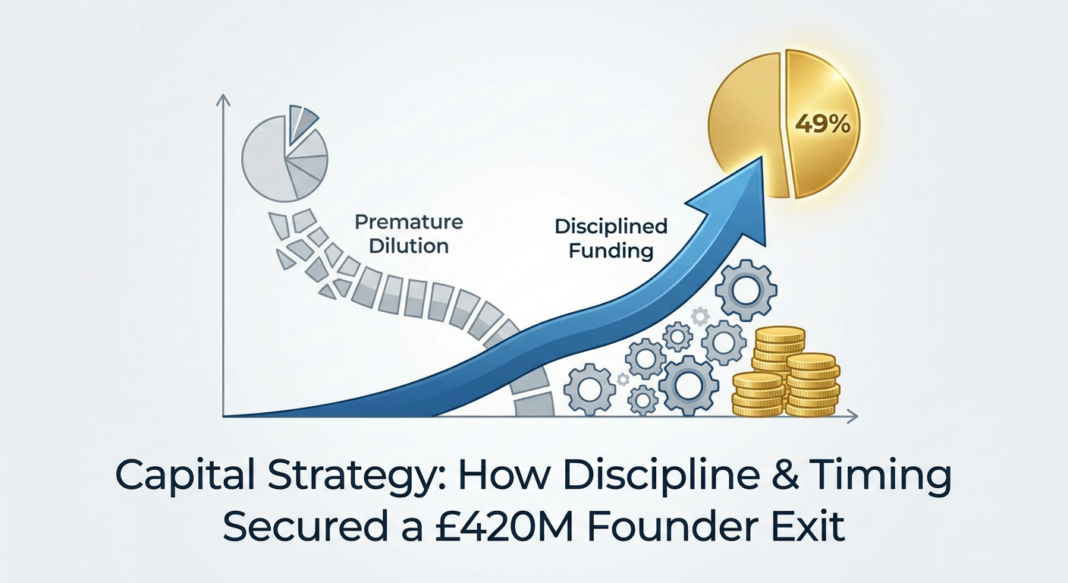
Hearn rejected that logic entirely. According to cap table analysis based on publicly available Companies House filings, he bootstrapped Huel to approximately £18 million in annual revenue before approaching institutional investors for a Series A. That single decision changed the entire trajectory of his ownership.
Here’s the arithmetic that matters: when you raise a Series A at £18M in revenue, a typical 5–6x revenue multiple puts your pre-money valuation at roughly £90–108 million. The dilution you absorb on a modest round at that valuation is manageable, and you’re negotiating from a position of proof, not promise. Contrast that with a founder who raises Series A at £1M ARR at a £10M pre-money valuation and needs three or four follow-on rounds to reach the same scale. Each round compounds the dilution. By exit, 49% has become 18%.
Hearn raised only what the business needed to reach each successive inflection point, no vanity rounds, no growth-at-all-costs capital deployment. The result, documented in the Danone transaction, was that he entered exit negotiations with 49.3% ownership intact. When Danone paid €1 billion, a reported 17–20x EBITDA multiple reflecting Huel’s exceptional unit economics, vertically integrated manufacturing, and omnichannel distribution across 25,000 retail doors, nearly half of that went directly to the founder.
Capital strategy, in this case, was company strategy. As George Alifragis, SVP at Metropolitan Partners Group, has argued in his work with founder-led businesses: debt and non-dilutive structures are often cheaper than equity for businesses that are actually scaling, but only when the structure fits the business and the partner is aligned with the founder’s north star. Hearn achieved the same result through a different instrument: the discipline to not raise equity until the cost of doing so was genuinely worth it. thunder.vc
The Outcome: What 49% Actually Means at Exit
The Danone acquisition, completed in 2026, produced a result that illustrates the compounding power of ownership preservation more vividly than almost any recent deal in the consumer sector.
Consider the counterfactual. A DTC founder who raises the same $184M but does so earlier (at lower valuations, across more rounds, with aggressive investor pro-rata rights) might realistically exit with 18–22% ownership. On a €1 billion exit, that’s a personal outcome of roughly £150–185 million. Still life-changing money. But it’s less than half of what Hearn walked away with.
The delta, somewhere in the region of £235–270 million in personal proceeds: is the price of premature dilution. That’s not a fee paid to investors for capital that built the business. That’s a structural tax on founders who gave away ownership before they had the leverage to negotiate fair terms.
Hearn’s unit economics made this outcome possible: gross margins expanded from the low 50s to 59% by 2024 through vertical manufacturing integration; contribution margin improved by 800 basis points to 29%; EBITDA doubled in a single year to £18.2 million. These are the metrics that commanded a premium exit multiple. But premium metrics only translate to premium founder outcomes when the cap table reflects real ownership, and that ownership was protected by the decision not to raise equity until the business had proven its right to demand better terms.
The broader market context reinforces the point. Late-stage venture debt hit a decade high in Q1 2026, with the average deal reaching $68.2 million and growth-stage startups capturing $13.3 billion (or 67%) of all US venture debt in the quarter alone, per PitchBook’s latest Venture Monitor. The smartest founders and operators are actively choosing non-dilutive structures where the business supports them. humcapital.com SpaceX’s debt load grew from $14B to $23B last year. OpenAI has taken on $4B in debt alongside equity. These aren’t distressed companies, they’re sophisticated capital allocators preserving optionality and ownership.
The Other Side: When Capital Structure Destroys What It Was Meant to Build
For every Huel, there is a Divvy Homes. The rent-to-own proptech company, which once carried a $2.3 billion valuation and counted a16z and Tiger Global among its backers, sold to Brookfield Properties in January 2025 for approximately $1 billion. Founders and common shareholders received nothing.
CEO Adena Hefets wrote to shareholders that after repaying roughly $735 million in debt financing taken on in October 2021, at the peak of the market, and satisfying liquidation preferences for preferred shareholders, there was nothing left for those who built it. A billion-dollar exit. Zero founder proceeds. saastr.com
The lesson from Divvy is not that debt is dangerous. It’s that debt taken on at the wrong moment (at peak valuations, in a rate-sensitive business model, at maximum deployment) becomes a senior claim on your future that the business cannot survive. Debt used as a buffer or a structured tool is different from debt used as a substitute for a working business model. The capital structure doesn’t care how hard you worked. It pays in seniority order, and founders are last.
The contrast with Huel is stark. One founder preserved equity patiently, raised at inflection points, and built margin. The other took on maximum debt at maximum cost at maximum risk, and the capital structure consumed everything when rates moved. Same exit headline. Radically different personal outcomes.
The Lessons: A Framework for Founders Facing the Same Decision
The Huel story (and the Divvy contrast) distills into a set of principles that apply well beyond consumer brands or British nutrition companies. They apply to any operator-led business facing the recurring question of how to fund growth without surrendering the outcome they’re building toward.
Musely, the telemedicine company, recently demonstrated a third path: securing more than $360 million in non-dilutive financing from General Catalyst’s Customer Value Fund, structured entirely around predictable customer lifetime value: no equity transferred, no board seats given, no valuation negotiated. The company gets growth capital. The fund gets repaid from future revenue. startupfortune.com For businesses with measurable retention and cohort economics, that product now exists at institutional scale.
The lending market has genuinely expanded. Revenue-based financing, asset-based lending, cash flow facilities, and structured credit are all accessible to companies in the $5M–$50M revenue range that would not have had these options five years ago. The question is whether founders know to look for them before they default to equity out of habit.
Key Insights
- Bootstrap to leverage, then raise: Hearn’s decision to reach £18M revenue before his Series A allowed him to negotiate from proof, not promise, preserving 49% ownership through $184M in raises that would have cost most founders 30+ additional percentage points.
- Equity dilution compounds invisibly until exit: The gap between Hearn’s £420M outcome and a typical DTC founder’s £150–185M outcome on the same deal is not product difference, it’s cap table discipline compounded over a decade.
- Debt is a tool, not a strategy: Divvy’s $735M debt load, taken on at peak market conditions in a rate-sensitive model, turned a $1 billion exit into a zero-founder outcome. Debt used as a buffer is protective; debt used as fuel for a broken model is terminal.
- Non-dilutive structures are maturing fast: From Musely’s $360M customer value financing to the $13.3B in growth-stage venture debt deployed in Q1 2026 alone, founders in 2026 have access to non-dilutive capital at scale that simply didn’t exist at the founding of most current growth-stage companies.
- Capital strategy is company strategy: The most important financing decision most founders make is not which investor to take, it’s when to take capital and how much. Raising at inflection points, matching capital type to use of proceeds, and treating equity as a genuinely scarce resource are the disciplines that separate £420M outcomes from £150M ones on the same deal.


