
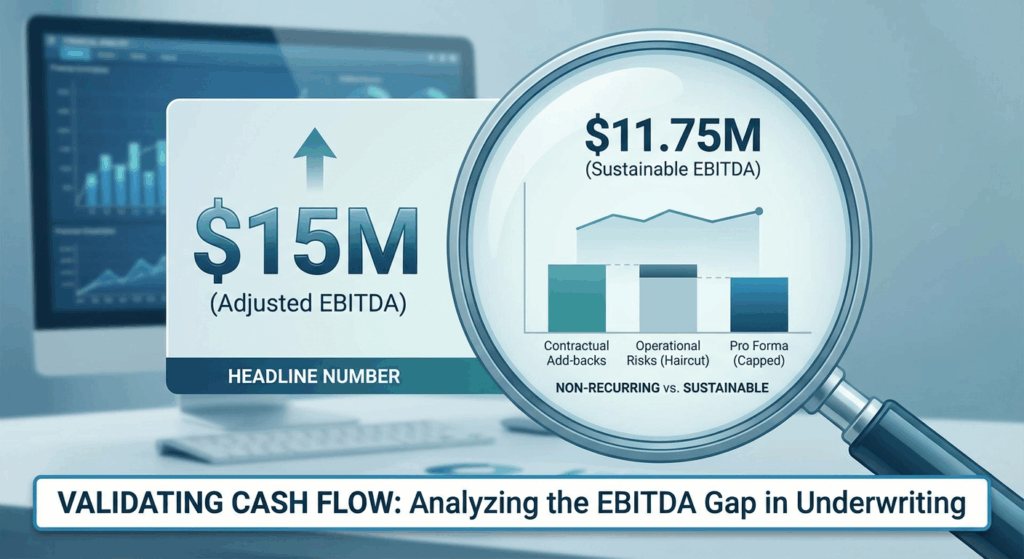
The Underwriting Challenge: The Optical Illusion of “Adjusted” EBITDA
In modern credit underwriting, the headline EBITDA number rarely tells the full story. As borrowers and sponsors increasingly present highly structured “Adjusted EBITDA” figures to market lenders, the gap between reported operating income and the cash flow actually available for debt service has widened. For the underwriter, the primary risk is not just the business model, but the normalization of earnings used to justify leverage.
Miscalculating sustainable earnings leads to “optical leverage” that appears conservative (e.g., 3.5x) but is practically aggressive (e.g., 5.0x) when speculative add-backs fail to materialize. This article details the rigorous framework required to analyze EBITDA adjustments, ensuring that the denominator in your leverage calculation reflects reality, not optimism.
The Framework: Determining Sustainable EBITDA
The goal of normalization is to arrive at Sustainable EBITDA: a proxy for the recurring cash flow generation capacity of the business post-closing. The Fitch Corporate Rating Criteria emphasizes that financial analysis must look beyond historical data to a “three- to five-year time horizon,” heavily weighting the predictability of cash flows. A robust underwriting framework categorizes adjustments into three buckets of increasing risk:
- Category 1: Definitive & Contractual. These are verifiable expenses that will disappear post-transaction (e.g., owner’s excessive salary replaced by market-rate management, discontinuing a product line, removing non-recurring legal settlements).
- Category 2: Operational Irregularities. These require judgment. Examples include inventory write-downs, FX losses, or “one-time” consulting fees. The risk here is defining “one-time”, if a company has “one-time” restructuring costs every year for three years, it is a recurring operating expense.
- Category 3: Pro Forma & Synergies. The highest risk category. These are anticipated cost savings (e.g., closing a facility, implementing new ERP software). Underwriting best practices dictate capping these add-backs (often at 10-20% of EBITDA) and requiring third-party validation.
The Analysis: Stress-Testing a $10M Manufacturer
Consider a manufacturing company seeking $45 million in senior debt. The CIM presents a Trailing Twelve Month (TTM) Reported EBITDA of $10 million, but requests $5 million in add-backs for an Adjusted EBITDA of $15 million. This implies a leverage ratio of 3.0x ($45M / $15M).
Borrower’s Proposed Adjustments:
- $1.0M: Owner’s excess compensation (verified via tax returns).
- $1.5M: “Non-recurring” raw material spike due to supply chain disruption.
- $2.5M: Pro forma savings from confusing two warehousing facilities.
The Underwriter’s Re-calculation:
- Adjustment 1 (Owner Comp): Accepted. This is contractual and verifiable.
- Adjustment 2 (Material Spike): Partial Credit. Was this truly a one-time disruption, or is it the new market reality? If commodity prices have structurally shifted, this add-back is invalid. Let’s assume 50% is accepted ($0.75M).
- Adjustment 3 (Synergies): Rejected/Haircut. Integration risks are high. Without a signed lease termination or Quality of Earnings (QoE) validation, a prudent lender might credit zero or strictly cap this. Let’s credit $0.
Result: Validated Sustainable EBITDA is $11.75M ($10M + $1.0M + $0.75M).
Impact: The true leverage is 3.8x ($45M / $11.75M), not the advertised 3.0x. This nearly full turn of leverage changes the credit scoring, pricing model, and covenant headroom significantly.
Industry Standards & Red Flags
Institutional lenders and rating agencies maintain strict standards regarding “add-back bloat.” The Basel Committee’s Principles for the Management of Credit Risk (2025) reinforce that sound credit-granting processes must include a thorough assessment of the borrower’s ability to repay under “various scenarios,” implying that reliance on optimistic pro-forma adjustments violates core risk principles.
Common Red Flags:
- Recurring “Non-Recurring” Charges: Restructuring charges appearing in 3+ consecutive years.
- uncapped Synergies: Synergies that exceed 20% of the total EBITDA base.
- orphaned Costs: Adjusting out costs (like IT implementation) without adjusting for the future capitalization or maintenance of that system.
- Poor Quality of Earnings: A QoE report where the “adjusted” number relies heavily on management methodology rather than GAAP reconciliation.
According to FDIC Risk Management Manual guidelines, the evaluation of asset quality must weigh exposure to borrower default under legally implied agreements, suggesting that lending against “future” earnings that haven’t materialized is a regulatory concern as well as a credit risk.
Underwriting Checklist: Validating Adjustments
Before issuing a commitment letter, the underwriting team should execute the following diligence steps on EBITDA adjustments:
- Verify “Out-of-Period” Revenue: Ensure revenue recognition adjustments aren’t simply pulling future sales into the current TTM period.
- Cash vs. Non-Cash: Confirm that add-backs for “non-cash” expenses (like stock-based compensation) are truly non-cash and won’t require settlement.
- CapEx Review: Check if “maintenance CapEx” is being aggressive categorized as “growth CapEx” (and thus added back to cash flow).
- Legal & Professional Fees: Review invoices to ensure “transaction-related” fees aren’t actually recurring retainer fees.
- The “Look-Back” Test: Compare the borrower’s previous years’ budgeted adjustments to actual performance. Did previous “synergies” actually flow through to the bottom line?
Key Takeaways
- EBITDA is an Opinion; Cash Flow is a Fact: Always bridge Adjusted EBITDA back to Operating Cash Flow (OCF).
- Beware the “Pro Forma” Trap: Covenants should essentially limit how much “future” savings can be counted today (e.g., capped at 15% of EBITDA).
- Leverage Sensitivity: Small changes in adjustments can swing leverage ratios by 0.5x to 1.0x; price the risk accordingly.
- Definitive Documentation: Ensure the Credit Agreement definition of EBITDA explicitly limits “monitoring fees” and “restructuring charges” to prevent covenant erosion.
- Trend Analysis: A company with declining Reported EBITDA but rising Adjusted EBITDA is a massive red flag for credit deterioration.


