
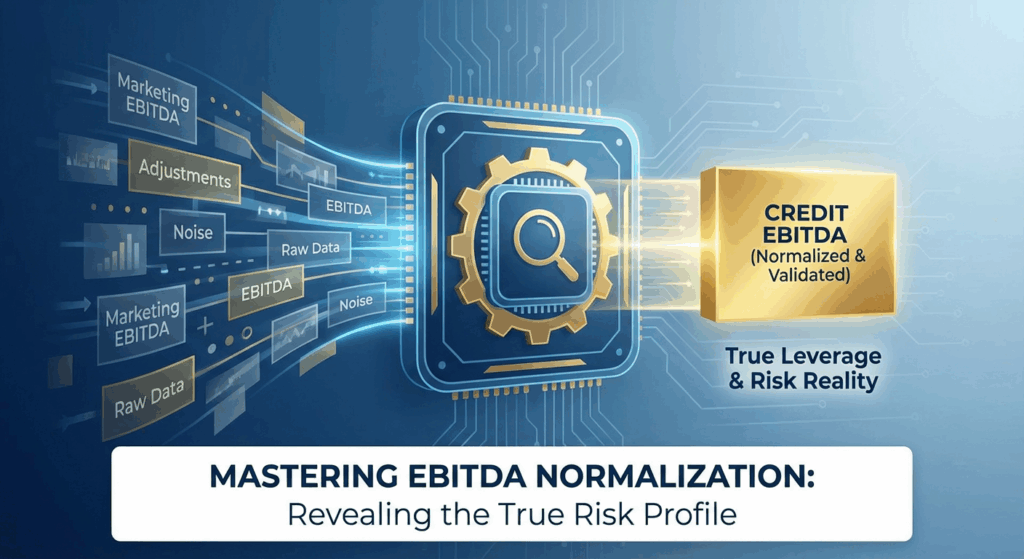
The Underwriting Challenge: Marketing vs. Credit Reality
In the high-stakes environment of corporate credit, one metric reigns supreme: EBITDA (Earnings Before Interest, Taxes, Depreciation, and Amortization). However, for the disciplined underwriter, reported EBITDA is merely a starting point, a “marketing number” often heavily adjusted by borrowers and intermediaries to present the most favorable view of cash flow. The gap between “Marketing EBITDA” and “Credit EBITDA” is where risk resides.
The fundamental underwriting challenge lies in distinguishing between legitimate one-time non-recurring expenses and structural operating costs disguised as “adjustments.” Misinterpreting these figures leads to understated leverage ratios, overstated coverage, and ultimately, a mispriced risk. As noted in recent Fitch Ratings criteria, a robust financial profile analysis requires a comparative review of an issuer’s business strength relative to its peer group, typically looking at a three-to-five-year time horizon to capture a full economic cycle.
The Framework: Normalization Methodology
To determine Sustainable EBITDA, the actual proxy for long-term debt repayment capacity, underwriters must apply a rigorous normalization framework. This process strips away noise effectively to reveal the core earnings power of the business.
The methodology generally follows three phases:
- Validation: verifying that the expense actually occurred and was recorded correctly (Quality of Earnings).
- Normalization: Determining if the expense is truly non-recurring or an inherent cost of doing business.
- Pro Forma Analysis: Adjusting for the go-forward capital structure and operational reality (e.g., removing owner salaries that will be replaced by professional management).
According to Basel Committee principles, a sound credit-granting process must clearly establish the authority and independence of the credit assessment. This means underwriters must autonomously validate adjustments rather than accepting borrower definitions of “one-time” events.
The Analysis: Walking Through the Adjustments
Let us apply this framework to a hypothetical middle-market manufacturing company, “Alpha Corp,” presenting a $10 million EBITDA in its Confidential Information Memorandum (CIM). The borrower asks for 4.0x leverage based on this figure ($40M debt).
Calculation Example
1. Reported EBITDA (LTM): $7,500,000
The base number derived from GAAP financials.
2. Proposed Adjustments (by Borrower):
- + $1,000,000: One-time litigation settlement fees.
- + $500,000: Management fees paid to current owners (to be discontinued).
- + $1,000,000: “Pro-forma synergies” from a recent tuck-in acquisition.
3. Underwriter’s Re-Calculation:
- Litigation ($1.0M): ACCEPTED. Review of legal dockets confirms the suit is settled with prejudice. This is a true non-recurring cash outflow.
- Management Fees ($500k): ACCEPTED. The deal structure replaces the owner-operator; this cash flow becomes available for debt service.
- Synergies ($1.0M): REJECTED. Synergies are speculative. FDIC examination policies emphasize that asset quality ratings reflect the “quantity of existing and potential credit risk.” Crediting future cost savings that have not been executed introduces potential risk without historical basis.
4. Final Underwritten EBITDA: $9,000,000
The Impact on Risk
The borrower marketed the deal at $10M EBITDA. At $40M debt, they claimed 4.0x leverage.
The underwriter approved only $9M. At $40M debt, the true leverage is 4.44x.
This 0.44x turn of leverage difference is critical. It impacts pricing grids, covenant headroom, and the probability of default classification. By rejecting speculative adjustments, the underwriter protects the lender from “EBITDA creep.”
Industry Standards and Red Flags
Institutional lenders and rating agencies maintain strict standards regarding what constitutes a valid add-back. While private credit markets have seen a proliferation of “covenant-lite” structures allowing broad definitions of EBITDA, risk standards remain grounded in repayment capacity.
Red Flags in EBITDA Analysis:
- Recurring “Non-Recurring” Charges: If a company has “restructuring costs” every year for three years, it is not a restructuring; it is an operating cost.
- Inventory Accounting Shifts: Moving from LIFO to FIFO to boost margins artificially.
- Excessive Owner Add-Backs: Personal expenses run through the business that are difficult to verify or separate from operations.
- Unrealized Synergies: According to FDIC supervisory insights, blind reliance on external projections or ratings without independent due diligence on the obligor’s repayment capacity is a regulatory deficiency.
Underwriting Checklist: Due Diligence Requirements
Before locking in a credit facility, the following diligence items are non-negotiable for EBITDA validation:
- Quality of Earnings (QoE) Report: Third-party verification of the reconciliation between EBITDA and OCF (Operating Cash Flow).
- Bank Statements (12 Months): To cross-reference revenue recognition with actual cash deposits.
- Legal Settlement Documentation: To prove “one-time” nature of legal add-backs.
- Employment Contracts: To verify that removed management salaries are not being replaced by equally expensive new hires.
- Customer Concentration Analysis: Ensuring EBITDA is not comprised of risky, high-concentration contracts.
Key Takeaways
- Skepticism is Safety: Always start with Reported EBITDA and force every add-back to earn its place.
- Cash is Sovereign: EBITDA is an accounting construct; Operating Cash Flow (OCF) rarely lies. If they diverge significantly, investigate.
- Synergies are Not Earnings: Never underwrite 100% of projected synergies. Standard practice is to underwrite 0% or uncapped only with a 12-month look-back validation.
- Metrics Matter: A 0.5x difference in leverage due to adjustments can move a credit from “Pass” to “Substandard” in a downturn.
- Regulatory Alignment: Independent assessment of repayment capacity is not just best practice; it is a regulatory requirement for safety and soundness.


