
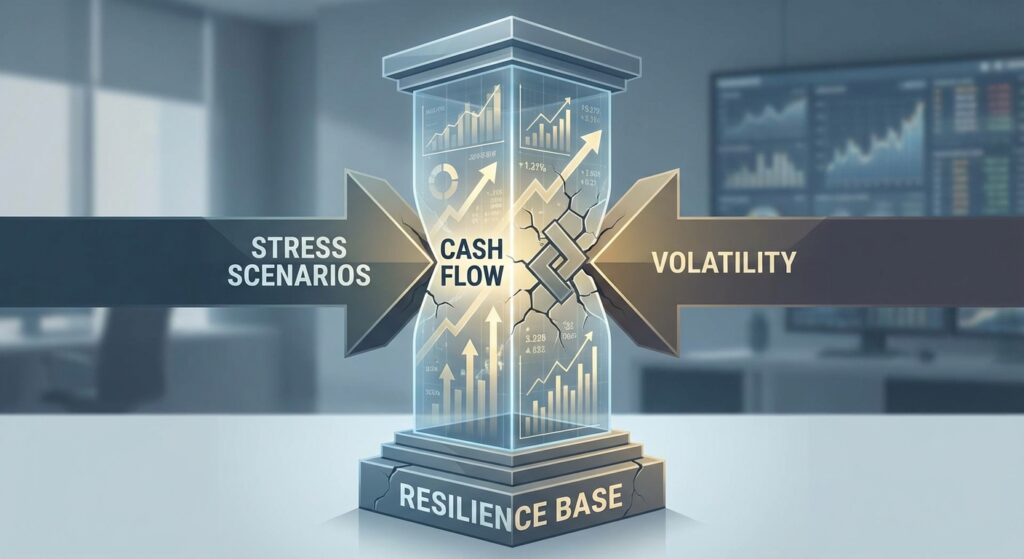
In the current lending environment of late 2026, the distinction between a performing loan and a distressed asset often lies not in the borrower’s base case projections, but in their resilience to unforecasted shocks. For middle-market lenders, the primary underwriting challenge is no longer just assessing historical Quality of Earnings (QoE); it is rigorously stress testing future cash flows against volatility. With economic cycles shortening and sector-specific disruptions becoming more frequent, relying solely on management’s “sunny day” EBITDA adjustments is a recipe for impairment.
The “Base Case” model provided by a borrower typically assumes perfect execution: rising volumes, stable margins, and compressed working capital cycles. However, prudent underwriting requires a defensive posture. The goal is to determine the “Break-Even” point, the exact level of revenue decline or margin compression that triggers a payment default or covenant breach. As noted in recent regulatory updates, sound credit risk management requires a shift from static analysis to dynamic, forward-looking stress scenarios.
The Framework: Building a Resilient Model
Effective stress testing moves beyond simple sensitivity analysis (e.g., “revenue down 5%”) and employs a multi-variable approach that isolates operating leverage. According to Fitch Ratings’ Corporate Rating Criteria, financial profiles must be evaluated over a three- to five-year horizon, capturing a full economic cycle. This supports a “Through-the-Cycle” underwriting philosophy rather than a point-in-time snapshot.
The analytical framework involves three distinct layers of stress:
- Top-Line Erosion: Differentiating between price degradation and volume loss. Volume loss saves on variable costs; price drops hit the bottom line dollar-for-dollar.
- Margin Compression: Modeling an inability to pass through input cost inflation or labor increases.
- Cash Flow Conversion: Adjusting the “Cash Conversion Cycle” to simulate slow receivables collection or inventory build-up, which traps liquidity exactly when the borrower needs it most.
This framework aligns with the Basel Committee on Banking Supervision (BCBS) 2025 Principles, which emphasize that credit-granting processes must assess the borrower’s ability to withstand “adverse economic conditions” without relying solely on collateral realization.
The Analysis: Calculating Operating Leverage
Let’s apply this framework to a hypothetical manufacturing borrower, “IndustrialCo,” to demonstrate the impact of operating leverage on credit metrics.
Base Case Scenario:
- Revenue: $50 million
- EBITDA: $10 million (20% margin)
- Debt: $40 million (4.0x Leverage)
- Fixed Charges (P&I + Capex): $6 million
- Fixed Charge Coverage Ratio (FCCR): 1.67x ($10M / $6M)
The Stress Test (The “Operating Squeeze”):
We apply a scenario where Revenue declines by only 10% due to a lost contract, but the company has high fixed costs (operating leverage). Simultaneously, we uncompress the “Adjusted EBITDA” add-backs that management claimed were one-time expenses.
Stress Calculation:
- New Revenue: $45 million (-10%)
- Variable Costs: Decline proportionally.
- Fixed Costs: Remain static (absorption issue).
- Resulting EBITDA: Drops to $7.0 million (-30% decline in profit from a 10% drop in sales).
Impact on Credit Metrics:
- New Leverage: $40M Debt / $7M EBITDA = 5.7x (Up from 4.0x)
- New FCCR: $7M EBITDA / $6M Charges = 1.16x
In this scenario, a modest 10% revenue miss pushes the Leverage near 6.0x and the Coverage Ratio dangerously close to the standard 1.10x – 1.20x technical default covenant. This analysis identifies that the borrower has low error tolerance.
Industry Standards & Red Flags
Institutional lenders and rating agencies utilize these stress metrics to assign internal risk ratings. The European Central Bank’s SREP Methodology highlights the necessity of assessing the “quality of the credit portfolio” by checking potential deterioration through forward-looking perspectives, not just current arrears.
Common Red Flags in Underwriting:
- The “Hockey Stick” Projection: Models that show flat performance in Year 1 followed by aggressive growth in Years 2-3 without capital expenditure alignment.
- EBITDA Add-Back Dependency: When “Pro Forma adjustments” account for more than 15-20% of the marketed EBITDA.
- Covenant “Lite” Requests: Borrowers asking for wide cushions (30-40%) on coverage ratios often anticipate volatility.
According to OCC guidelines on Rating Credit Risk, effective risk rating systems must evaluate the borrower’s ability to generate cash flow under “most likely” and “stress” conditions, specifically warning against over-reliance on secondary repayment sources (collateral) when primary sources (cash flow) fail.
Underwriting Checklist
To ensure underwriting rigor, the following diligence points must be addressed prior to committee approval:
- Verification of Cost Structure: Have we validated which costs are truly variable (e.g., raw materials) vs. fixed (e.g., union labor contracts, rent)?
- Capex Stressing: Is the “Maintenance Capex” figure provided by management sufficient to support the assumed revenue, or is it artificially deflated to boost Free Cash Flow?
- Working Capital PEG: Have we stress-tested the liquidity impact if Days Sales Outstanding (DSO) extends by 15 days?
- Customer Concentration: What is the EBITDA impact if the top 2 customers churn simultaneously?
- Covenant Breakeven Analysis: Exactly what revenue dollar amount triggers a breach of the Leverage or Fixed Charge covenant?
Key Risk Management Takeaways
- Cash Flow is King: EBITDA is an accounting opinion; Free Cash Flow is the fact that services debt.
- Operating Leverage Kills: High fixed-cost businesses suffer disproportionate EBITDA erosion from minor revenue dips.
- Structure for the Downside: Covenants should be set tight enough to act as “tripwires” meant to bring parties back to the table before liquidity is exhausted.
- Question Adjustments: Aggressively discount “synergies” and “one-time” add-backs in the downside case.
- Defensive Liquidity: Ensure the borrower has sufficient revolver availability to weather a 2-quarter storm identified in the stress test.


